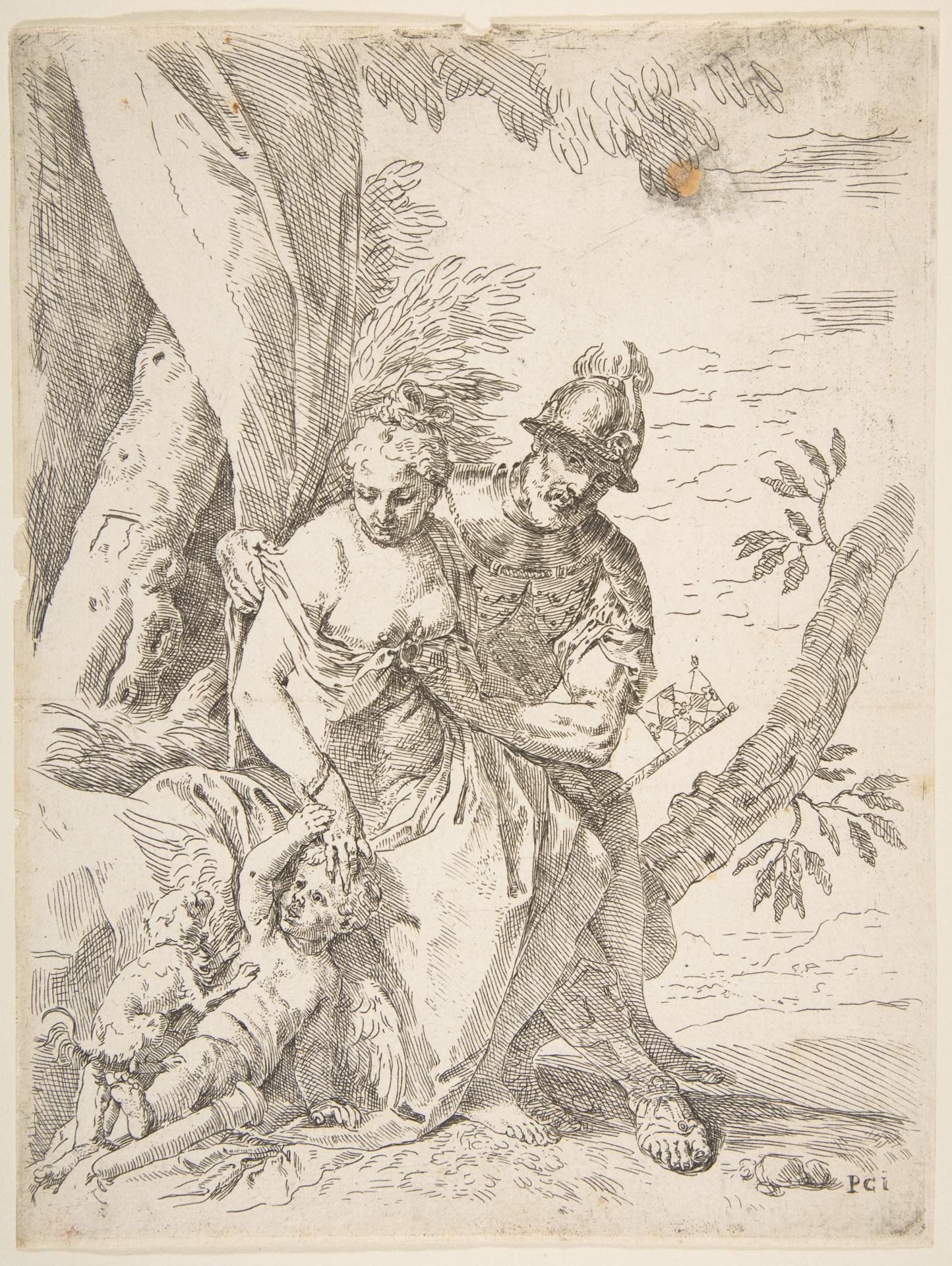
Mars, Venus and Cupid (ca. 1637–39, Met-Objekt 6112)
Original title: Mars, Venus and Cupid
kurzbeschreibung
Venus has taken a seat and holds the winged Cupid on her lap. Beside her stands Mars, armed with shield and lance. Simone Cantarini captured these three mythological figures in an etching around 1637–39, creating a familiar, almost domestic situation. The print ranks among his successful printed works in the Baroque style.
Description
Venus sits while Cupid lies as a child on her lap, and Mars is posted in the foreground with shield and lance. The figures' bodies are worked out with clear contours and fine hatching, detailed and carefully articulated. Trees and a cloud-covered sky suggest the background and open up the space. Light spreads evenly across the scene, with no harsh shadows, which gives the print a calm, balanced mood.
Context
Cantarini, an Italian painter and etcher of the Baroque, was active in Bologna and later in Mantua. He had trained under Guido Reni and adopted his classicist orientation, which also shines through here. This print arose in a phase when he devoted himself more to printmaking and preferred mythological subjects. It belonged to a series intended for collectors and cemented Cantarini's reputation as a printmaker.
Impact
The layout is balanced and calm, and the linework remains precise and fine. Despite the mythological theme, the figures appear almost everyday and at the same time elevated—an aesthetic tension grows from this. Even light and soft contrasts create an intimate, almost lyrical mood.
Technique
For this etching, the drawing was incised into a copper plate and then bitten with acid. Cantarini used fine, parallel hatching and dot-like stippling to bring out shadows and modeling. Printed on paper, the sheet shows a clear, high-contrast black-and-white effect typical of seventeenth-century printmaking.
AI-generated description text
Source: Metropolitan Museum of Art · Public Domain (CC0 1.0)