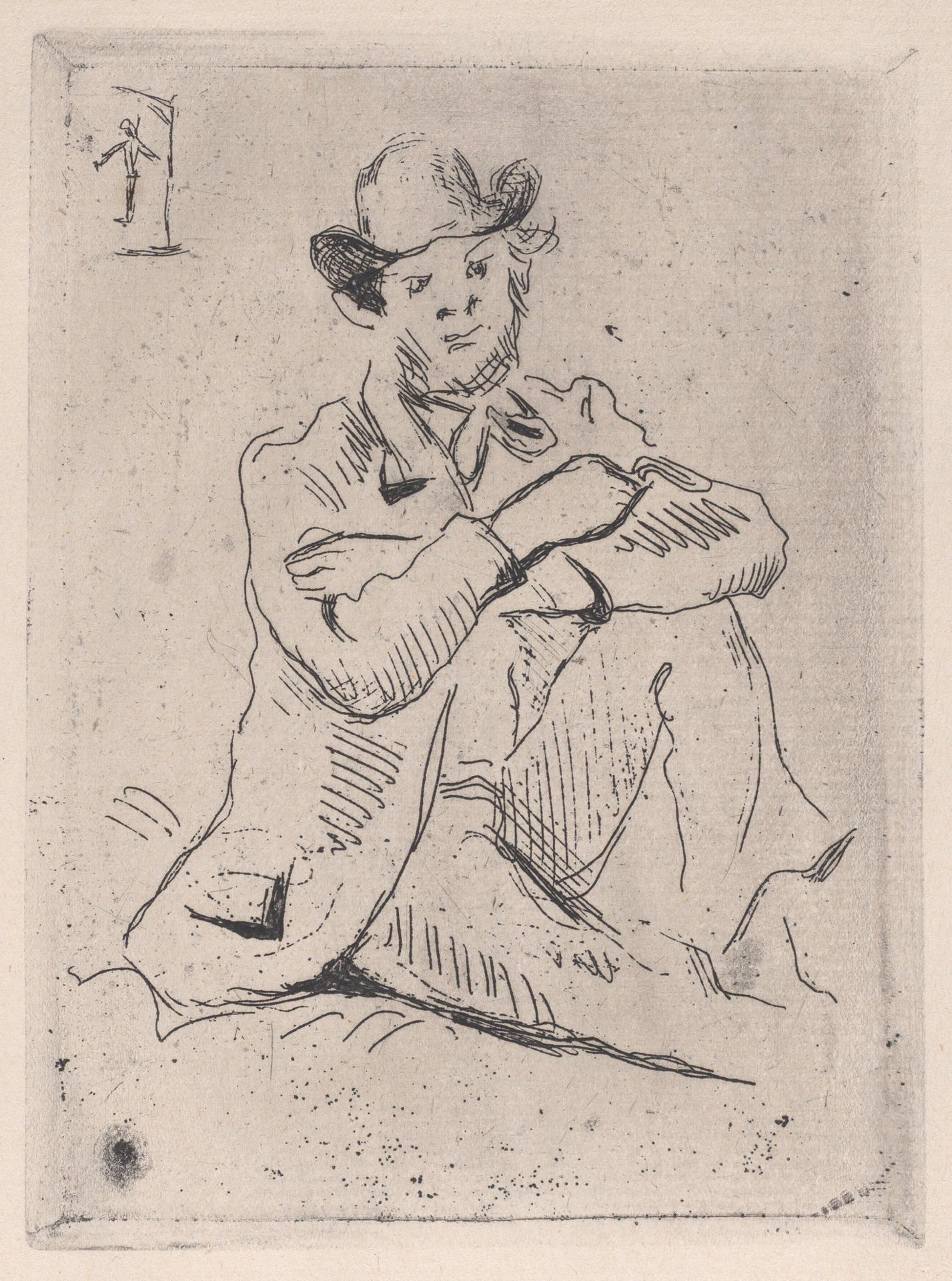
Portrait of Guillaumin with a Hanging Man
Original title: Portrait of Guillaumin with a Hanging Man
kurzbeschreibung
Armand Guillaumin sits with his arms crossed, wearing a cap. Paul Cézanne captured him in 1873 in an etching with drypoint. The sheet is the second state of two, a later restrike. Beside the intimate portrait appears a small, stylized figure of a hanged man.
Description
A seated man with crossed arms, dressed in a cap and a collared shirt, dominates the image. Behind him, a small, stylized depiction of a hanged man is visible. The layout remains simple, focusing attention on the figure. Monochrome tones and neutral light shape the impression. The linework and shading point to a combination of etching and drypoint.
Context
This portrait was made in 1873, when Cézanne was engaging with Impressionism and was in close contact with his fellow artist Armand Guillaumin. The etching was probably intended as a gift between friends; it was printed later as a restrike. The hanged man in the background might hint at a shared interest in drastic subjects, but the exact meaning is not recorded.
Impact
The sitter's calm pose and the reduced visual language create a concentrated, pensive mood. The small hanged man in the background acts as a jarring contrast and gives the sheet an ambivalent aura.
Technique
Fine lines and soft shading characterize the etching with drypoint work. The present restrike of the second state comes from a later edition. This technique allows precise lines and nuanced tonal values in the monochrome print.
AI-generated description text
Source: Metropolitan Museum of Art · Public Domain (CC0 1.0)