The Crucifixion (1582)
Original title: The Crucifixion
kurzbeschreibung
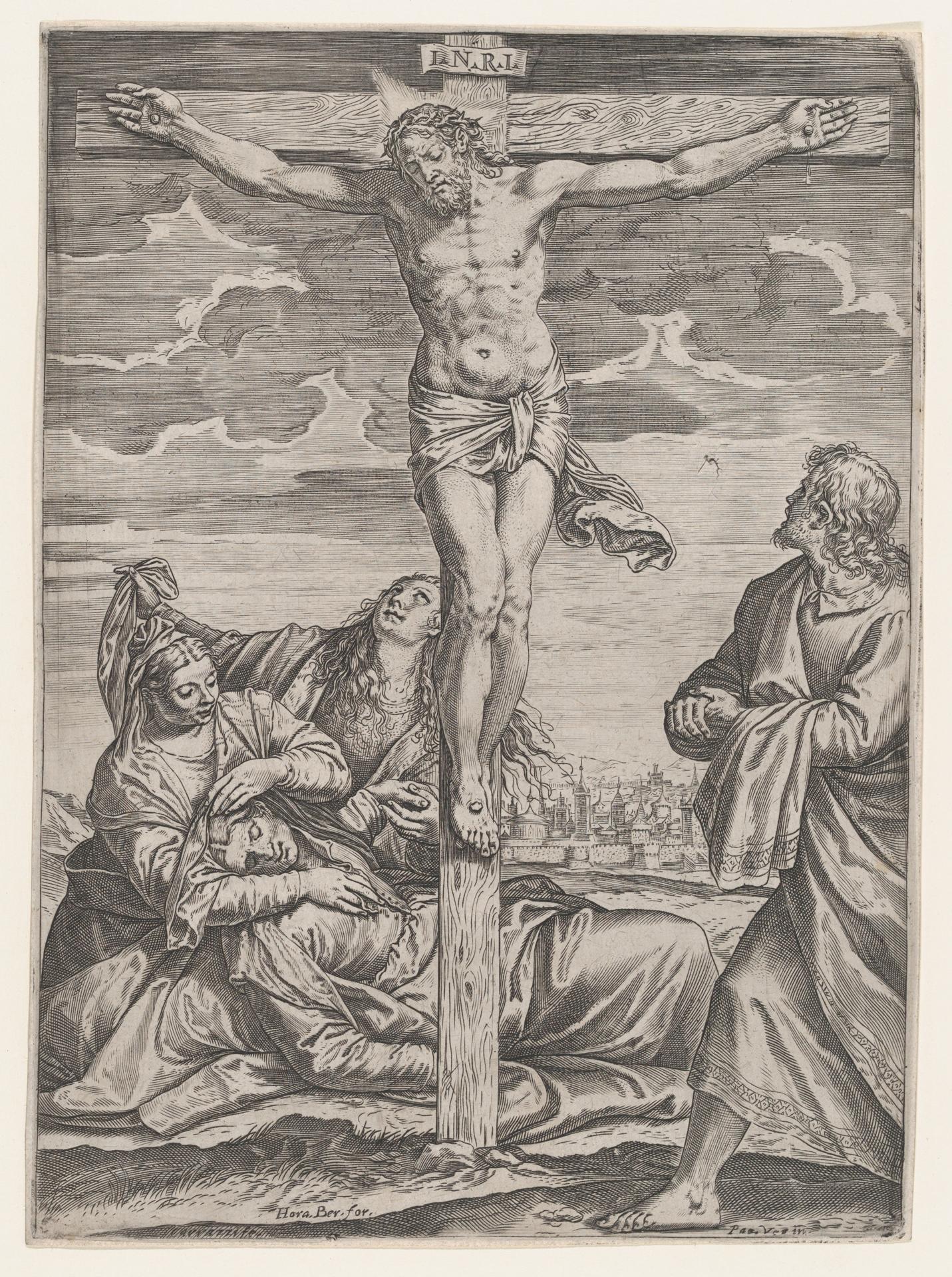
Agostino Carracci engraved this crucifixion in 1582, placing Christ on the cross among Mary and other onlookers. The sheet ranks among the significant documents of Italian printmaking at the close of the sixteenth century.
Description
Christ hangs at the centre of the design, his face marked by suffering, a long cloth wrapped around his hips. A plaque bearing the letters 'I.N.R.I.' sits above the cross. Beneath it a woman bends over another figure lying on the ground, while at the right a further figure looks up at the cross. Behind the group rises a city defined by towers, under a clouded sky.
Context
Carracci made the engraving in Italy in 1582, when the Catholic Church was reordering its ideas about religious art after the Council of Trent (1545–1563). A member of the Carracci family of artists, Agostino worked both as a printmaker and as a painter. Roman antiquity and the High Renaissance left their traces on the sheet, as was typical for artists of the late Mannerist period.
Impact
The symmetrical layout and clear contours produce a calm, devotional mood in the viewer. Graded shading gives the figures body and makes them stand out in relief. A solemn seriousness emanates from the whole sheet, inviting one to linger and reflect.
Technique
The lines were incised into a copper plate and then printed onto paper. Varying density and shading of the strokes yield the monochrome rendering in shades of grey. This method allows precise recording of details and surfaces, as can be seen in the garments and the architecture.
AI-generated description text
Source: Metropolitan Museum of Art · Public Domain (CC0 1.0)