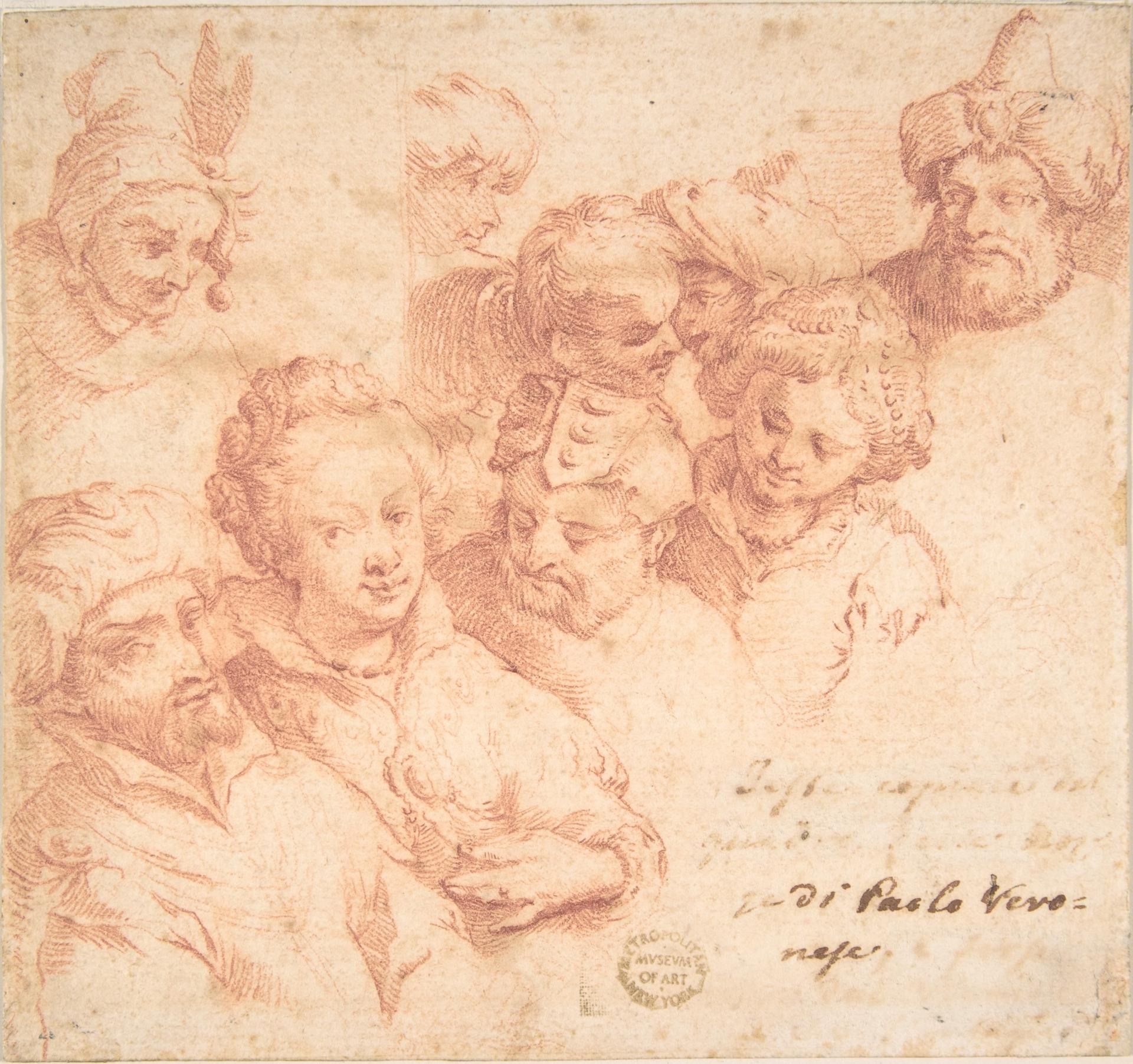
Nine heads after Paolo Veronese
Original title: Nine heads after Paolo Veronese
kurzbeschreibung
Unlike many straightforward copies after Veronese, this anonymous Italian sheet from the 17th century brings nine study heads together into a loose grouping. Drawn in red chalk on light tan paper, it measures 13 by 14 centimeters. The heads show varied directions of gaze, hairstyles, and headwear, and are worked up in places with detail, elsewhere more sketchily.
Description
Nine heads look in different directions; hair and headgear vary. Some areas are carefully drawn through, others remain fleeting. The heads overlap in part, creating a dense cluster. At lower right is a handwritten inscription, likely with the artist's name and a date. The paper shows signs of age.
Context
The sheet was made in 17th-century Italy, presumably in the orbit of the Roman-Bolognese school. It served as a study sheet after works by Paolo Veronese, a major Venetian painter of the Renaissance. Such copies were common in workshops for studying compositions and techniques of great masters. Whether the sheet was intended as an exercise or as a model for original work is not documented.
Impact
The loose yet precise handling of the red chalk gives the sheet liveliness and spontaneity. The uneven finish of the heads creates tension between fidelity to detail and sketchiness. The warm paper tone and reddish stroke feel intimate and almost tactile.
Technique
Red chalk on light tan paper—a typical material for 17th-century study drawings. The chalk allows both fine shading and strong contours, and both appear here. The handwriting at the bottom was probably applied with ink or chalk, suggesting a later inscription.
AI-generated description text
Source: Metropolitan Museum of Art · Public Domain (CC0 1.0)