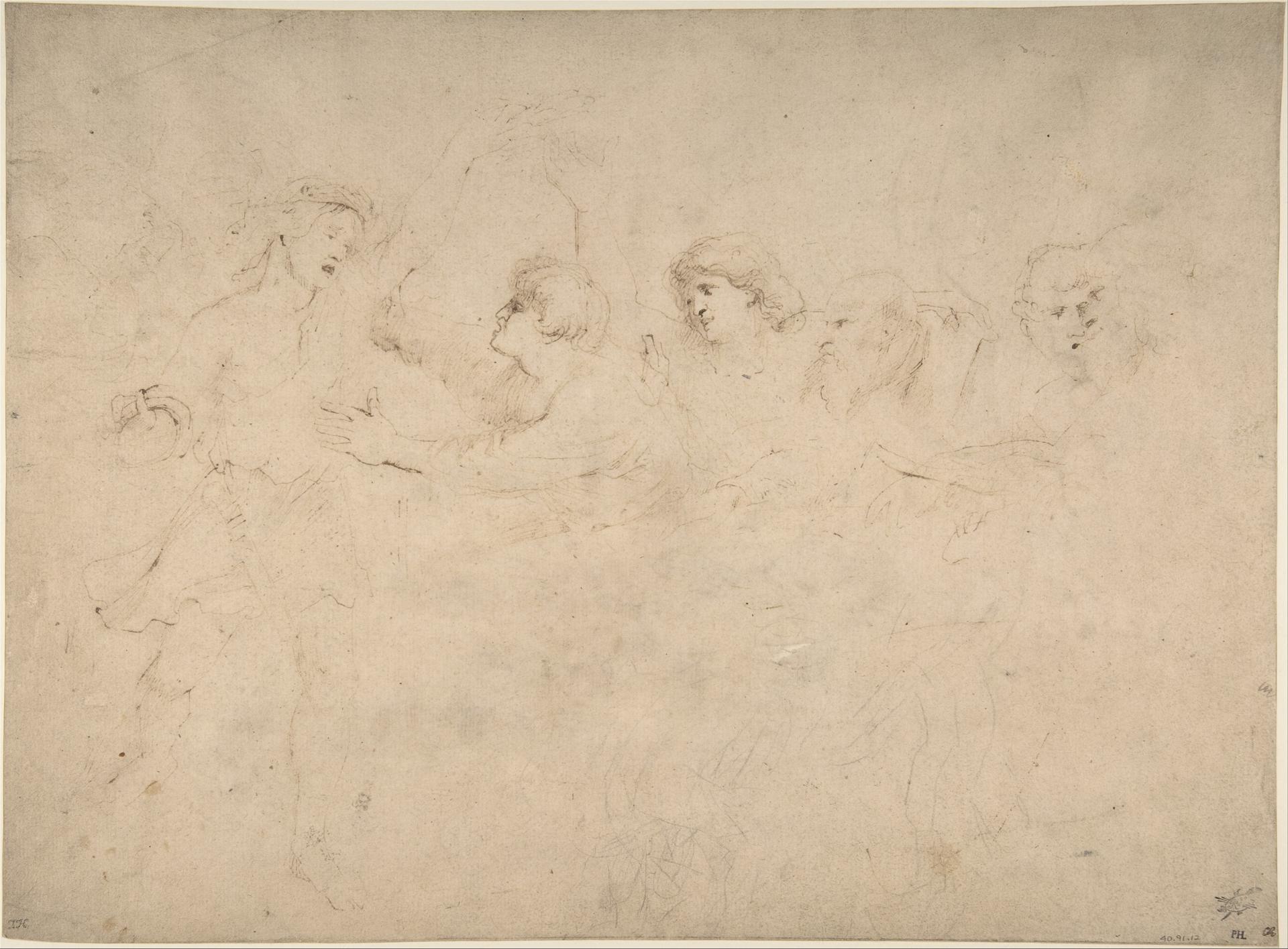
Alcibiades Interrupting the Symposium (recto); Sketches of the Baptism of Christ and of a Man (verso)
Original title: Alcibiades Interrupting the Symposium (recto); Sketches of the Baptism of Christ and of a Man (verso)
kurzbeschreibung
Peter Paul Rubens drew Alkibiades Interrupting the Symposium on the recto of this sheet around 1601–02, working in pen and brown ink over black chalk. The verso carries sketches for the Baptism of Christ and a male figure. The drawing measures 26.7 × 36.7 cm.
Description
At the left, a figure with a flute approaches a group of men absorbed in lively conversation. The characters wear garments that look contemporary to the artist's own day, and their expressions vary in mood and intensity. The stroke flows freely, with faces and passages of drapery worked out in recognizable detail. Brown and gray tones dominate the sheet, and no particular lighting scheme is employed.
Context
This sheet belongs to Rubens's years in Italy around 1601–02, a period when he studied antique and Renaissance models closely. The symposium subject points to Plato's dialogue, in which Alkibiades bursts in on the gathering. The sketches on the reverse for the Baptism of Christ suggest engagement with biblical themes, perhaps as preparatory work for larger projects.
Impact
Vitality and an expressive handling of the figures define the sheet. The animated line gives the scene an immediacy that draws the viewer into the action. Because only brown and gray tones are used, attention settles on the pictorial structure and the figures themselves.
Technique
Pen and brown ink sit over an underdrawing in black chalk. Precise contours thus stand alongside loose, flowing hatching. Rubens uses these means to capture movement and expression, and the drawing reveals his assured command of the draftsman's tools.
AI-generated description text
Source: Metropolitan Museum of Art · Public Domain (CC0 1.0)