Jupiter
Original title: Jupiter
kurzbeschreibung
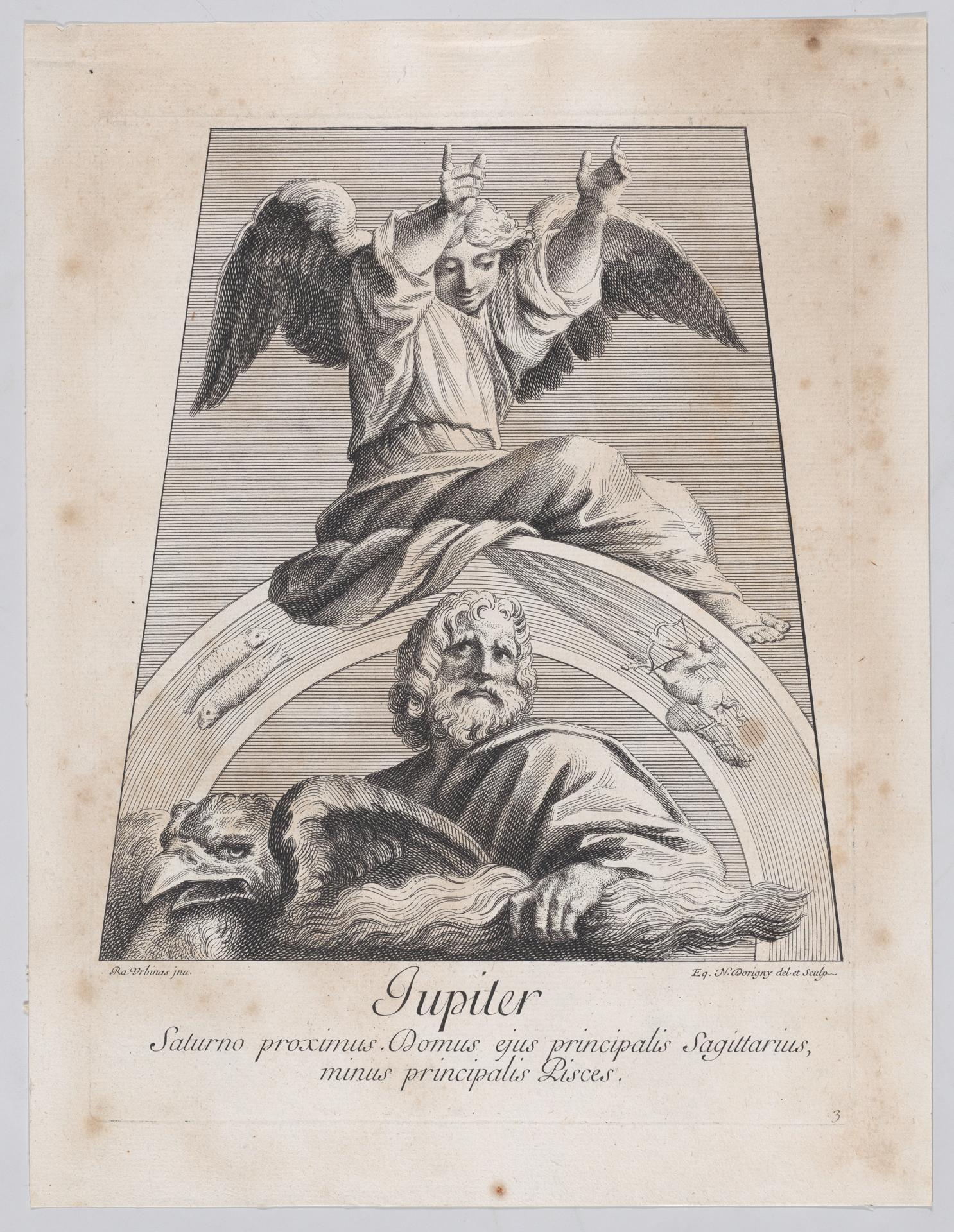
In 1695 Sir Nicolas Dorigny etched the Roman god Jupiter seated with a hovering angel above him. The plate measures 28.7 × 21.6 cm, and the sheet 33.8 × 25.8 cm.
Description
Jupiter occupies the lower half of the image, his face serious and pensive, bearded and dressed in a long-haired grey robe. His right hand rests on the head of an eagle lying at his feet. Above him hovers an angel with outspread wings, touching the god's forehead with both hands. The layout feels clear and balanced: Jupiter at the centre, the angel above in a dynamic, horizontal pose. The etching remains black on white, with strong contrasts built from hatching and lines.
Context
The Frenchman Sir Nicolas Dorigny (1658–1746) worked as a copperplate engraver and etcher and became known above all for reproductive prints after antique and Renaissance models. This sheet was made in 1695, an era when Baroque art dominated Europe and mythological subjects were popular with collectors. Dorigny later worked in Rome and was involved in the graphic reproduction of Raphael's Stanze. The work probably belongs to a series of mythological scenes aimed at art lovers and collectors.
Impact
Precisely drawn lines and a dramatic arrangement, characteristic of the Baroque, sustain the sheet. The interplay between Jupiter and the angel creates a mysterious, almost otherworldly mood that holds the viewer's gaze. The balanced symmetry and hard contrasts give the image a calm yet weighty presence.
Technique
The motif was etched into a metal plate that had first been coated with an acid-resistant layer and then worked with a needle; the intaglio process of etching produces the final print. Depending on how long the acid acts, lines of varying depth form, building up fine shading and tonal values. Dorigny's confident handling of the needle and his gradation of etching times show in the sharp, clean execution of the print.
AI-generated description text
Source: Metropolitan Museum of Art · Public Domain (CC0 1.0)