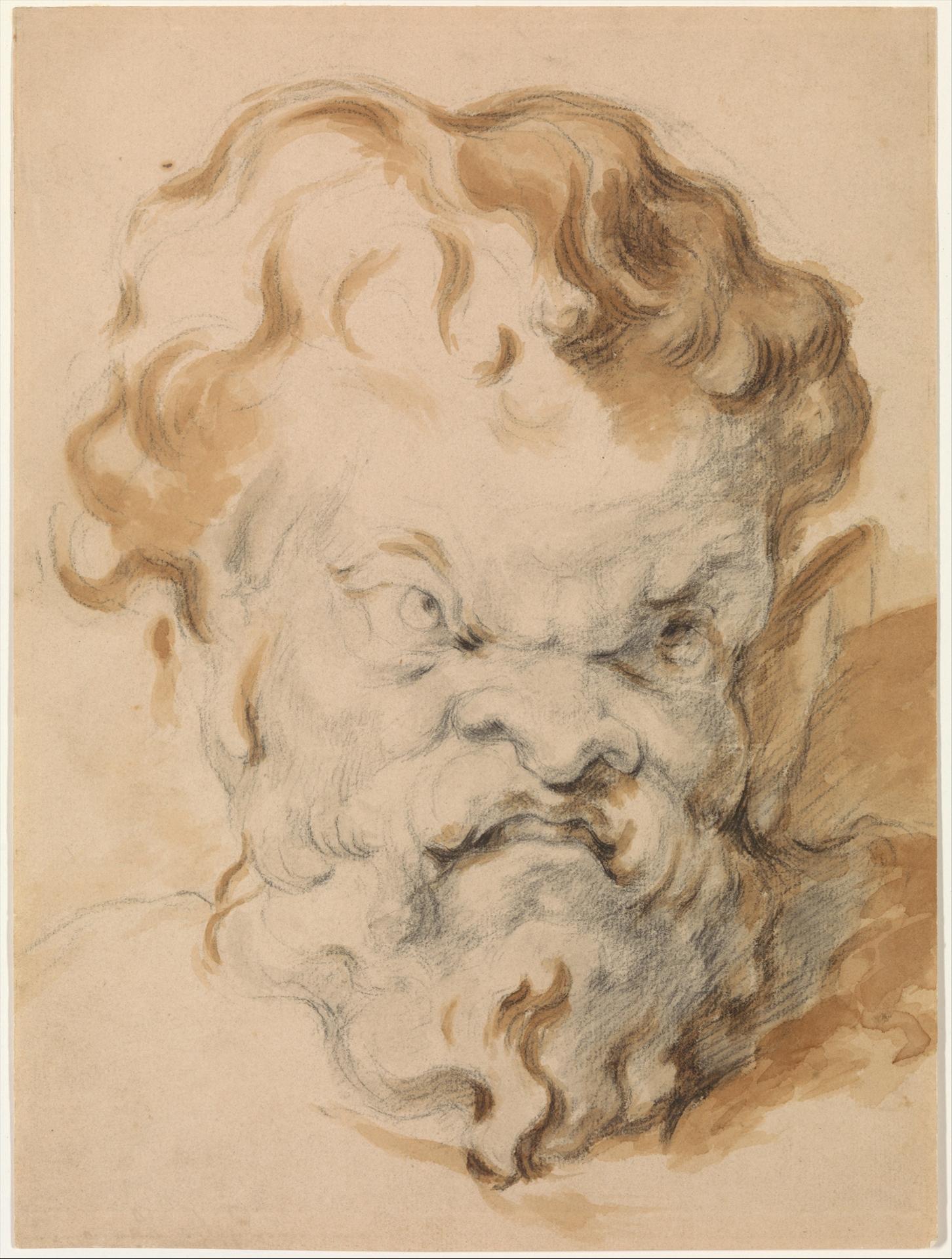
Head of Silenus (1855–1906)
Original title: Head of Silenus
kurzbeschreibung
Executed between 1855 and 1906, Paul Cézanne's drawing 'Kopf des Silen' presents the portrait of a bearded male head using black chalk and a light brown wash. The head faces forward, with curly hair and a thick beard; the eyes gaze slightly upward.
Description
A frontal male head with curly hair and a full beard. The eyes are slightly raised. Black and white dominate, while a restrained brown tone reveals the use of chalk and water-based paint. The background remains bare, focusing all attention on the head. The lines flow and appear detailed, indicating careful work with chalk and brush.
Context
Cézanne drew this sheet in a later phase of his career, when he was deeply engaged with figures and faces. Silenus, a companion of Dionysus from Greek myth, was a common motif in art and was often associated with drunkenness and wisdom. Cézanne, known for his structured approach to form, might have prepared a study for a larger work here. The exact date of the drawing within the given years is not recorded.
Impact
A calm, collected presence emanates from the sheet, reinforced by the frontal view and the plain background. Strong contours meet soft washes; as a result, the head gains sculptural presence without losing its flatness. All in all, the drawing feels like an intimate study that immediately captivates the viewer.
Technique
For contours and hatching, Cézanne used black chalk; for shadow areas, a brush with light brown wash. The interplay of dry and wet media allows precise linework and soft tonal transitions. The paper measures 26.2 x 19.4 cm, suggesting a compact, handy study.
AI-generated description text
Source: Metropolitan Museum of Art · Public Domain (CC0 1.0)