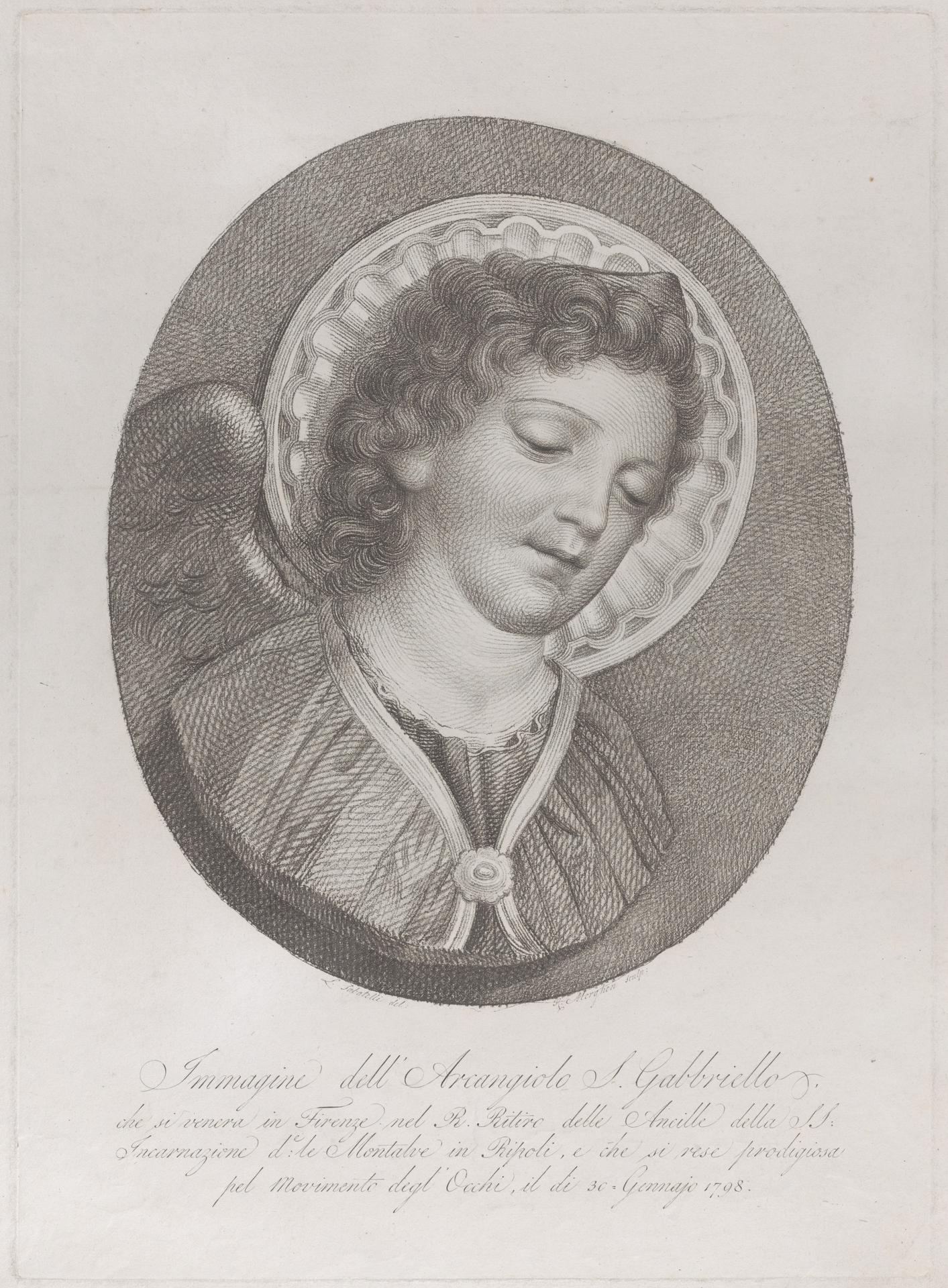
The Archangel Gabriel
Original title: The Archangel Gabriel
kurzbeschreibung
Unlike many contemporary depictions of Gabriel that show the angel in action or with attributes, this 1800 print by Raphael Morghen focuses almost entirely on the face. The crayon-manner print, in the second of two states, reproduces an oval drawing of a curly-haired young man interpreted as the Archangel Gabriel; angel wings are only hinted at in the background. Everything is executed in monochrome, with an accompanying Italian text.
Description
A young man with closed eyelids and curly hair fills the oval field; he wears a simple garment with a single button. Only indistinctly can the angel's wings be made out behind him, and they remain incomplete. The dark, spare background pushes everything toward the face, while hair and fabric are drawn with fine gradation. Below the image field follows an Italian text with details about the work and artist. The whole is kept monochrome.
Context
Morghen, an Italian engraver, was active in the late 18th and early 19th centuries and became known mainly for reproductive engravings after old masters. Around 1800, crayon manner was widespread as a means of imitating chalk drawings, and this print dates from that period. The existence of a second state points to a reworking of the plate, probably to sharpen fine details. A drawing or painting by a Renaissance master may have served as the model for the Archangel Gabriel.
Impact
The lowered eyes and softly modeled features give the angel something pensive, almost dreamy. Because the background remains dark and spare, attention concentrates on the delicate linework in hair and garment; this creates a quiet, intimate mood. The monochrome design emphasizes the draftsmanship and brings out the skill of the crayon manner.
Technique
The print was made in crayon manner, a technique that uses grainy or stippling tools to create the impression of a chalk or pastel drawing. Morghen employed this method to achieve soft transitions and a lively surface texture. The present work is the second state: the plate was reworked after the first impression and printed again.
AI-generated description text
Source: Metropolitan Museum of Art · Public Domain (CC0 1.0)