La Madonna del Latte
Original title: La Madonna del Latte
kurzbeschreibung
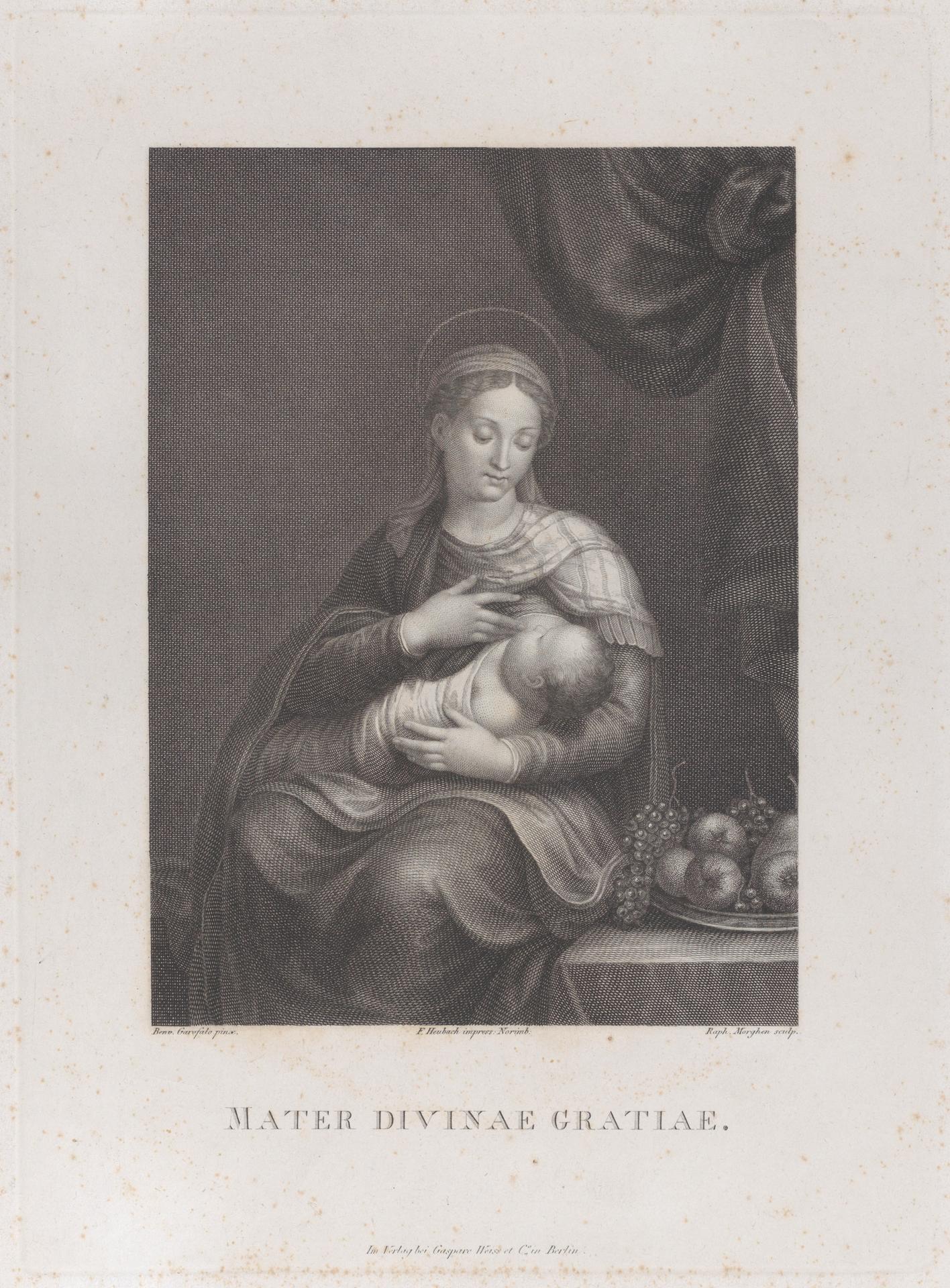
Raphael Morghen's 1815 engraving La Madonna del Latte presents the nursing Mother of God with the Christ Child. The print is a fine line engraving that exists in three states, and this impression belongs to the third. Its subject follows the classic devotional image of Christian iconography.
Description
At the center, the Madonna sits on a cloth-covered seat and offers her breast to the child she holds in her arms. Her dark, traditional robe has a light stripe on the sleeve. To one side stands a bowl of fruit, including apples and grapes. Curtains frame the scene behind, and the layout remains symmetrical, focused entirely on the two figures. In black and white and monochrome, the light spreads evenly, without strong shadows or highlights.
Context
The Italian Raphael Morghen (1758–1833) was known as an engraver, celebrated for reproductions after Renaissance and Baroque paintings. This sheet was made in 1815, when religious motifs were widely circulated in printmaking. Morghen often worked from models by older masters; the exact source for this engraving is not recorded. What appears is the iconography of the nursing Madonna, a hallmark of religious art that was especially popular in the sixteenth and seventeenth centuries.
Impact
Calm and devout, the print meets the viewer with its symmetrical arrangement and evenly guided light. The engraving's lines give the figures a clear, almost classical elegance. Because the image stays monochrome, nothing distracts from the forms and the intimate gesture of nursing.
Technique
As an engraving, the work is produced in intaglio, with lines cut into a copper plate. This is the third of three states, suggesting later revisions to the plate. The technique allows precise reproduction of details and shading, as the visual analysis shows.
AI-generated description text
Source: Metropolitan Museum of Art · Public Domain (CC0 1.0)