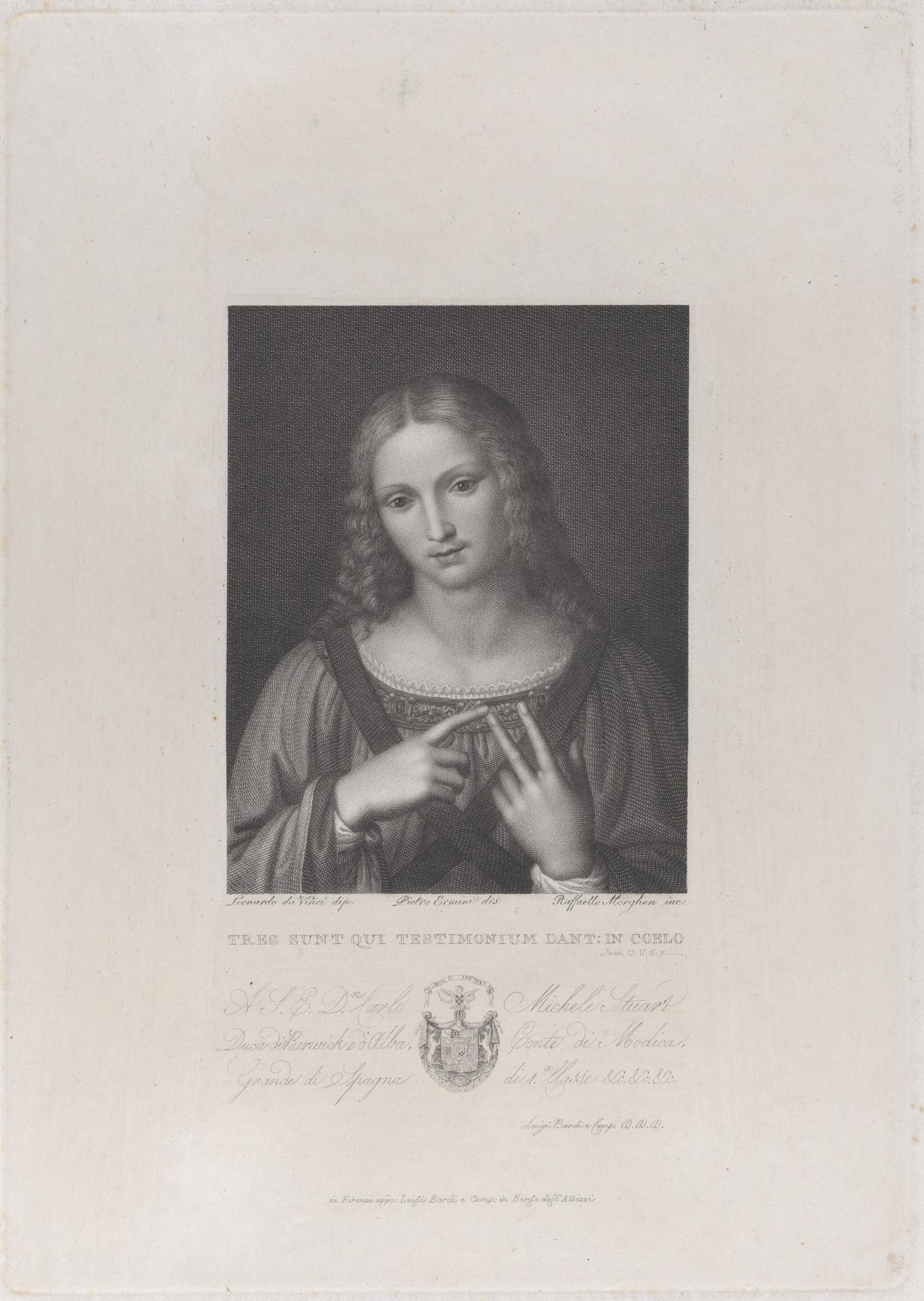
Christ proclaiming the law
Original title: Christ proclaiming the law
kurzbeschreibung
Raphael Morghen's engraving Christus verkündet das Gesetz dates to 1817 and is the third state of four. It depicts a female figure with curly hair in traditional dress, her hands held before her body; Latin inscriptions and an eagle coat of arms fill the lower part of the sheet.
Description
The layout is centrally focused: the female figure stands in the foreground, her hands held in front of her body, fingers pointing toward each other. Latin lettering and a coat of arms with an eagle appear in the lower area. Rendered in black and white, the sheet points to a printmaking process such as etching or engraving. Light is distributed evenly, without strong shadows; the Neoclassical style shows clear lines and precise details.
Context
Raphael Morghen (1758–1833), an Italian engraver, became known for his reproductive engravings after famous paintings. The sheet of 1817 falls in an era when Neoclassicism was dominant in Europe and print graphics played a central role in disseminating art. The Latin inscriptions and the coat of arms suggest an official or religious commission, possibly from church or court circles.
Impact
Clearly guided lines and the centered arrangement give the engraving a calm, dignified presence. Even lighting and precise detail reproduction lend it a solemn, almost monumental aura that invites the viewer to linger before the depicted scene.
Technique
In this engraving, the motif is incised into a copper plate and then printed on paper. The present third state of four shows that the plate was further worked after the first pull—an indication of careful revision and refinement of details. At 32.3 × 23 cm, the print's dimensions correspond to the usual format of reproductive engravings of the period.
AI-generated description text
Source: Metropolitan Museum of Art · Public Domain (CC0 1.0)