La Fornarina
Original title: La Fornarina
kurzbeschreibung
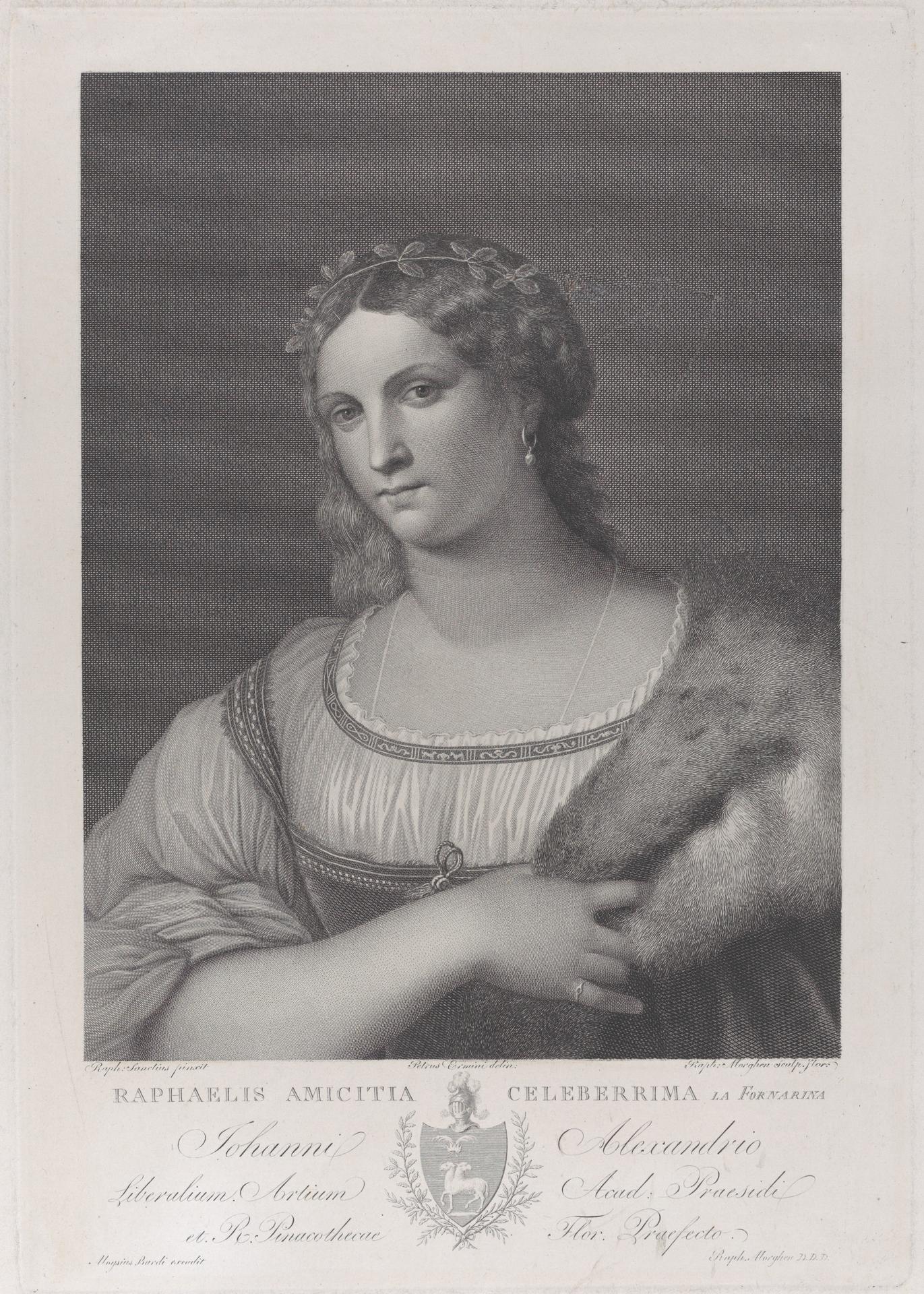
A young woman in elegant dress, a fur sleeve draped over her shoulder: this is how Raphael Morghen's 1814 engraving presents the celebrated Fornarina, widely thought to have been Raphael's lover. The sheet is the fourth of four states and reproduces a painting by Raphael in black and white.
Description
Her appearance is defined by a plain yet refined gown with a pattern across the bodice and a scarf wound around her neck. The hair is gathered into a curly braid and crowned with a wreath of leaves. A fur coat sleeve rests on her shoulder, while the dark ground pushes the figure forward. Latin inscriptions and a coat of arms with a stag and shield appear at the bottom, alluding to the friendship between Raphael and La Fornarina. Everything in the arrangement leads toward the woman.
Context
Morghen made the print in 1814 after a painting Raphael produced around 1518–1520. The original, now in the Galleria Nazionale d'Arte Antica in Rome, shows a woman often identified with Raphael's lover Margherita Luti. Morghen was a noted Italian engraver whose faithful copies of famous works were highly prized. That this is the fourth of four states points to a plate revised several times and brought to its final form.
Impact
Precise linework and a clear modeling of light and shadow give the print a calm, intimate mood. Placed at the center against the dark ground, the woman draws the eye straight to her face and gesture, lending her an almost monumental presence. The careful rendering of fabrics and hair gives the sheet a sensuous quality that goes beyond mere reproduction.
Technique
For this engraving the lines were cut into a copper plate and then transferred to paper with printing ink. The fourth state shows the plate after several rounds of revision, suggesting painstaking finishing work. Working in black and white, the print uses fine hatching and cross-hatching to build volume and to bring out textures such as fur and cloth.
AI-generated description text
Source: Metropolitan Museum of Art · Public Domain (CC0 1.0)