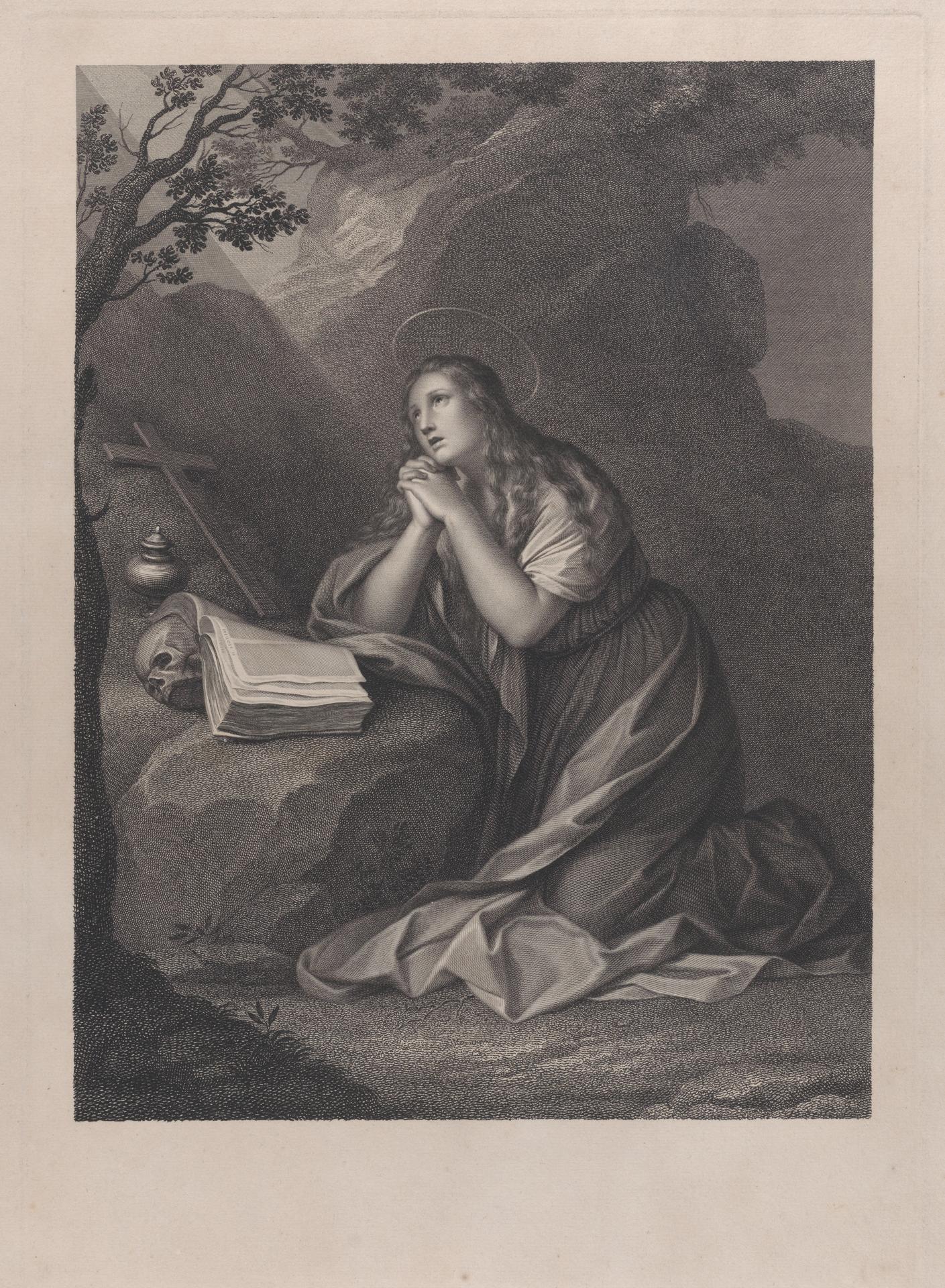
Mary Magdalene, penitent in the desert
Original title: Mary Magdalene, penitent in the desert
kurzbeschreibung
An engraving by Raphael Morghen from 1801 shows Mary Magdalene as a penitent in a rocky setting, kneeling in prayer. The impression measures 45.3 × 32 cm (plate) and represents the first of six states.
Description
Mary Magdalene kneels on a rock at the center, hands clasped, gaze turned upward. A simple garment wraps her, a halo rests above her head. At her feet lie an open book, a skull, and a cross. Trees and rocks close off the space, while light falls from above onto the scene.
Context
The Italian engraver Raphael Morghen made this print in 1801 as a reproductive engraving after a painting. Such prints served in the 18th and early 19th centuries to bring paintings to a wide audience. The subject of the penitent Mary Magdalene enjoyed great popularity in Christian art of the Baroque and Neoclassical periods.
Impact
The clear arrangement and the light falling from above give the print a calm, devout mood. Finely graded lines and shadows create plasticity and carry the spiritual effect of the motif.
Technique
Lines are engraved into a copper plate, from which the print was pulled. Morghen used dense hatching to render the texture of garment and rocks. That this impression is the first of six states points to careful, step-by-step reworking of the plate.
AI-generated description text
Source: Metropolitan Museum of Art · Public Domain (CC0 1.0)