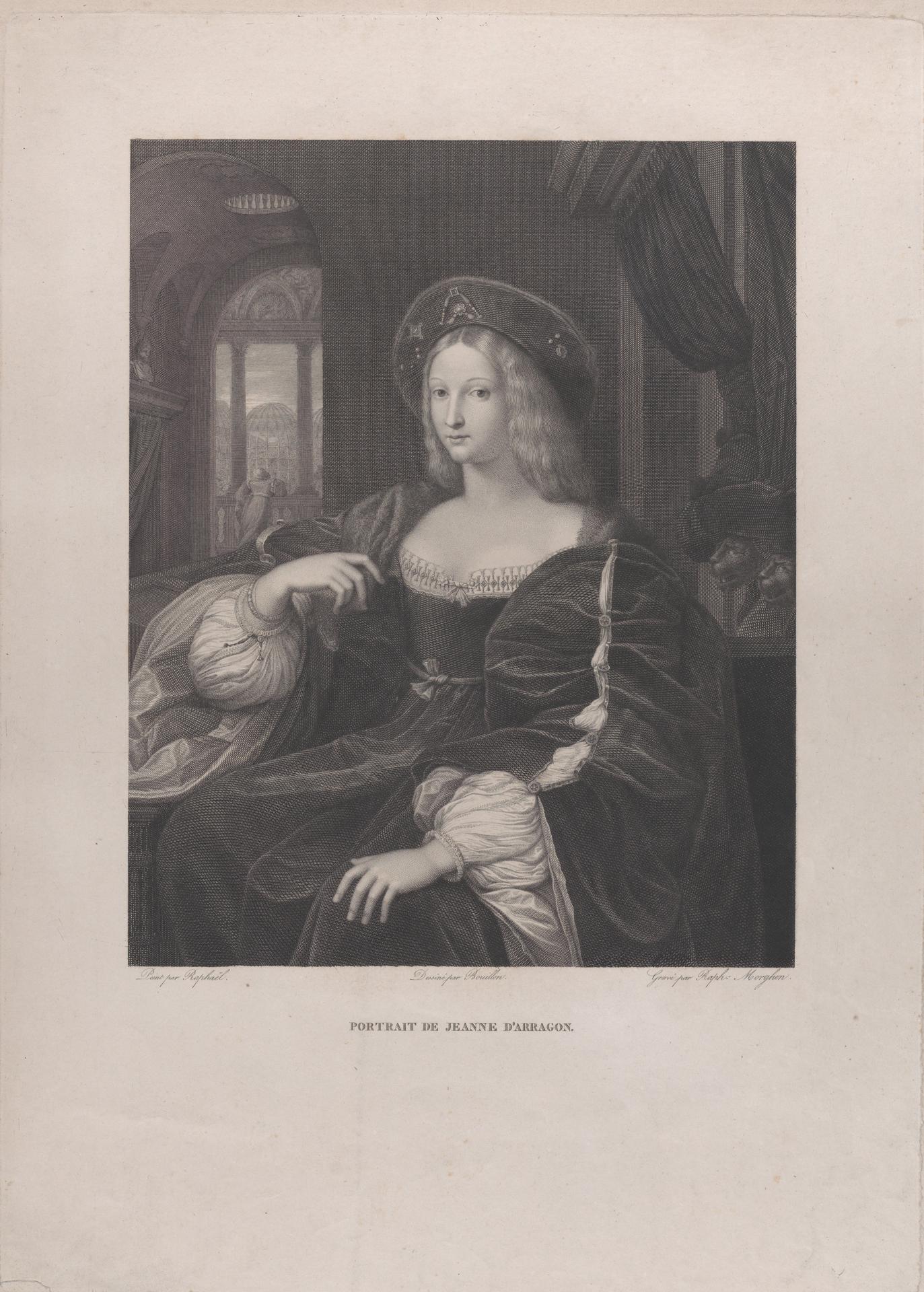
Portrait of Doña Isabel de Requesens y Enrìques de Cardona-Anglesola (formerly identified as Joanna of Aragon)
Original title: Portrait of Doña Isabel de Requesens y Enrìques de Cardona-Anglesola (formerly identified as Joanna of Aragon)
kurzbeschreibung
Raphael Morghen's 1821 engraving presents Doña Isabel de Requesens y Enríquez de Cardona-Anglesola in a formal three-quarter-length portrait. This impression is the third of four states. A seated woman of elegant bearing appears before an architectural setting.
Description
The sitter occupies a room, her body turned slightly to the left while her face meets the viewer. A dark gown with a high collar and a headdress adorned with a symbol define her appearance. One arm rests on the arm of the chair, the other is slightly raised. Columns and a window admitting daylight structure the space behind her. The layout reads as symmetrical: the figure holds the foreground while the architecture orders the room.
Context
The 1821 print reproduces a painting by Raphael that was long taken to show Joanna of Aragon. Only later did art-historical research establish the sitter as Doña Isabel de Requesens. Morghen, an Italian engraver, was known for his reproductions of celebrated paintings, which circulated widely in the nineteenth century. Four states were printed from the plate; the third points to reworking.
Impact
Careful shading and varied linework give the sheet a calm, dignified mood. The monochrome range of greys draws attention to the facial features and the details of the dress, reinforcing the elegance of the woman portrayed.
Technique
Engraving is an intaglio process in which lines are cut into a copper plate. Printing was done in black ink on paper, producing the delicate gradations of light and dark. The third state of the plate reveals retouching that strengthens the contrasts.
AI-generated description text
Source: Metropolitan Museum of Art · Public Domain (CC0 1.0)