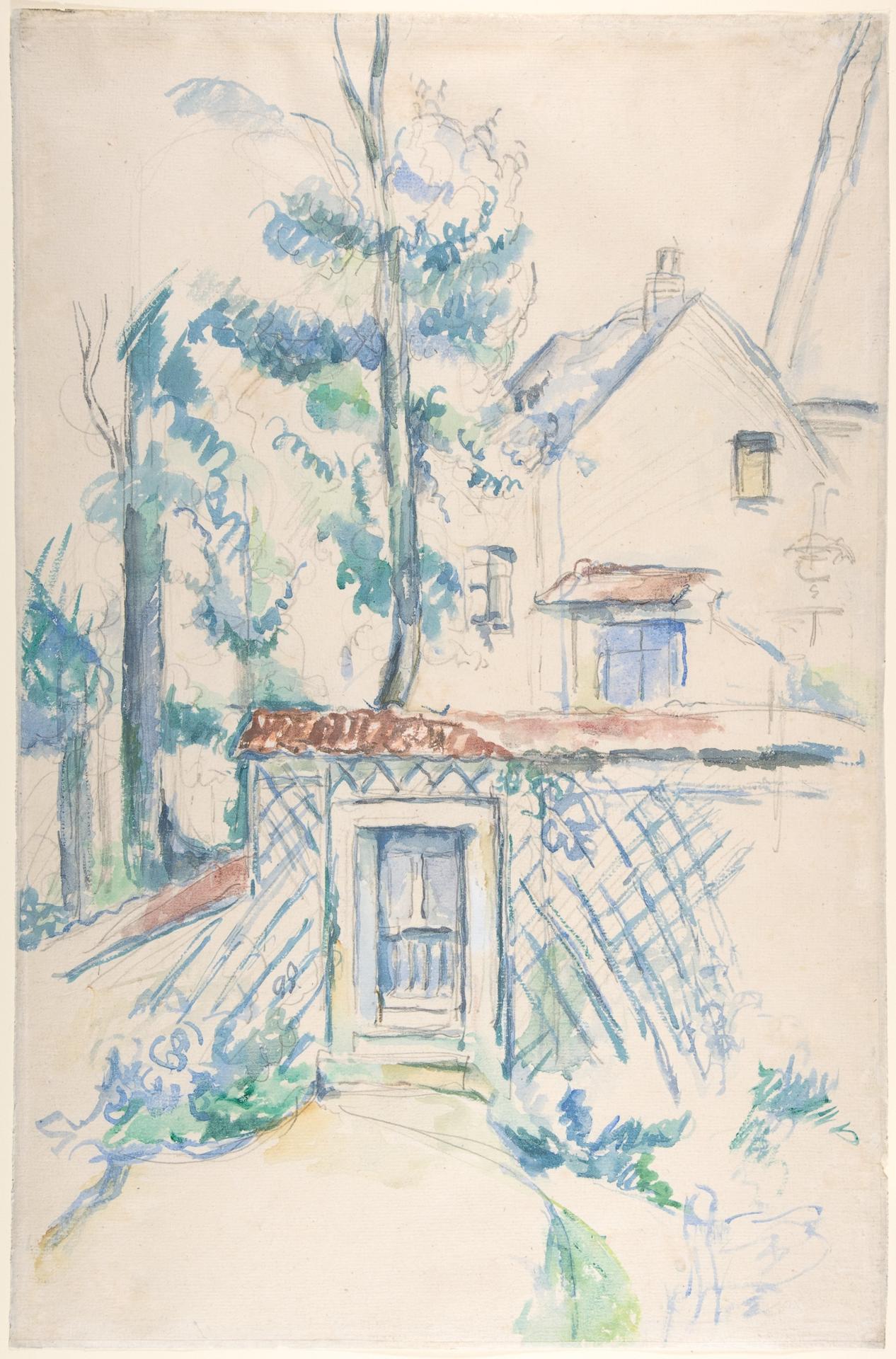
Entrance to a Garden
Original title: Entrance to a Garden
kurzbeschreibung
Paul Cézanne's watercolor over graphite, made around 1878–80, is titled "Eingang zu einem Garten" (Entrance to a Garden). Where many of his landscape studies stay open and unbounded, this sheet sets vegetation inside a firm architectural frame: a gate leads into the garden, trees and shrubs flank the path, and a house stands in the distance.
Description
A wooden gate with a lattice structure, its door standing open a crack, marks the starting point. To the left, trees and shrubs crowd together in blues and greens, while farther back on the right a house with roof and window appears in grays and whites. Light falls in from the upper left, picking out shadows and the texture of branches and masonry. The layout is asymmetrical: the gate acts as the hinge, the house a quiet counterweight in the depth.
Context
Cézanne made this watercolor in the late 1870s, when he was devoting himself more and more to landscape painting in Provence. At the time he was testing the watercolor technique that he would later carry over into oil. Gardens and parks recur throughout his work, often in the surroundings of the family home, Jas de Bouffan.
Impact
The pale colors and the fluid, restless stroke give the sheet a fresh immediacy. Because the arrangement stays asymmetrical and light and shadow are emphasized, a quiet, familiar mood settles in that draws the eye into the scene.
Technique
The work is executed in watercolor over graphite, with the graphite lines serving as a scaffold for the colored passages. The watercolor sits in thin, transparent layers, which supports the brightness and lightness of the sheet.
AI-generated description text
Source: Metropolitan Museum of Art · Public Domain (CC0 1.0)