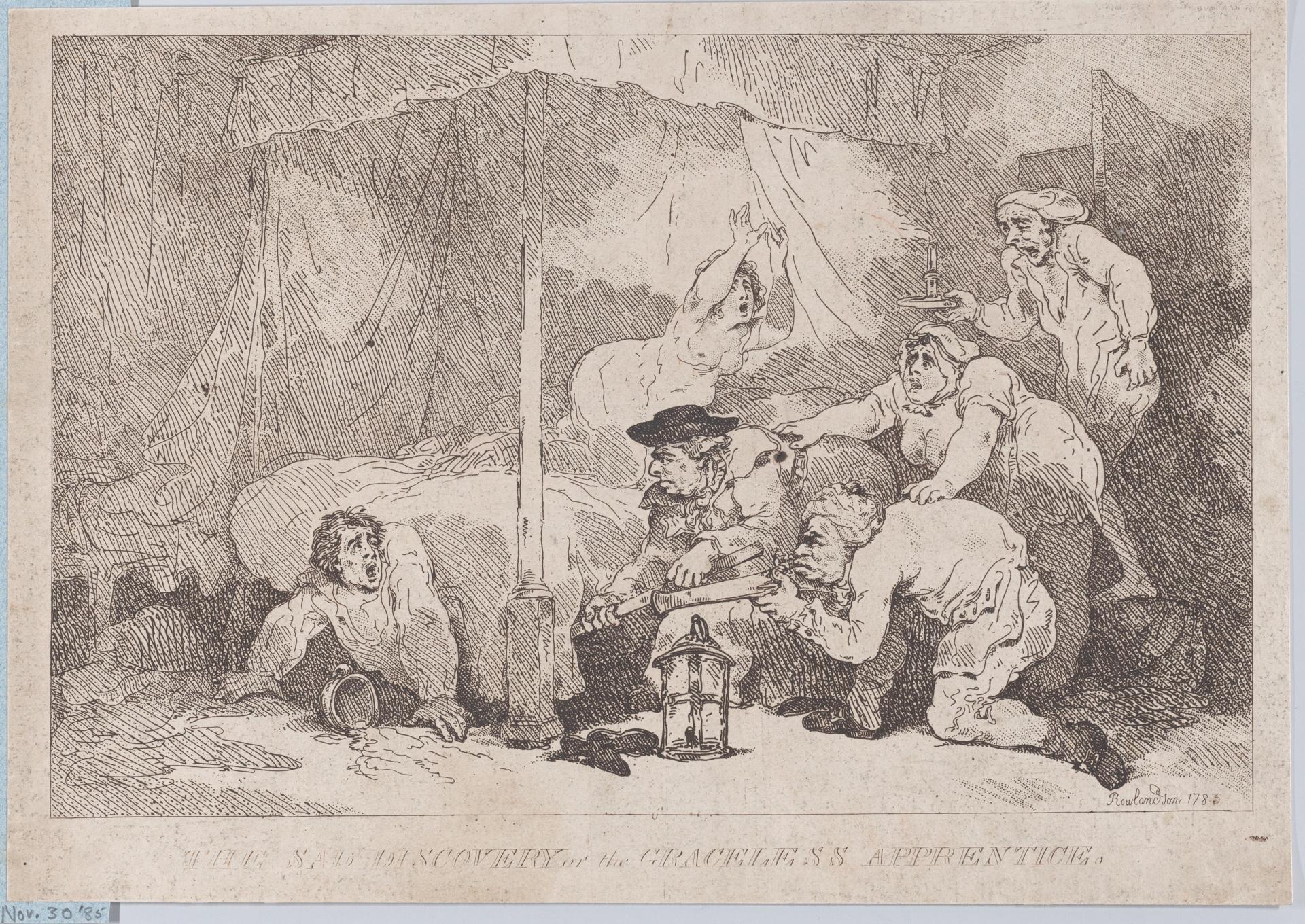
The Sad Discovery of the Graceless Apprentice (November 30, 1785, Met-Objekt 6067)
Original title: The Sad Discovery of the Graceless Apprentice
kurzbeschreibung
A man holding a candle stares in horror at a discovery, while other figures around him react with dismay in a dark, underground setting. Thomas Rowlandson made this etching on 30 November 1785; it is a typical example of his satirical work from the late eighteenth century.
Description
With arms raised and mouth wide open, a man stands at the center, seemingly screaming; the light from the candle in his hand falls on those around him. Several figures are grouped about him—some crouch on the ground, others stand or kneel, all with frightened or worried expressions. A large, semi-transparent curtain dominates the background and hides parts of the action. Gloomy, slanting lines run across the image, heightening the sense of fear and shock. The etching is monochrome in shades of gray, worked out through fine hatching.
Context
The etching was made on 30 November 1785, when Rowlandson was already known for his satirical and often socially critical portrayals of English daily life. It belongs to a series of prints dealing with moral or comic situations. Rowlandson often worked with the publisher Rudolph Ackermann, who sold his works in London. Nothing is known about the exact genesis of this print; it fits into the genre of moralizing pictorial satires that were popular in the late eighteenth century.
Impact
The dramatic gesture of the man at the center and the threatening darkness of the setting create immediate tension. Screaming, candlelight, and slanting lines combine into an oppressive mood that draws the viewer into the action. The scene feels like a frozen moment of horror, and the fine linework gives it an almost tangible intensity.
Technique
The etching is recognizable by the fine, parallel lines that form contours and shading. This technique allowed light and shadow to be rendered precisely, as the candle lighting in the image shows. The hatchings create the gray tones and give the print a detailed texture typical of Rowlandson's graphic works.
AI-generated description text
Source: Metropolitan Museum of Art · Public Domain (CC0 1.0)