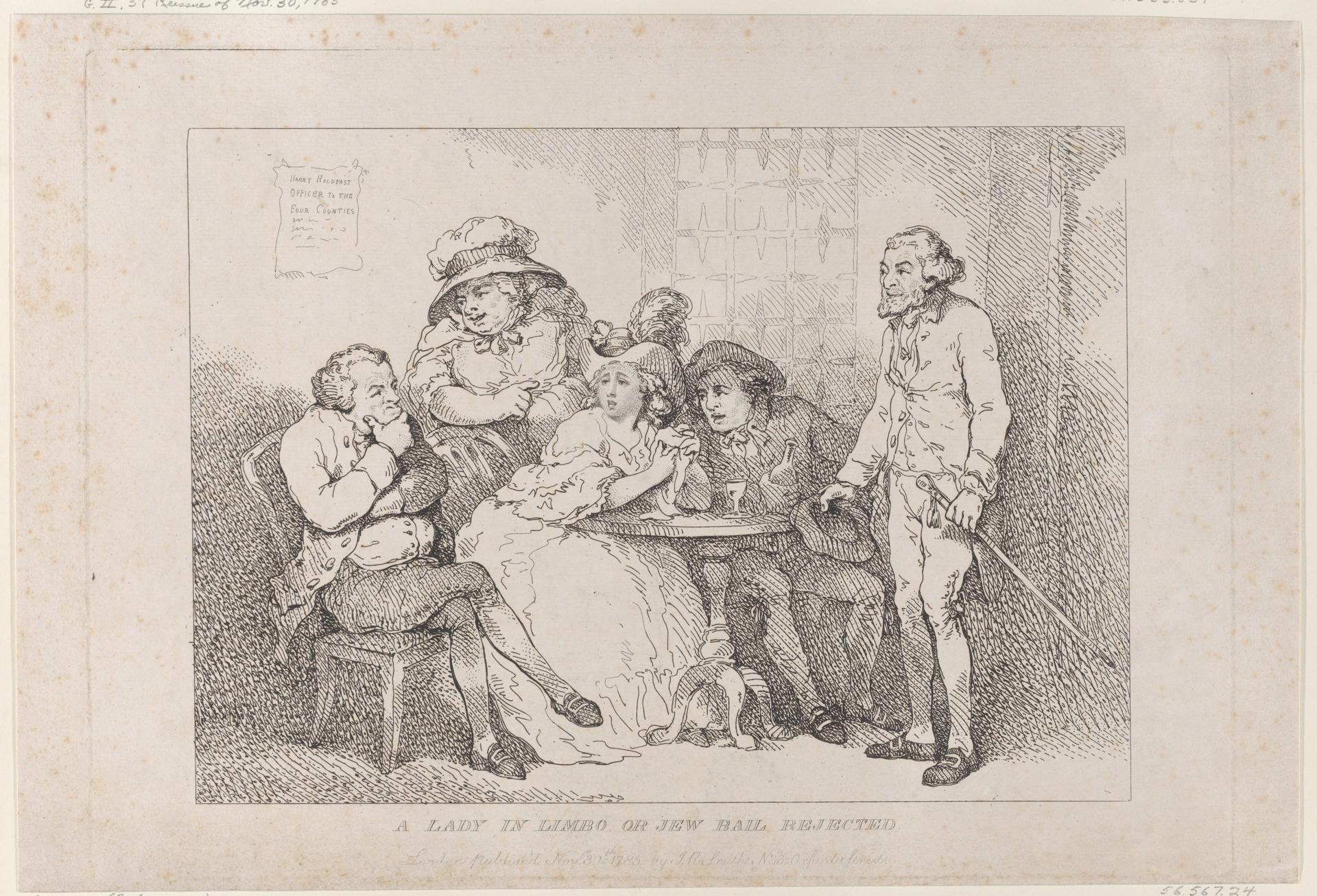
A Lady in Limbo, or Jew Bail Rejected
Original title: A Lady in Limbo, or Jew Bail Rejected
kurzbeschreibung
Unlike the usual prison scenes of his day, Thomas Rowlandson turns his attention here to a well-dressed woman pressed by three men inside a debtors' prison. This 1785 etching and stipple print presents a legal or financial entanglement as a satirical image.
Description
In the foreground sits a woman in an elaborate, long gown and a large headdress; she holds her arms before her body and tilts her head slightly to one side, signaling shock or surprise. Beside her sits a man in plain but neat clothes, apparently trying to engage her in conversation. To the right stands a man in a light shirt and trousers, a stick in one hand, the other hand pointing at something. A third man in the background also gestures, while iron bars suggest the prison space.
Context
The etching dates from late 18th-century England, when caricature had become a common means of political and social criticism. Rowlandson was known for his satirical depictions of everyday life and social ills. The title refers to the fate of debtors, who in England could be imprisoned until the 19th century if they failed to pay their debts. That a woman is shown in this situation was unusual and aimed at the absurdity of such conditions.
Impact
The exaggerated facial expressions and the woman's unusual situation make the caricature both humorous and critical. The monochrome approach and fine hatching give the sheet a lively, almost sketch-like quality. One smiles while looking at it and at the same time reflects on social injustice.
Technique
Rowlandson combined etching and stipple, producing subtle tonal gradations and a soft texture. Fine lines and hatching model the figures and the space. The monochrome handling matches the usual appearance of prints from this period.
AI-generated description text
Source: Metropolitan Museum of Art · Public Domain (CC0 1.0)