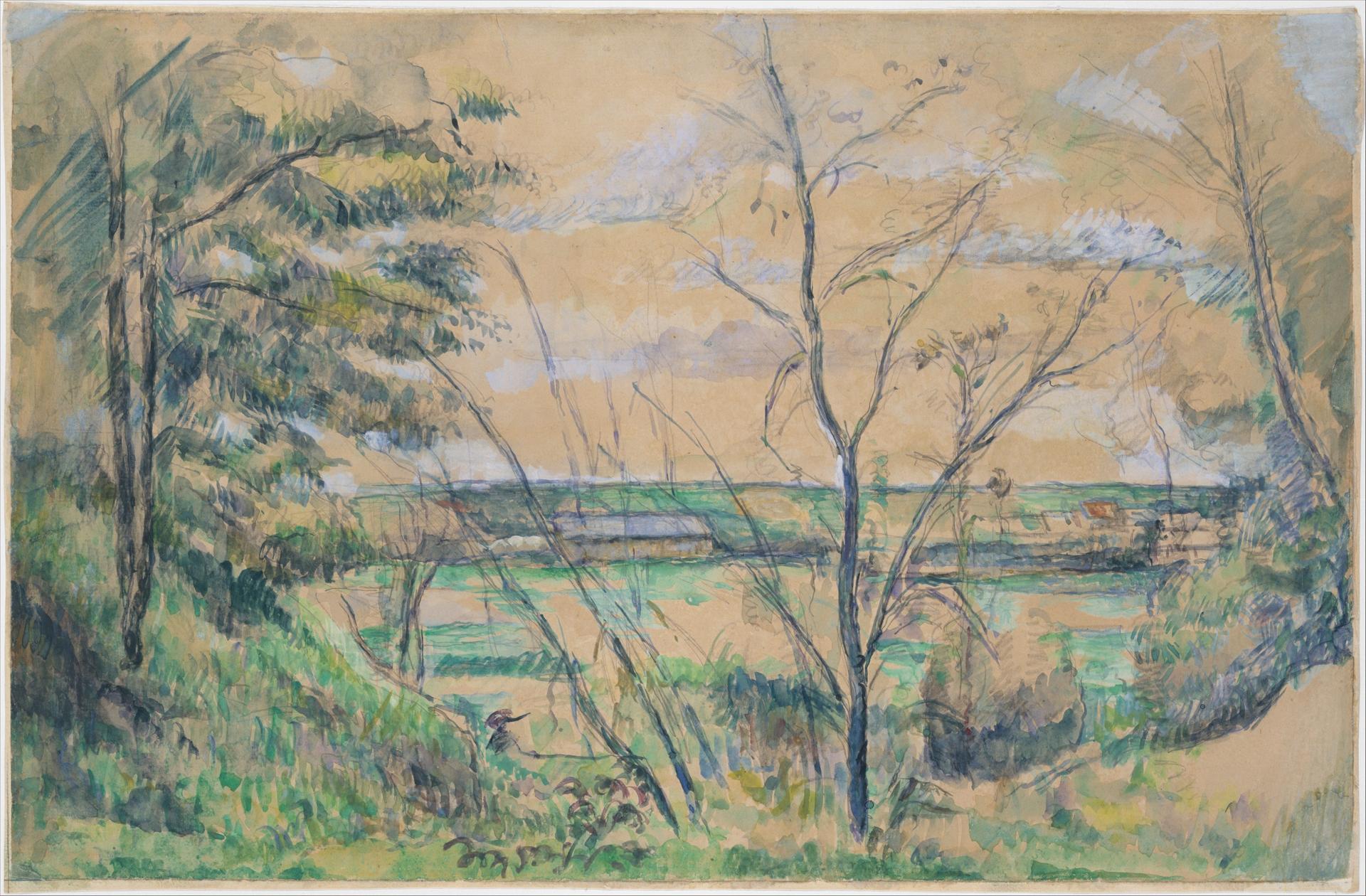
In the Oise Valley
Original title: In the Oise Valley
kurzbeschreibung
Paul Cézanne painted 'Im Oise-Tal' between 1878 and 1880. It is a river landscape executed in graphite, gouache, and watercolor. The picture presents a quiet rural view: a body of water in the foreground, trees and a low line of buildings behind. Its dimensions are 32.4 x 50 cm.
Description
A river or lake occupies the foreground, its surface still. On the right edge and in the foreground grow slender trees with sparse foliage, suggesting autumn or winter. Beyond, flat land with scattered houses or farms stretches out. The sky is cloudy and warm in tone, creating a calm mood. The colors are mainly earthy — green, brown, beige — with light accents that hint at reflections of the sun.
Context
This watercolor was made during Cézanne's stay in the Oise valley, an area north of Paris that he visited several times in the late 1870s. At that time he was increasingly experimenting with watercolor techniques, which he developed alongside his oil painting. The work falls in a period when he was moving away from Impressionist plein-air painting and searching for his own constructive pictorial language. River landscapes recur frequently in his oeuvre, often with motifs from around Auvers-sur-Oise.
Impact
The combination of spare line and delicate washes of color creates a quiet, almost meditative atmosphere. Warm sky tones and the earthy palette give the sheet an intimate, understated mood that draws the viewer into the landscape. Its apparent simplicity conceals a complex pictorial structure, held together by the balanced relationship of water, trees, and horizon.
Technique
Cézanne combined graphite for drawing with gouache and watercolor, the transparency of the watercolor allowing the paper texture to show through. The brushstrokes appear partly sketchy and reveal the texture of the landscape and clouds. He probably used gouache to thicken certain areas and set light accents.
AI-generated description text
Source: Metropolitan Museum of Art · Public Domain (CC0 1.0)