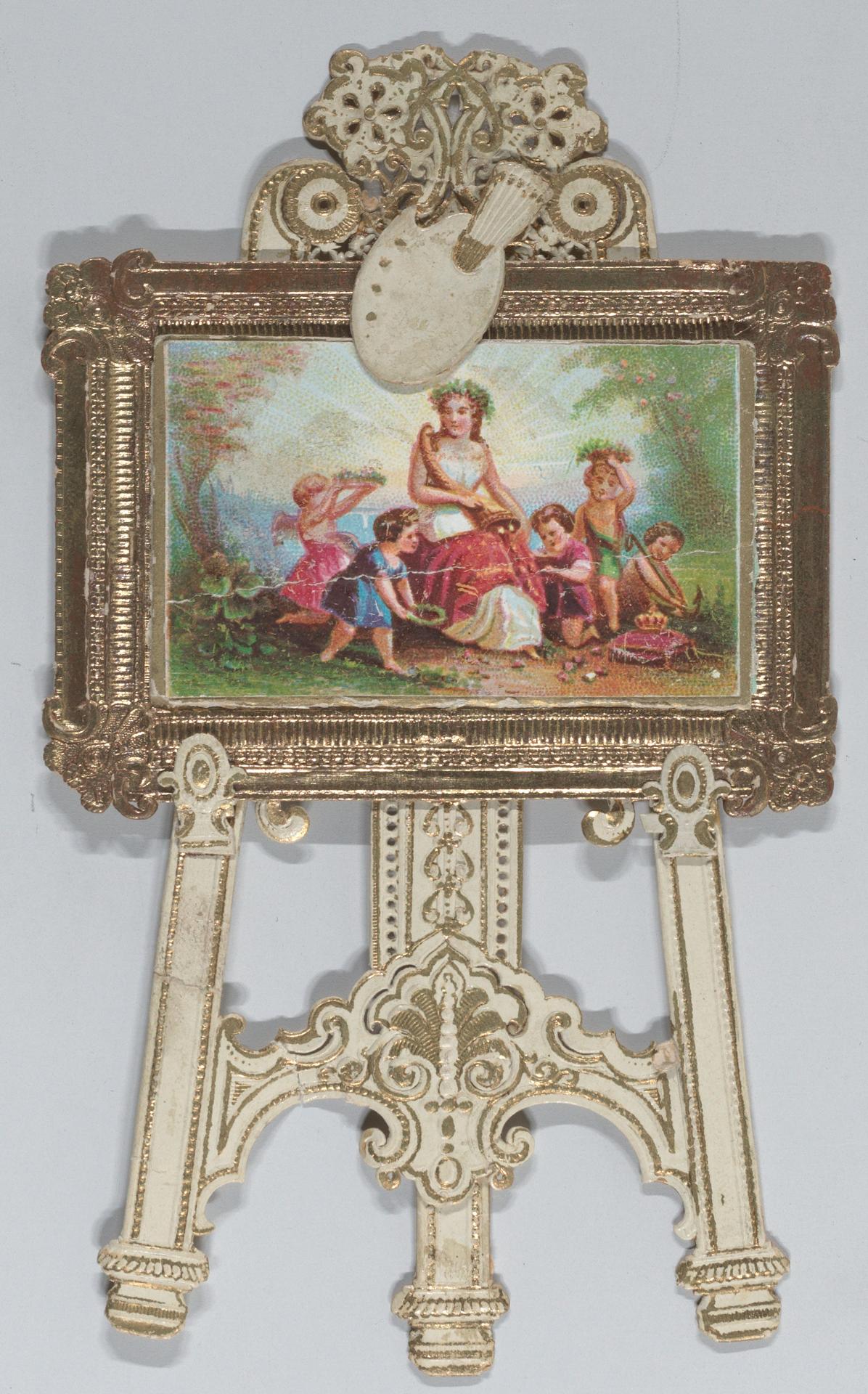
Valentine - Standing easel, chromolithographed family
Original title: Valentine - Standing easel, chromolithographed family
kurzbeschreibung
This Victorian Valentine from Raphael Tuck & Sons dates to 1873. It is made of sturdy card-stock, embellished with gilding and a chromolithograph that reproduces a family scene. The piece measures 7.3 cm in width and 12.2 cm in length.
Description
A golden frame with an elaborate, decorative structure first draws the eye. At its center sits a chromolithographed scene: a woman in white robes, surrounded by playing children in brightly colored clothes. Trees and plants suggest a rural setting. Above the scene is a decorative element reminiscent of the knob of a stylized musical instrument. The whole has a vintage feel and is intended for wall mounting.
Context
Raphael Tuck & Sons, a renowned British printing and publishing house, gained fame for high-quality greeting cards and printed materials. The firm relied on chromolithography, a process that produced vividly colored prints. This object was created in 1873, at the height of Victorian greeting-card culture. Such Valentines often served as wall decorations or table ornaments.
Impact
Gold sheen and brilliant colors give the sheet a festive, elegant presence. The idyllic family scene evokes a sentimental, romantic mood typical of Victorian Valentines. The wealth of detail and harmonious layout captivate the viewer, drawing the gaze back again and again.
Technique
Heavy card-stock serves as the support, furnished with gold ornaments. The central motif was produced by chromolithography, in which multiple color stones are used to achieve realistic tones. Gilding and the intricate printed details attest to the high craftsmanship of Victorian printmaking.
AI-generated description text
Source: Metropolitan Museum of Art · Public Domain (CC0 1.0)