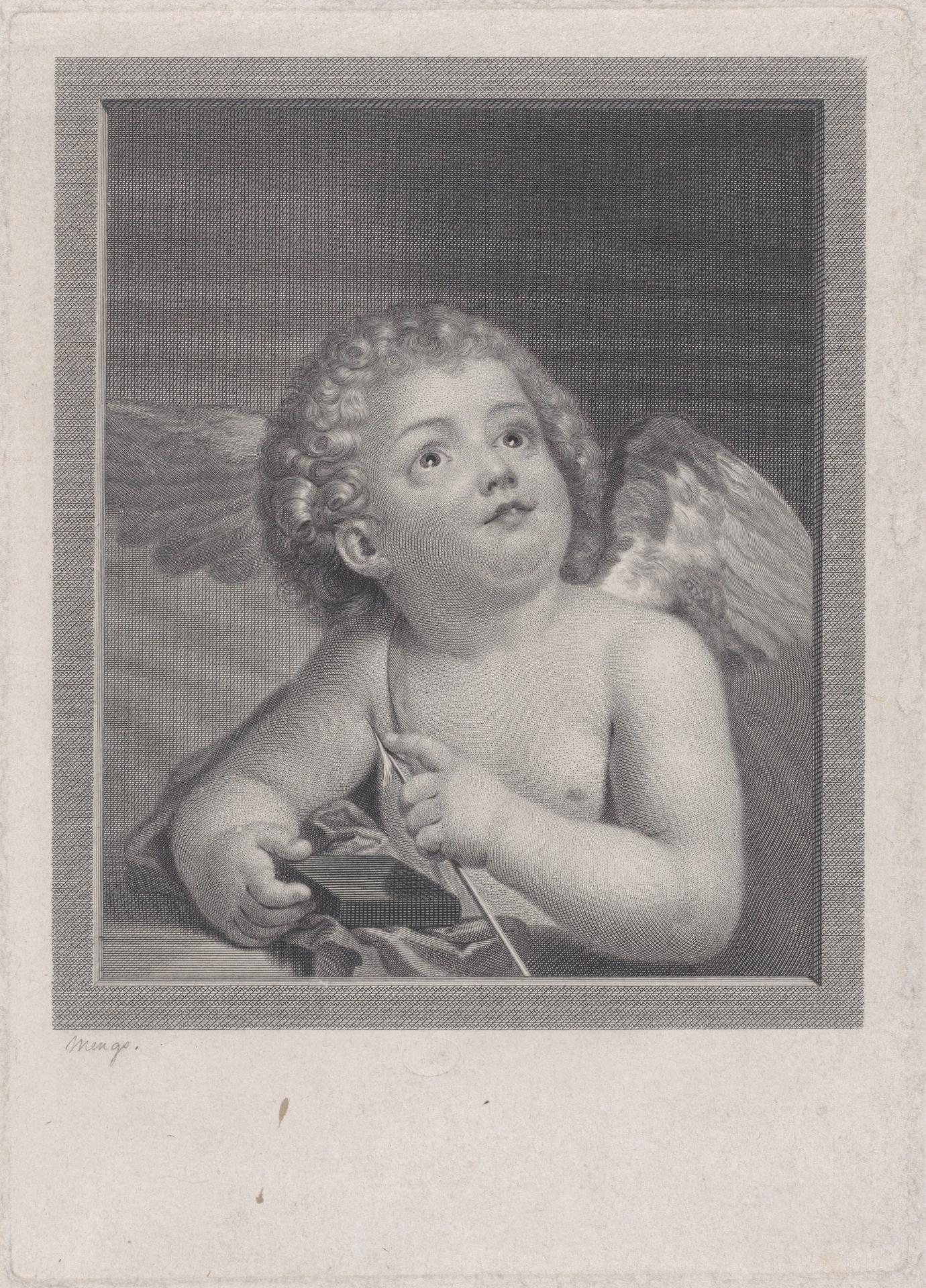
Cupid feeling the point of an arrow
Original title: Cupid feeling the point of an arrow
kurzbeschreibung
A cherub who touches the tip of an arrow appears on this sheet. Johann Friedrich Bause made the copperplate engraving in 1790, in its first of two states.
Description
Curly hair and wings mark the cherub as an angel. He holds an arrowhead in his hand, his gaze turns upward, and his face registers both surprise and pain. Against the dark ground the bright, finely worked face stands out with real force. Delicate lines and hatching give shape to the figure's contours and surfaces.
Context
Bause ranked among the leading German engravers of the eighteenth century and was known for his precise reproductive prints. Cupid testing an arrowhead is a familiar allegory in art history for the wounding power of love. The work dates from 1790, when printmaking was prized as a collectible in middle-class circles.
Impact
Childlike innocence meets painful recognition, and the clash produces an emotional tension. The contrast between the lit face and the dark ground pulls the eye straight to the cherub's expression.
Technique
The sheet is executed as a copperplate engraving, evident in the fine, exact lines and hatching. It is the first of two states, an early impression made before further reworking of the plate.
AI-generated description text
Source: Metropolitan Museum of Art · Public Domain (CC0 1.0)