Polygamy
Original title: Polygamy
kurzbeschreibung
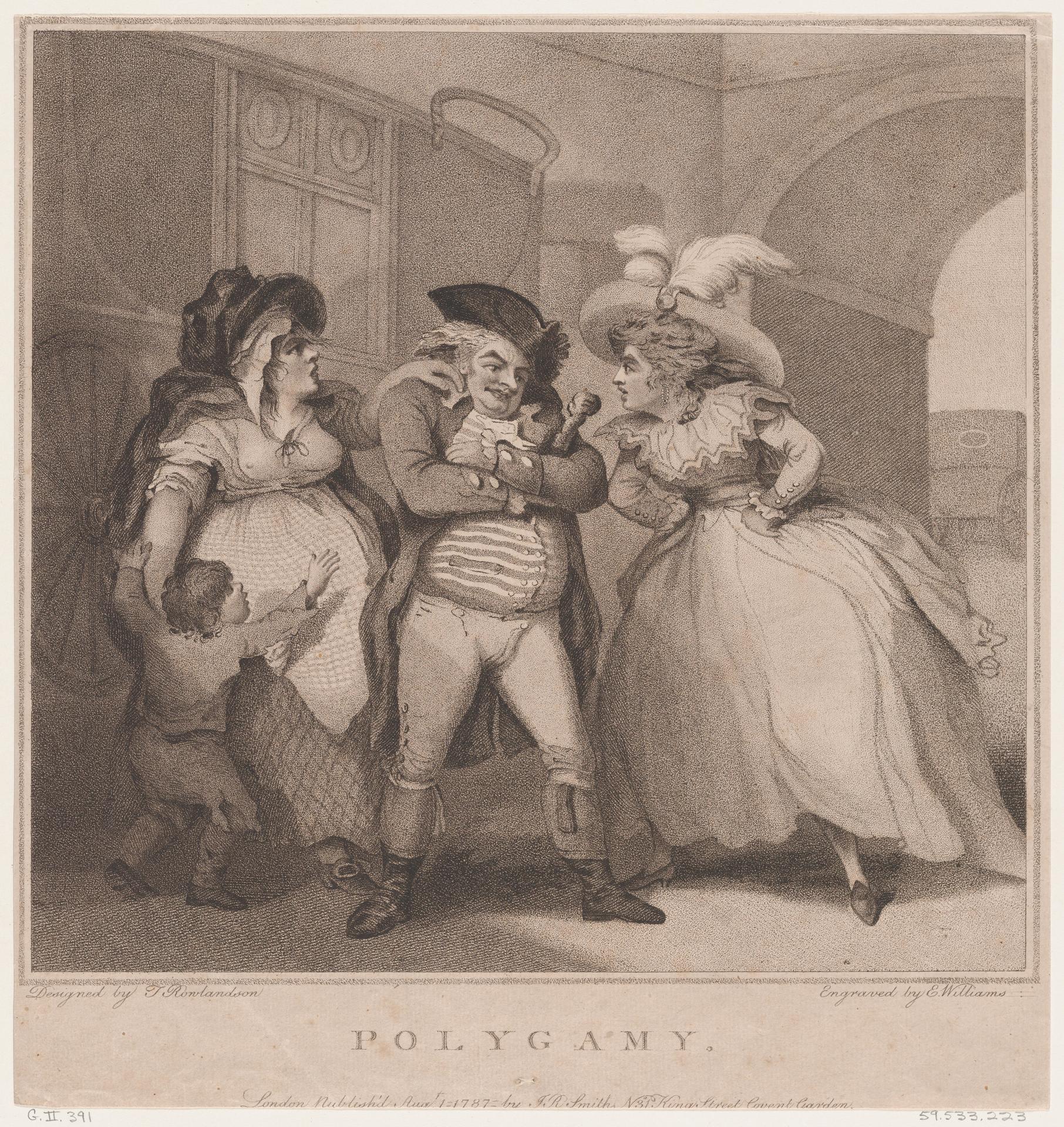
Edward Williams the Elder engraved Polygamie in 1787. Gathered in a courtyard are two women, a man and two children, rendered in tones of grey through a fine web of dots.
Description
Up front stand two women and a man, while a small boy tugs from behind at the woman on the left. She wears a large, elaborate hat and a loose blouse that pushes her belly forward. The woman on the right also has a showy hat and a dress trimmed with flounces. Between them the man cradles a little boy; his own cap, shirt with sleeves rolled to the elbow and trousers with turned-up legs suggest a working man at ease. A doorway and a column behind the group hint at an enclosed yard. Greys carry the whole image, shading and line working side by side.
Context
The Briton Edward Williams the Elder (1722–1782) made this print in 1787 and was known for landscapes and genre scenes. Satirical and moralising prints circulated widely in England at the time. The title Polygamie nods to contemporary debates about marriage and the roles of men and women. Stippled engraving was often used for reproduction because it could carry such delicate gradations of tone.
Impact
The stippling and the calm arrangement give the scene both detail and restraint. A faint tension rises from how the figures hold themselves, nudging the viewer to think about the relationships on display.
Technique
The image is built from tiny dots and short strokes, a stippled engraving. This allows soft tonal transitions and a precise handling of light and shadow. The sheet measures 34.5 × 32.6 cm.
AI-generated description text
Source: Metropolitan Museum of Art · Public Domain (CC0 1.0)