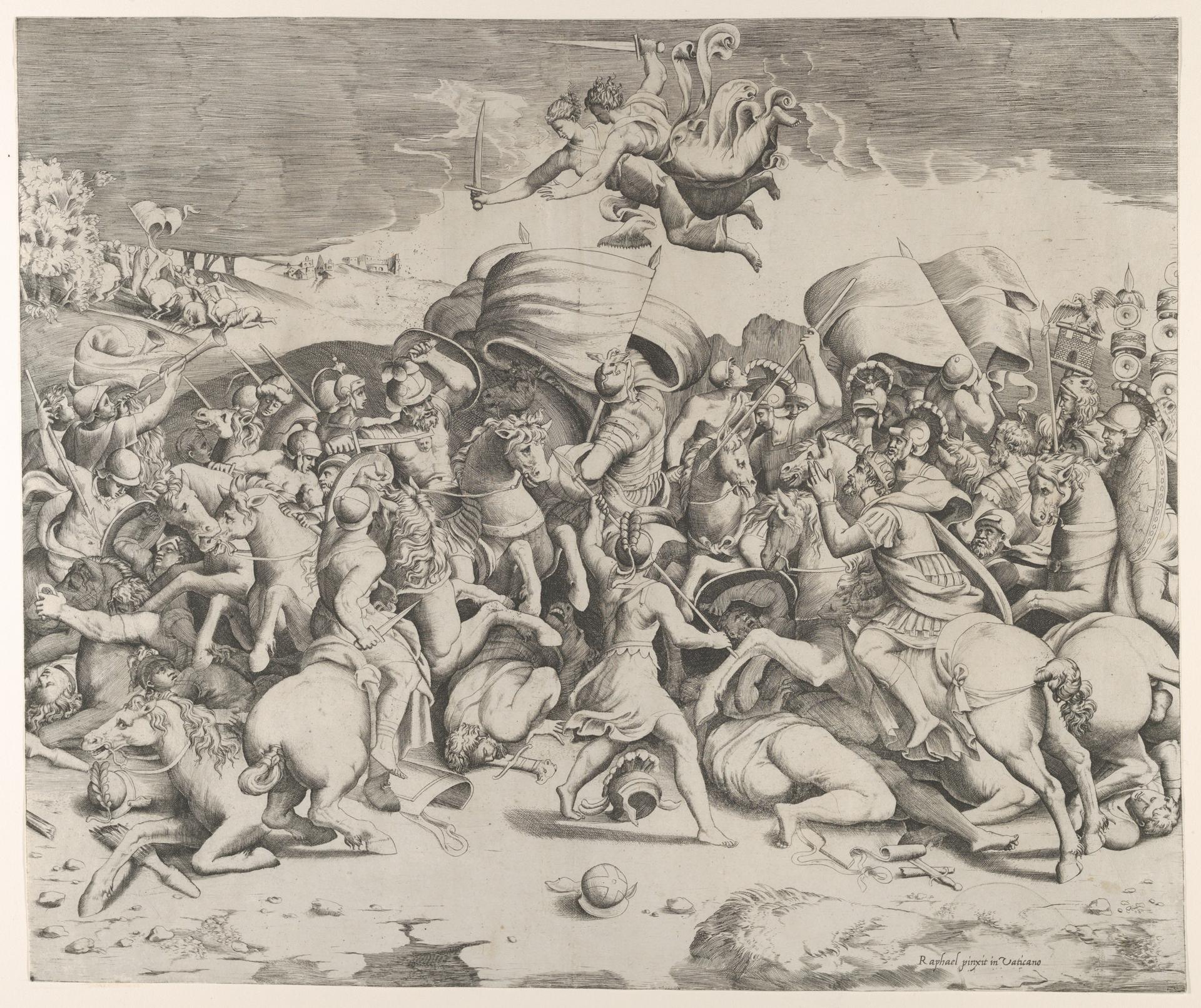
Constantine defeating the tyrant Maxentius, angels carrying swords fly above
Original title: Constantine defeating the tyrant Maxentius, angels carrying swords fly above
kurzbeschreibung
At the Milvian Bridge in 312 AD, Constantine's army meets the troops of the tyrant Maxentius. Giulio Bonasone recorded this battle as an engraving in 1544, and the present impression comes from the second of two states. The sheet is counted among the Renaissance, or more specifically Mannerism.
Description
Mounted fighters collide at the picture's center; some sink to the ground, others seem to be swept upward. Behind them, further figures and skirmishes stack in layers toward the deep space. Above the throng two angels hold swords and shields ready, pointing to divine support. The arrangement is tightly packed, full of movement and small details; the rendering stays monochrome, with light evenly spread, as is usual for an engraving.
Context
Bonasone worked as an Italian engraver in the sixteenth century, in Bologna and Rome among other places. His sheet of 1544 appeared in an era when art regularly engaged with both ancient and Christian subjects. The victory at the Milvian Bridge in 312 AD sealed Constantine's path to sole rule and was later read as the triumph of Christianity. Images of this kind were meant to glorify rulers or to instruct morally.
Impact
The crowded layout and the many movements produce a tense, dramatic mood. The hovering angels open a transcendent level for the scene and make the victory appear divinely grounded. Precisely guided lines and carefully placed details betray a high level of craftsmanship.
Technique
The sheet was made as an engraving: lines are cut into a metal plate and then printed. For the second state, the plate was reworked after the first printing. The sheet measures roughly 37.3 × 44.5 cm and remains monochrome; its effect comes solely from lines and hatching.
AI-generated description text
Source: Metropolitan Museum of Art · Public Domain (CC0 1.0)