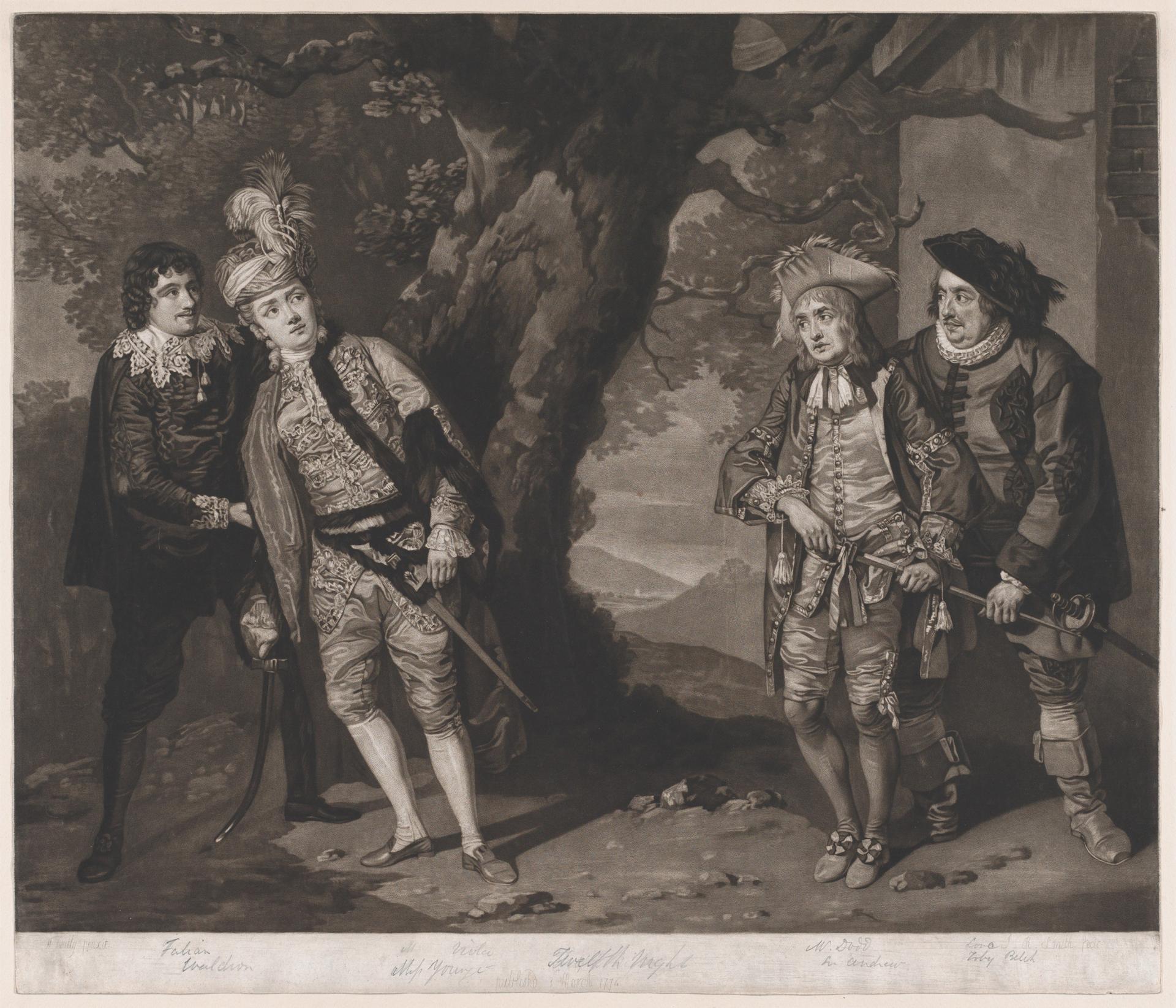
Miss Younge, Mr. Dodd, Mr. Love, and Mr. Waldron, in the Characters of Viola, Sir Andrew Aguecheek, Sir Toby Belch, and Fabian (Shakespeare, Twelfth Night, Act 3, Scene 4) (March 1, 1774, Met-Objekt 6030)
Original title: Miss Younge, Mr. Dodd, Mr. Love, and Mr. Waldron, in th Characters of Viola, Sir Andrew Aguecheek, Sir Toby Belch, and Fabian (Shakespeare, Twelfth Night, Act 3, Scene 4)
kurzbeschreibung
In Act III, scene 4 of Shakespeare's comedy Twelfth Night, four characters clash. John Raphael Smith captured this constellation in 1774 as a mezzotint, in the third of three states. A painting by Johann Zoffany served as the model. The figures appear in historical costumes before a landscape with trees and rocks.
Description
From left to right are Fabian, Viola, Sir Andrew Aguecheek and Sir Toby Belch, each in a distinctive theatrical pose. The layout places the four actors against a backdrop of trees and rock formations that suggests a stage landscape. Costumes with elaborate ornamentation point to the elevated status of the roles. Frontal light falls evenly on faces and fabrics. The arrangement feels balanced, and the group remains the focus of the sheet.
Context
The basis was a painting by Johann Zoffany that presents performers of the London theatre in their roles. Smith released the mezzotint on 1 March 1774, at a time when portraits of actors were in demand among collectors. Those portrayed belonged to the ensemble of the Theatre Royal in Drury Lane, where the play was performed. The third state reveals changes to the design compared with earlier impressions.
Impact
The grey tones of the mezzotint, through finely graded shading, create a physical presence that makes the figures seem almost three-dimensional. The balanced arrangement and calm light give the scene a dignified, almost ceremonial quality that captures the theatrical moment.
Technique
For mezzotint, the printing plate is roughened evenly with a rocking tool and then smoothed again in the desired areas, producing tonal gradations. This allows soft transitions and a velvety overall impression, which benefits the rendering of light and shadow. The present work is the third of three states, which suggests that the plate was reworked.
AI-generated description text
Source: Metropolitan Museum of Art · Public Domain (CC0 1.0)