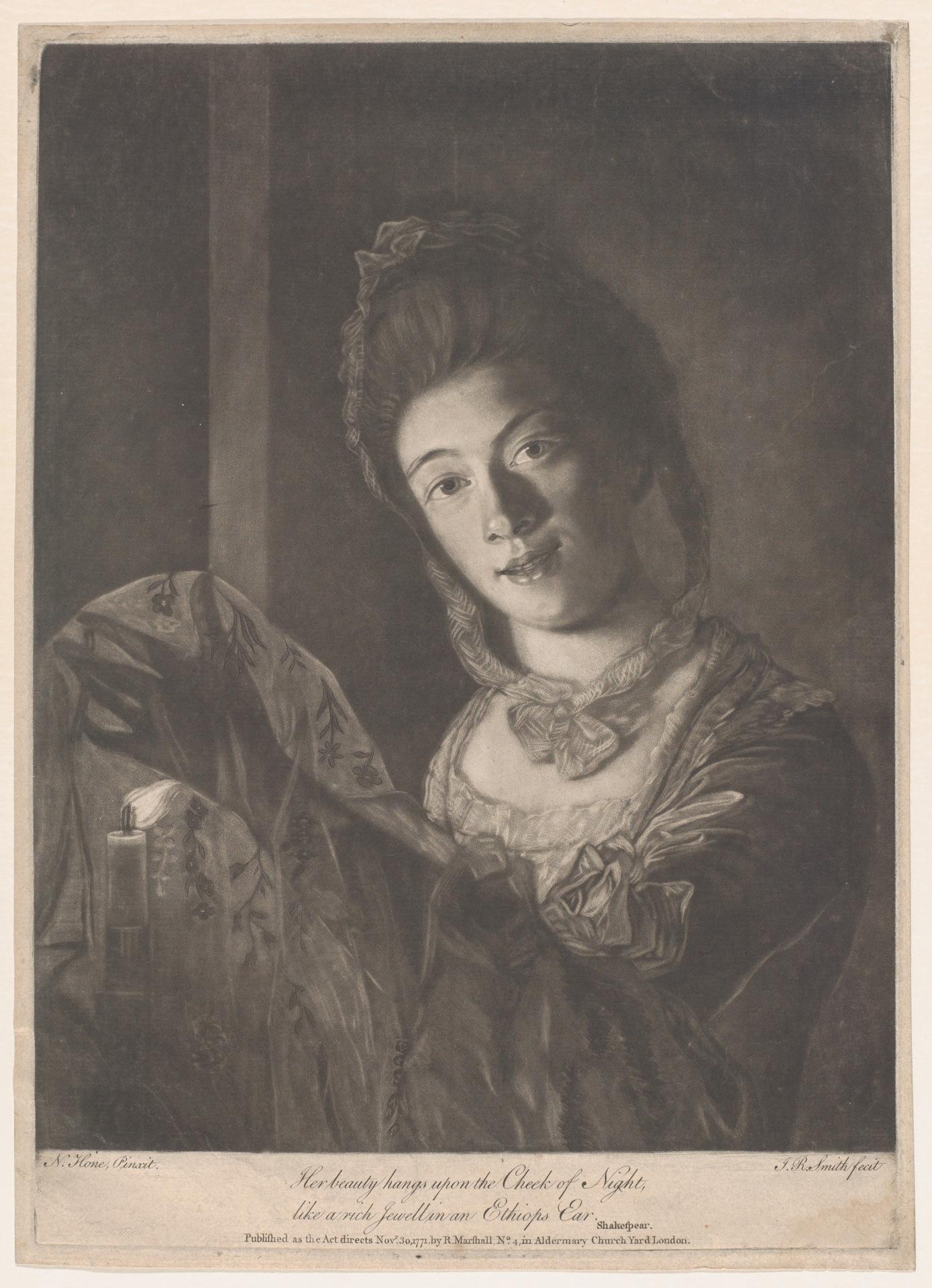
Miss Lydia Hone – 'Her beauty hangs on the Cheek of Night, like a rich Jewel in an Ethiop's Ear'
Original title: Miss Lydia Hone – "Her beauty hangs on the Cheek of Night, like a rich Jewel in an Ethiop's Ear"
kurzbeschreibung
John Raphael Smith published this mezzotint portrait of Miss Lydia Hone in 1771, placing her in a shadowed interior. The soft transitions of tone that define the medium bring out the folds of her dress, her headdress and the shawl draped over her, giving a well-dressed woman a strong sense of presence.
Description
Lydia Hone sits in the half-light of a room, her head turned slightly away. A striking scarf falls across her dress, and she wears a cap trimmed with ribbons. Behind her the outlines of a door or window can be made out; in front, on a table, a candle burns. Warm, muted light rests on the figure and draws out the surfaces of fabric and face, while the palette is made up almost entirely of greys.
Context
The print appeared on 30 November 1771 and represents the third of three states. In eighteenth-century England Smith was regarded as an accomplished mezzotinter who built his reputation chiefly on portraits of well-known contemporaries. The long title comes from Shakespeare's Romeo and Juliet and plays on the sitter's beauty in figurative language.
Impact
The graded tones of the mezzotint lend the portrait a softness that comes close to painting. Together with the candlelight they create a quiet, inward atmosphere in which the sitter's refinement is plainly felt.
Technique
For a mezzotint the plate is roughened evenly with a rocker and then smoothed again in the light areas, which allows especially fluid gradations of tone; here they serve the precise rendering of fabric and flesh. That a third state out of three exists points to repeated reworking of the plate.
AI-generated description text
Source: Metropolitan Museum of Art · Public Domain (CC0 1.0)