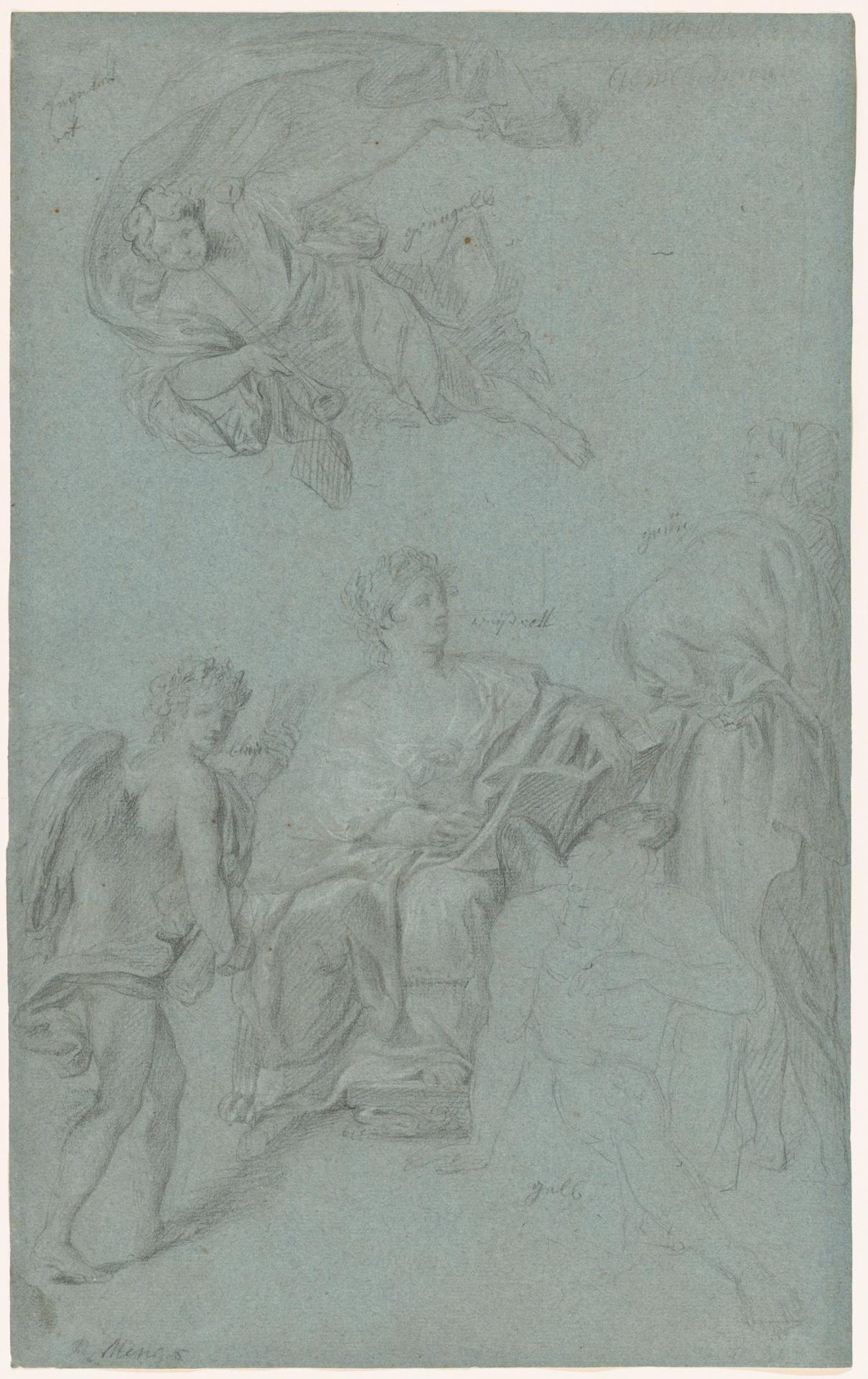
The Triumph of History over Time
Original title: The Triumph of History over Time
kurzbeschreibung
A winged figure sits enthroned above several interacting figures in this allegorical drawing by Anton Raphael Mengs, executed around 1771–75 in black and white chalk on blue paper. The sheet belongs to the genre of drawing and sets an elevated sphere against an earthly group.
Description
At the top, a winged figure spreads its wings wide, defined by sweeping lines. Below, several people have gathered: a barefoot figure in a long robe, and beside them someone holding a book. An exchange unfolds between them—a dialogue or a shared action. Hatching and line work model contours and surfaces. There is no colour, but the blue tone of the paper creates an effect of light and dark. The classical idiom is unmistakable.
Context
Mengs, a leading master of eighteenth-century classicism, worked in Dresden, Rome, and Madrid. Probably made in Rome, where he avidly studied antiquity and Raphael, the drawing dates from a period when he was producing large frescoes and paintings with mythological and allegorical subjects. The Triumph of History over Time is a common motif of the Enlightenment: it asserts the endurance of historical memory against all that is transient.
Impact
The animated line and clear structure give the sheet a calm grandeur. The contrast between the hovering figure above and the quieter group below generates a spatial tension that carries the allegorical meaning. Because everything is restricted to black and white on blue, the drawing feels concentrated and collected.
Technique
Black and white chalk on blue paper—a common eighteenth-century medium for designs and studies. The white chalk sets highlights, while the black outlines contours and shadows. Hatching gives the figures plasticity and makes the drapery tangible in its materiality.
AI-generated description text
Source: Metropolitan Museum of Art · Public Domain (CC0 1.0)