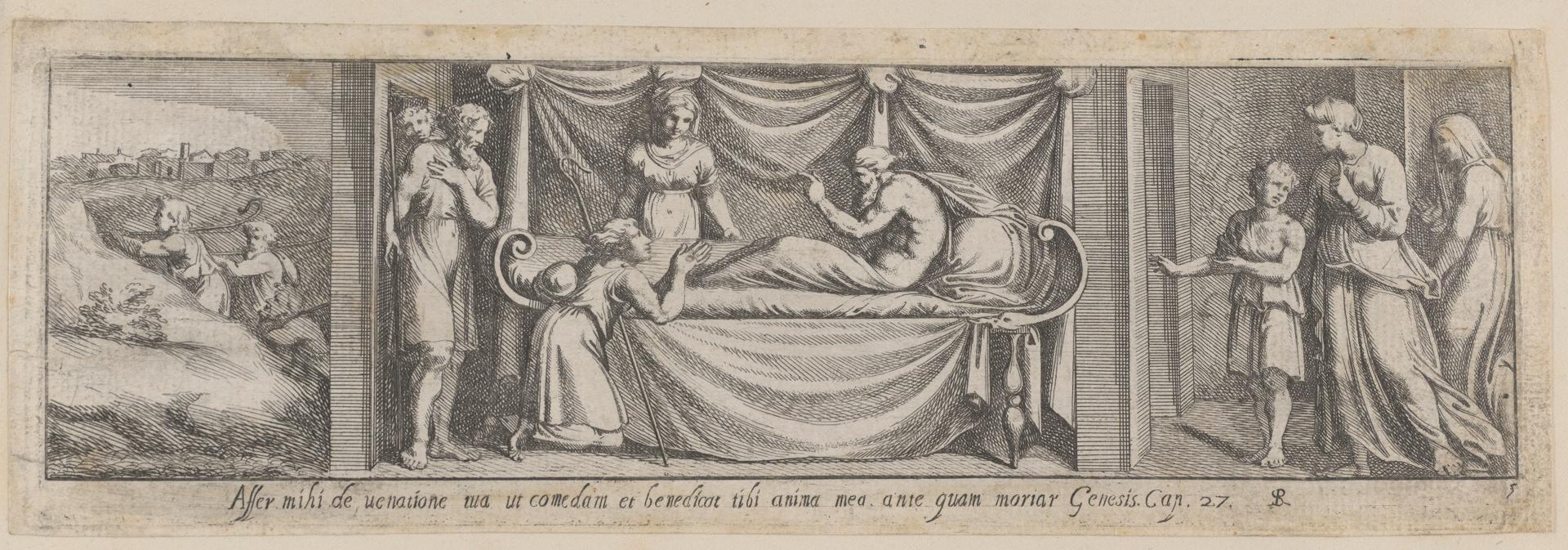
Plate 5: Isaac telling Esau to hunt for meat at left and Jacob and Rebekah at right, from Genesis 27, after a lost fresco in the basamento of Bay 5 of the Vatican Loggia
Original title: Plate 5: Isaac telling Esau to hunt for meat at left and Jacob and Rebekah at right, from Genesis 27, after a lost fresco in the basamento of Bay 5 of the Vatican Loggia
kurzbeschreibung
Pietro Santi Bartoli made this etching between 1650 and 1677. It shows two episodes from Genesis 27: on the left, the blind Isaac orders his son Esau to go hunting; on the right, Rebekah and Jacob discuss how to steal the blessing. The print belongs to a series after Raphael's frescoes in the Vatican Loggia.
Description
Isaac reclines on a bed at the center, supported by a woman, and hands a document to a man standing before him. On a hill to the left, two figures accompany a boy who carries antlers on his back. At the right, two more figures converse—likely Rebekah and Jacob. The layout runs horizontally, with figures arranged in a row. The etching remains in black and white, the light evenly distributed, without strong shadows. A Latin quotation from Genesis 27 is inserted at the bottom.
Context
Bartoli produced this print as part of a series reproducing the frescoes of the Vatican Loggia after Raphael. The Loggia, designed by Raphael and executed by his workshop, displays biblical scenes in the vaults and socle zones. The fresco in question, in the socle of bay 5, is lost; Bartoli's etching preserves an important visual record of it. Roman collectors commissioned the series, and it carried Raphael's inventions across Europe.
Impact
The arrangement is clear and narrative, presenting the biblical events in two simultaneous scenes. The classical style, reminiscent of Renaissance painting, gives the print a calm, dignified mood. Clean lines and a balanced layout make it a good example of Baroque reproductive printmaking.
Technique
For the etching, Bartoli scratched the drawing into an acid-resistant layer on a copper plate and then etched it. The sheet measures 8.3 × 25.4 cm (plate 8.7 × 24.7 cm) and is printed on paper. Even lines and the absence of hatching point to a precise, controlled etching technique.
AI-generated description text
Source: Metropolitan Museum of Art · Public Domain (CC0 1.0)