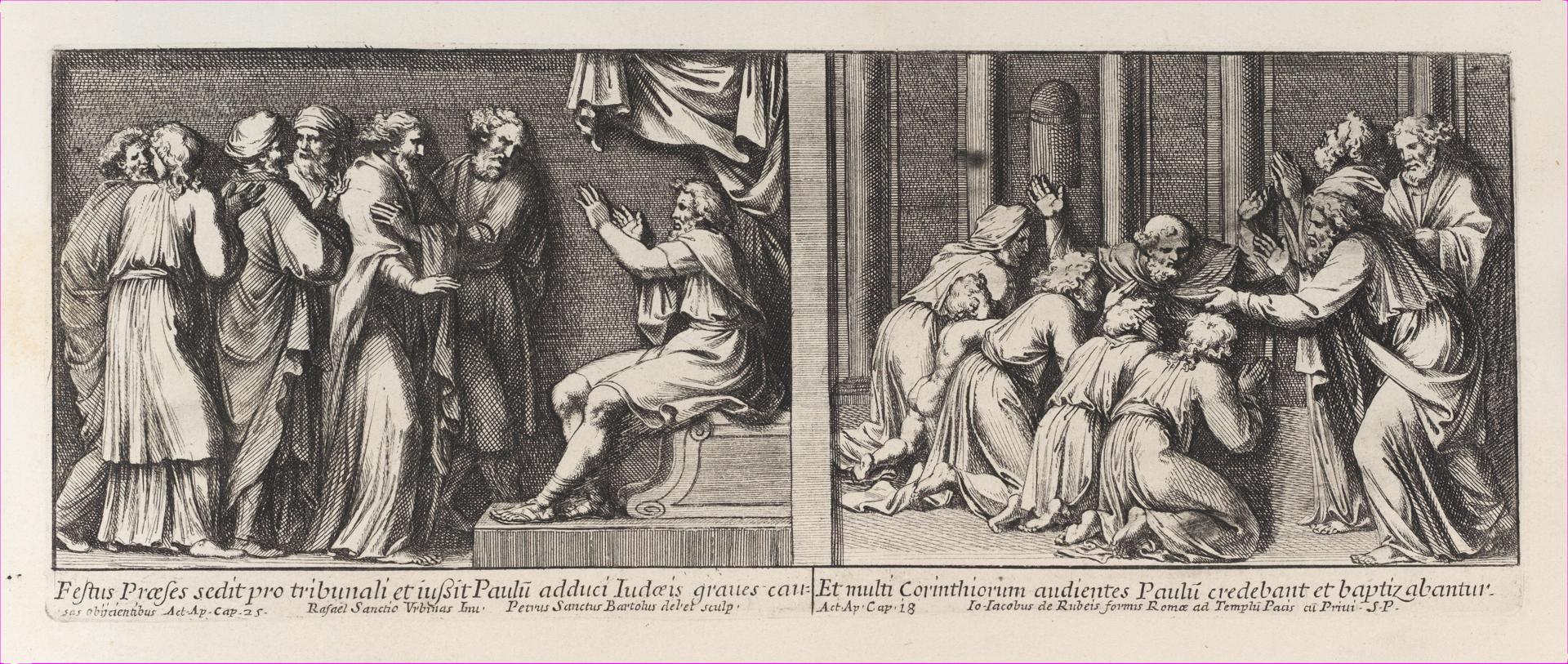
Two Biblical Scenes: Festus judging Saint Paul at left and Saint Paul Baptizing the Christians of Corinth at right, from a series of 15 plates depicting Raphael's works for the Vatican stanze and the Sistine Chapel tapestries
Original title: Two Biblical Scenes: Festus judging Saint Paul at left and Saint Paul Baptizing the Christians of Corinth at right, from a series of 15 plates depicting Raphael's works for the Vatican stanze and the Sistine Chapel tapestries
kurzbeschreibung
Pietro Santi Bartoli made this print between 1650 and 1670, bringing together two biblical scenes: on the left, Festus pronounces judgment on Paul, and on the right, Paul baptizes the Christians of Corinth. The etching belongs to a series of 15 plates in which Bartoli reproduced Raphael's work for the Vatican Stanze and the tapestries of the Sistine Chapel.
Description
The two scenes sit side by side across the width of the sheet. In the left half Festus has taken his seat on a judge's chair while Paul stands before him; on the right, Paul pours baptismal water for a group of Corinthian Christians. The figures' garments follow biblical tradition, and columns and curtains structure the architectural settings. Each half places its main figures near the middle, giving the layout a balanced feel. The etching stays monochrome, with light and dark built from hatching and from the contrasts between figures and space.
Context
Bartoli cut the plate for a series that copied Raphael's frescoes in the Vatican Stanze and his designs for the Sistine Chapel tapestries. In the seventeenth century, reproductive prints like these were an important way of spreading artworks beyond the places where they were kept. Bartoli was known as a careful engraver who recorded Renaissance works down to their details.
Impact
Clean lines and evenly distributed figures give the sheet a calm, dignified character. The biblical scenes, rendered in the visual language of the Renaissance, feel solemn and instructive, and viewers are encouraged to look closely at the details.
Technique
In etching, lines are bitten into a metal plate with acid, which allows fine hatching and crisp contours and so makes it possible to render light and shadow. The plate measures 10.5 × 27 cm, and the print sits on a sheet of 11.6 × 28.8 cm.
AI-generated description text
Source: Metropolitan Museum of Art · Public Domain (CC0 1.0)