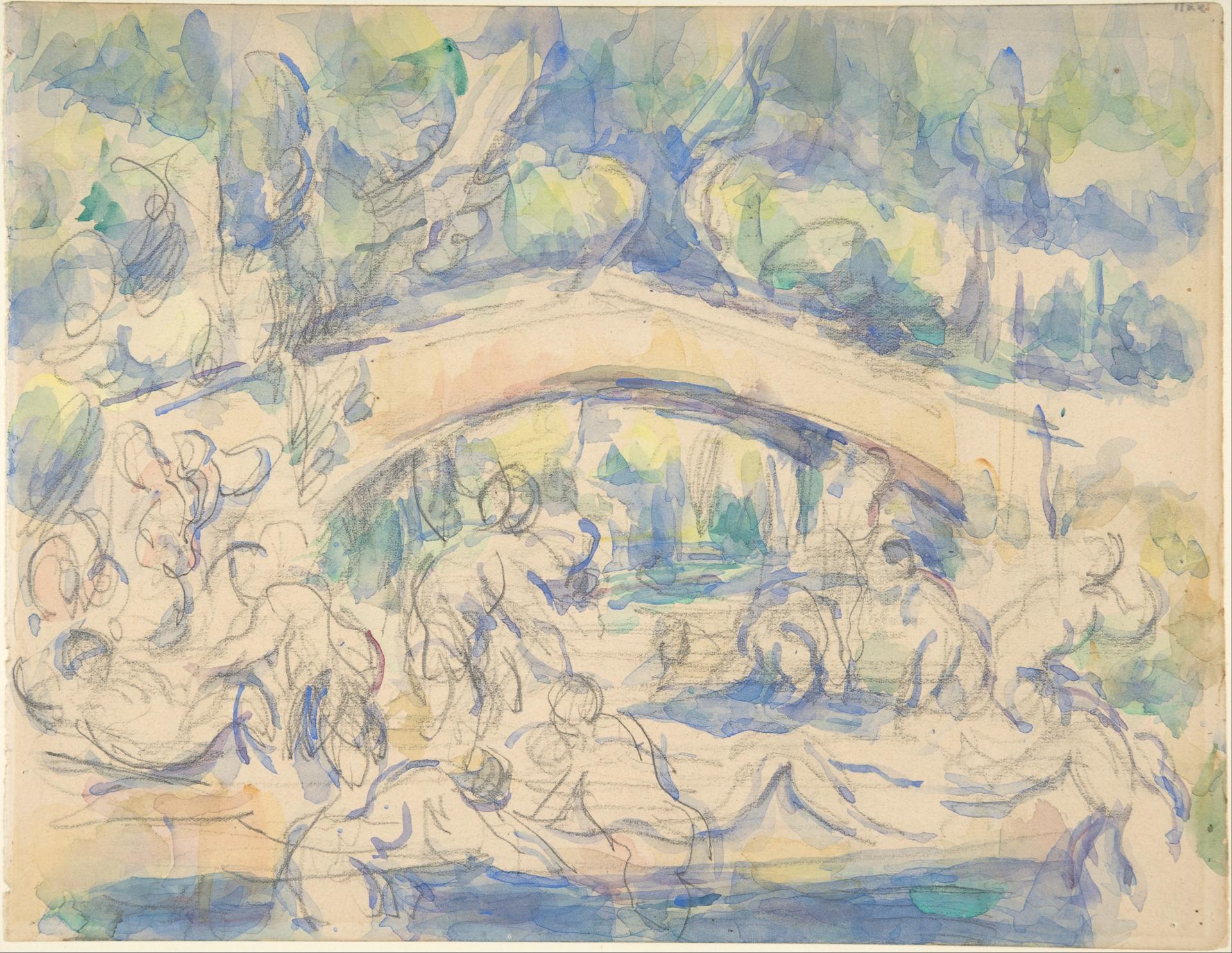
Bathers Under a Bridge (recto); Study after Houdon's Ecorché (verso)
Original title: Bathers Under a Bridge (recto); Study after Houdon's Ecorché (verso)
kurzbeschreibung
Between 1900 and 1906 Paul Cézanne made the watercolour over graphite titled Badende unter einer Brücke. Bathers appear beneath a bridge arch, surrounded by trees and bushes. On the verso is a graphite study after Houdon's Écorché, dated 1894–98.
Description
A bridge canopy spans the upper part of the sheet, giving the arrangement a firm frame. Below it, in the lower half, the contours of figures can be made out, evidently in the water. Blues and greens dominate, flowing into one another in a manner recalling Impressionist painting. The colours stay softly bounded, producing movement and uncertainty. Schematically rendered trees or shrubs enclose the scene at the edges.
Context
Cézanne made this sheet in his final years, when he repeatedly took up the motif of bathers. The verso, with its study after Houdon's Écorché, points to his ongoing interest in anatomical studies that fed into his figure depictions. The work was made in Aix-en-Provence, where Cézanne lived and worked permanently from 1899.
Impact
The flowing watercolour washes and open contours give the image something hovering, almost dreamlike. Because the palette remains reduced and transitions are soft, a calm, meditative mood sets in. At the same time the view stays deliberately vague and ambiguous through its abstracted forms.
Technique
On the recto, graphite drawing meets watercolour: the graphite lines give the arrangement support, while the watercolour areas provide colour and depth. The verso shows only a graphite drawing, which captures the anatomical details of the Écorché with fine strokes. The sheet measures 21 x 27.2 centimetres and belongs to a series of study sheets.
AI-generated description text
Source: Metropolitan Museum of Art · Public Domain (CC0 1.0)