Calumny after Raphael
Original title: Calumny after Raphael
kurzbeschreibung
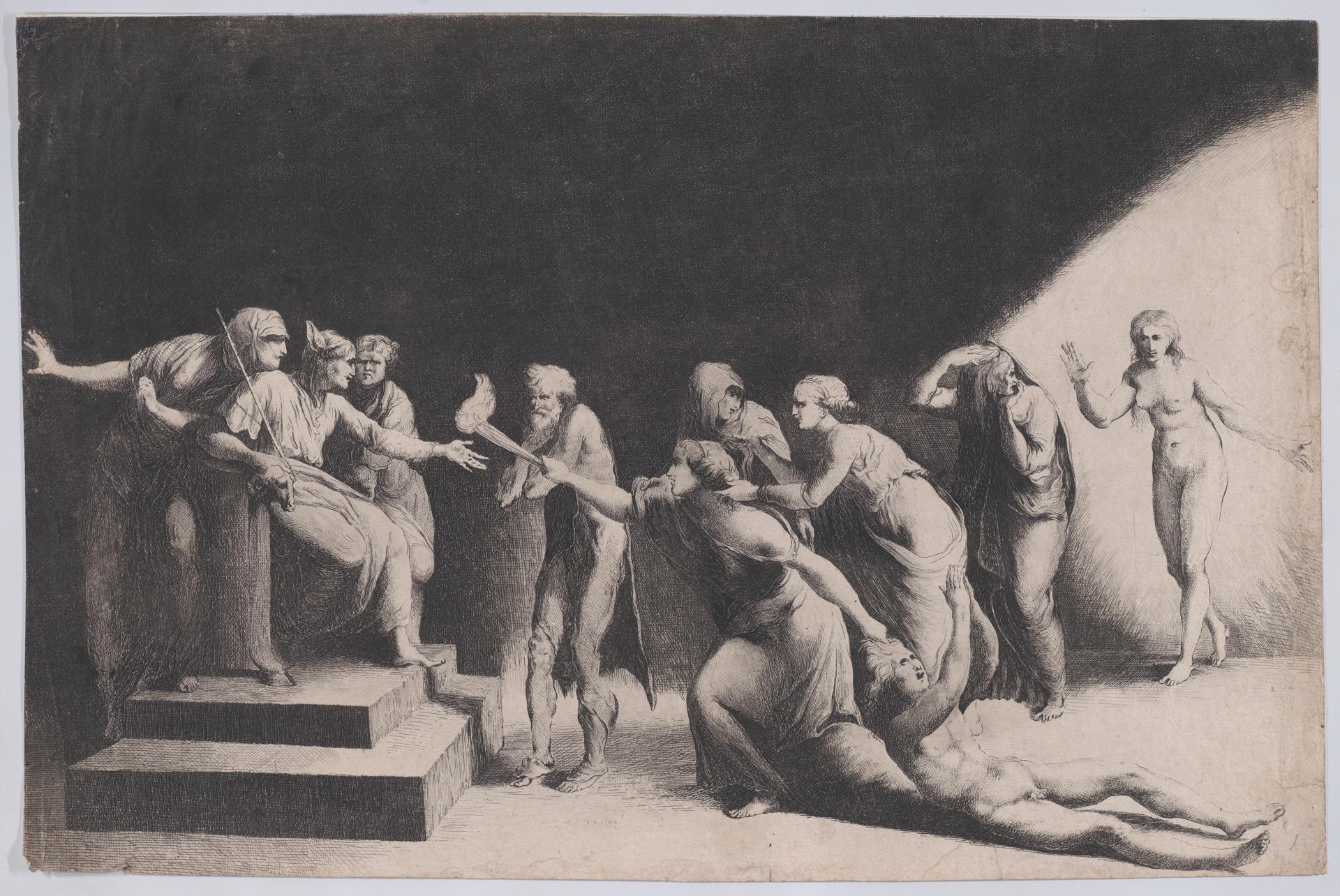
Aquatint and engraving carry the dense figure group that Baron Dominique Vivant Denon worked after Raphael's famous fresco. This impression shows the third of three states. The motif takes up the ancient allegory of calumny: a figure lying on the ground is pressed upon by those standing around.
Description
The figures are distributed asymmetrically across the image field, yet all gazes converge on the one lying on the ground. Several of them carry burning rods, a sign of persecution or open quarrel. From the background rises an upright figure whose posture sets them apart from the rest. Traditional garments surround the bodies; the monochrome gray palette sharpens contours and shadows. Light falls from the upper left and heightens the drama of the expressive faces and gestures.
Context
The source was Raphael's fresco "The Calumny of Apelles" in the Vatican, which in turn goes back to an account by Lucian. Denon, director of the Louvre and active as a printmaker, reproduced numerous works by old masters. Exactly when this sheet was made is unknown; Denon was active in the late eighteenth and early nineteenth centuries. The etching made Raphael's pictorial structure accessible to a wider public.
Impact
Gloomy monochrome and targeted lighting create an intense, menacing mood. The expression of the figures and the arrangement directed at the victim on the ground draw the eye together. Through the technique the sheet gains a painterly quality that carries the drama of the event.
Technique
Aquatint and engraving are combined here; this yields a fine gradation of gray tones and a soft, tonal effect. Flat shading comes from the aquatint, precise lines and contours from the engraving. Printing was done on paper; the third state indicates a reworking of the plate.
AI-generated description text
Source: Metropolitan Museum of Art · Public Domain (CC0 1.0)