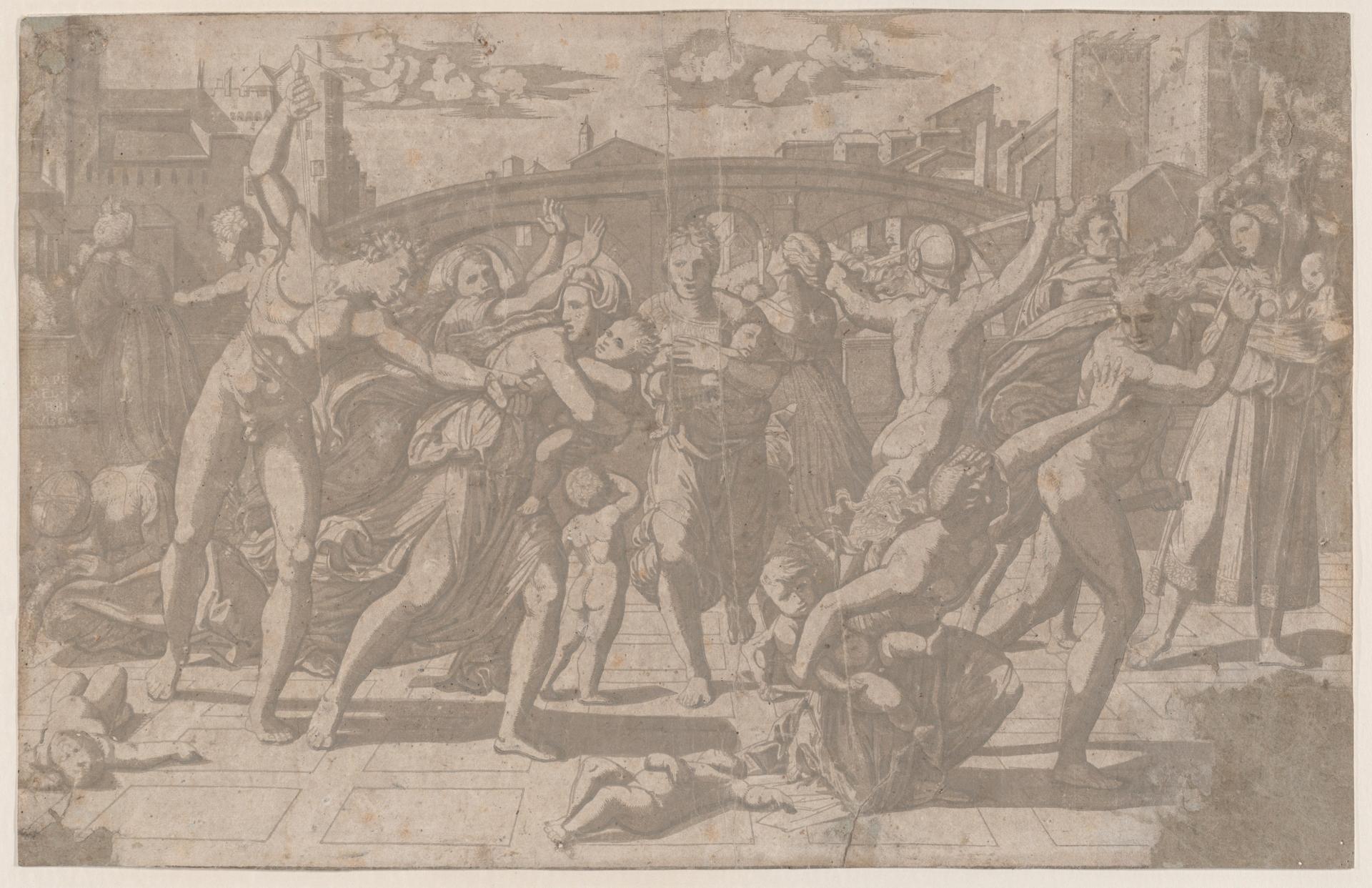
The Massacre of the Innocents (ca. 1520–27)
Original title: The Massacre of the Innocents
kurzbeschreibung
A barefoot man turns away, one of the first figures the eye catches in this chiaroscuro woodcut by Ugo da Carpi. Made around 1520–27, the print takes up the biblical Massacre of the Innocents at Bethlehem and packs it with a dense crowd of people.
Description
Barefoot figures push forward, others tumble to the ground, and still others are clothed and carry weapons or tools. Above the throng rise buildings and a bridge, while bodies lying at the lower edge point to the violence. The tone is mostly in shades of gray, and light falling from above traces contours and makes the violent movements visible. In the figures and the dynamism, Michelangelo's influence is evident.
Context
Ugo da Carpi worked in the sixteenth century as an Italian printmaker and became known above all for his chiaroscuro woodcuts. This sheet falls in the High Renaissance, an era shaped by artists such as Raphael and Michelangelo. The multicolored woodcut is considered Ugo da Carpi's invention, which he introduced in Italy and to which this work also belongs.
Impact
From the chaotic movement and the alternation of light and dark arises an oppressive mood. The large format gives the figures weight, and the dramatic lighting lends the whole something theatrical.
Technique
The sheet was printed as a chiaroscuro woodcut from three blocks in brown tones. This method allows fine gradations between light and shadow and comes close to a drawing. The blocks were used one after another to achieve the tonal effect.
AI-generated description text
Source: Metropolitan Museum of Art · Public Domain (CC0 1.0)