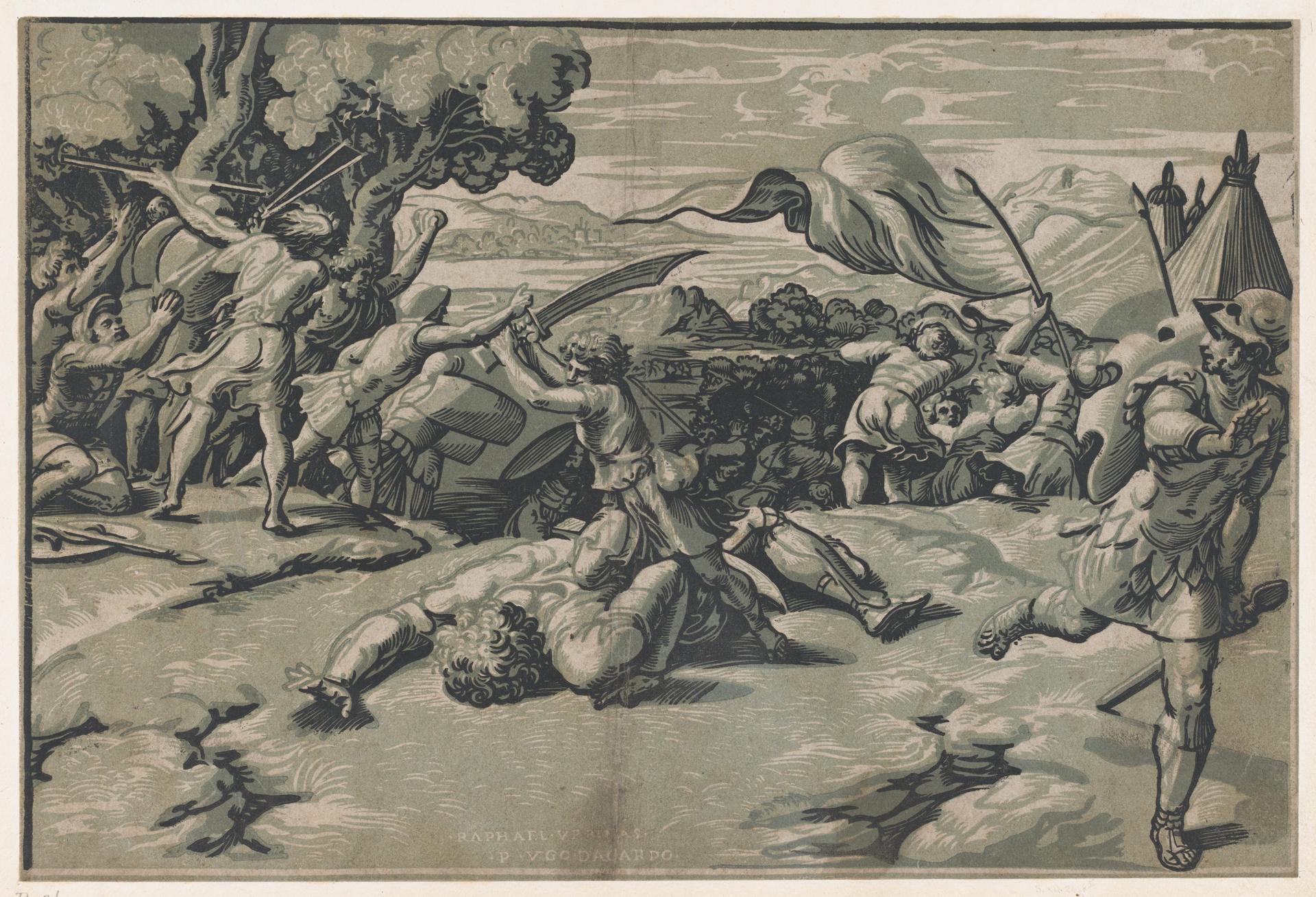
David and Goliath (ca. 1520–27, Met-Objekt 5993)
Original title: David and Goliath
kurzbeschreibung
Ugo da Carpi made this chiaroscuro woodcut, David and Goliath, around 1520–27. The sheet presents the biblical victory of David over the giant Goliath as a lively battle scene. It was printed in brown from three blocks and measures 26 × 38.6 cm.
Description
Goliath lies motionless on the ground in the foreground, while David stands above him, looking off into the distance in triumph. David carries a shield and sword; Goliath appears in armor and helmet. Behind the pair, other fighters can be made out, some falling, others still in combat. Trees and mountains close off the landscape. Grays and the contrast between the figures and their surroundings shape the play of light.
Context
Ugo da Carpi, an Italian printmaker, introduced the chiaroscuro woodcut to Italy around 1516. This sheet dates from the High Renaissance, a period when biblical subjects appeared often in printmaking. The scene follows the account in the first book of Samuel; David's victory was read as a moral example. The print belongs to a series Carpi made after designs by Raphael or his school.
Impact
The scene feels dramatic through David's larger-than-life gesture and its contrast with Goliath's body on the ground. Light and dark contrasts give the image sculptural depth and draw the eye toward the protagonist's triumph.
Technique
This work is a chiaroscuro woodcut printed from three blocks in shades of brown. Tone blocks produce effects of light and shadow in printing. The result has a painterly quality that recalls a drawing with wash.
AI-generated description text
Source: Metropolitan Museum of Art · Public Domain (CC0 1.0)