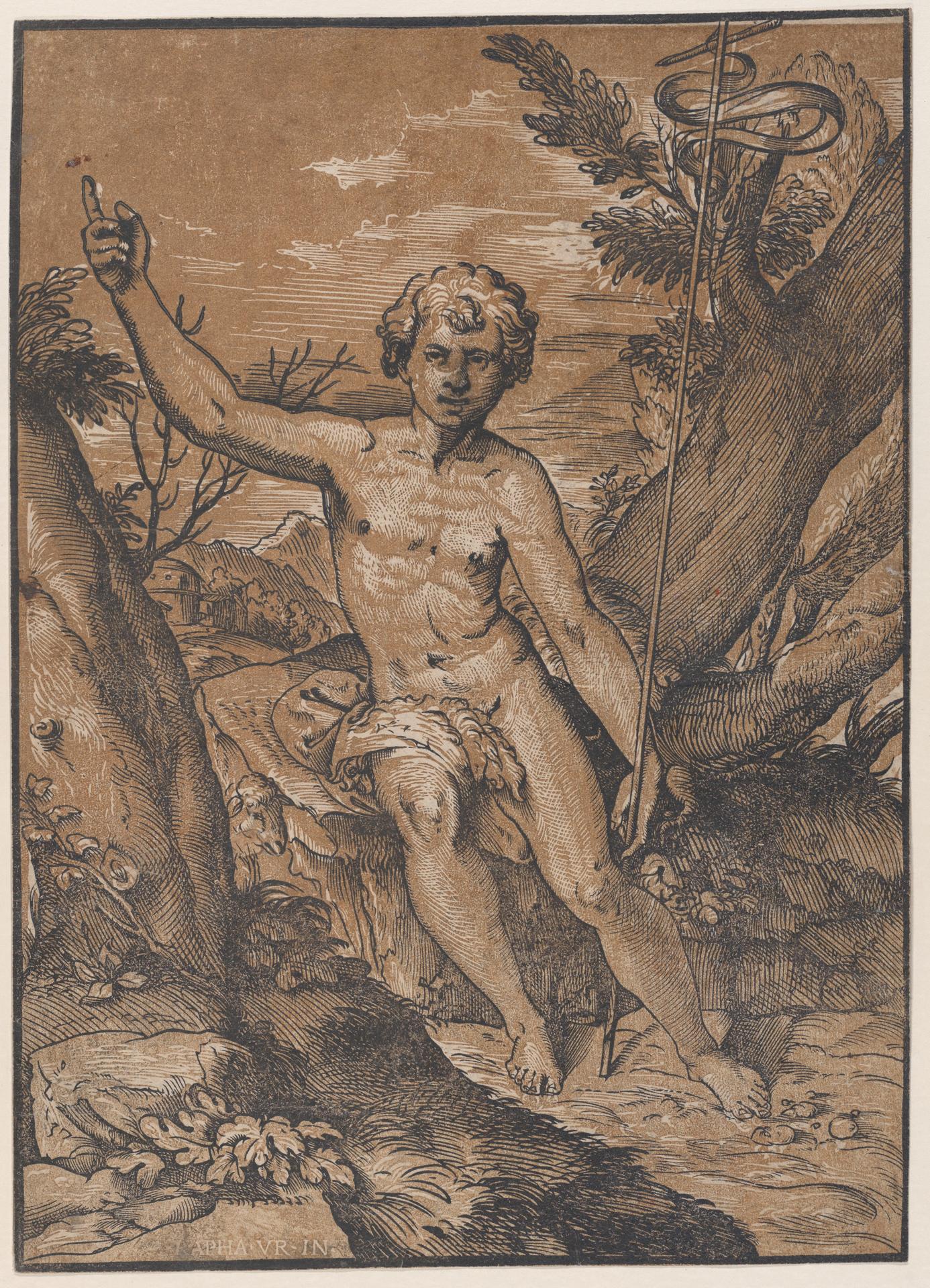
The young Saint John the Baptist in the wilderness
Original title: The young Saint John the Baptist in the wilderness
kurzbeschreibung
Where many contemporary depictions of the Baptist soften him into a preacher among crowds, this print leans into the austerity of the wilderness. Ugo da Carpi made the image around 1520–27 as a chiaroscuro woodcut. John stands naked but for a loincloth, a lance in his right hand, his left pointing upward.
Description
John occupies the foreground, bare except for the cloth at his hips, his expression grave and thoughtful. His right hand closes around the lance, the left gestures skyward. At his feet lies a sword whose hilt is formed as a snake. Trees, rocks and a cloud-filled sky fill the distance. Light falling from above picks out the contours of the body and its surroundings. Color stays monochrome, worked out in various shades of gray.
Context
Ugo da Carpi brought the chiaroscuro woodcut to prominence in Italy. The sheet belongs to the High Renaissance, a moment when artists pushed the rendering of the human body and of nature toward completion. John the Baptist was understood as a penitent in the desert, a reference to his ascetic way of life. Chiaroscuro woodcut made it possible to build tonal values and effects of light that recall painting.
Impact
The gray tones give the sheet a quiet, almost meditative mood. Clean lines and deliberate lighting draw the eye to John and underscore his seriousness.
Technique
Two woodblocks went into the printing: a tone block for the grays and a line block for the contours. This allowed fine transitions between light and dark. Printing in brown on paper accounts for the warm monochrome.
AI-generated description text
Source: Metropolitan Museum of Art · Public Domain (CC0 1.0)