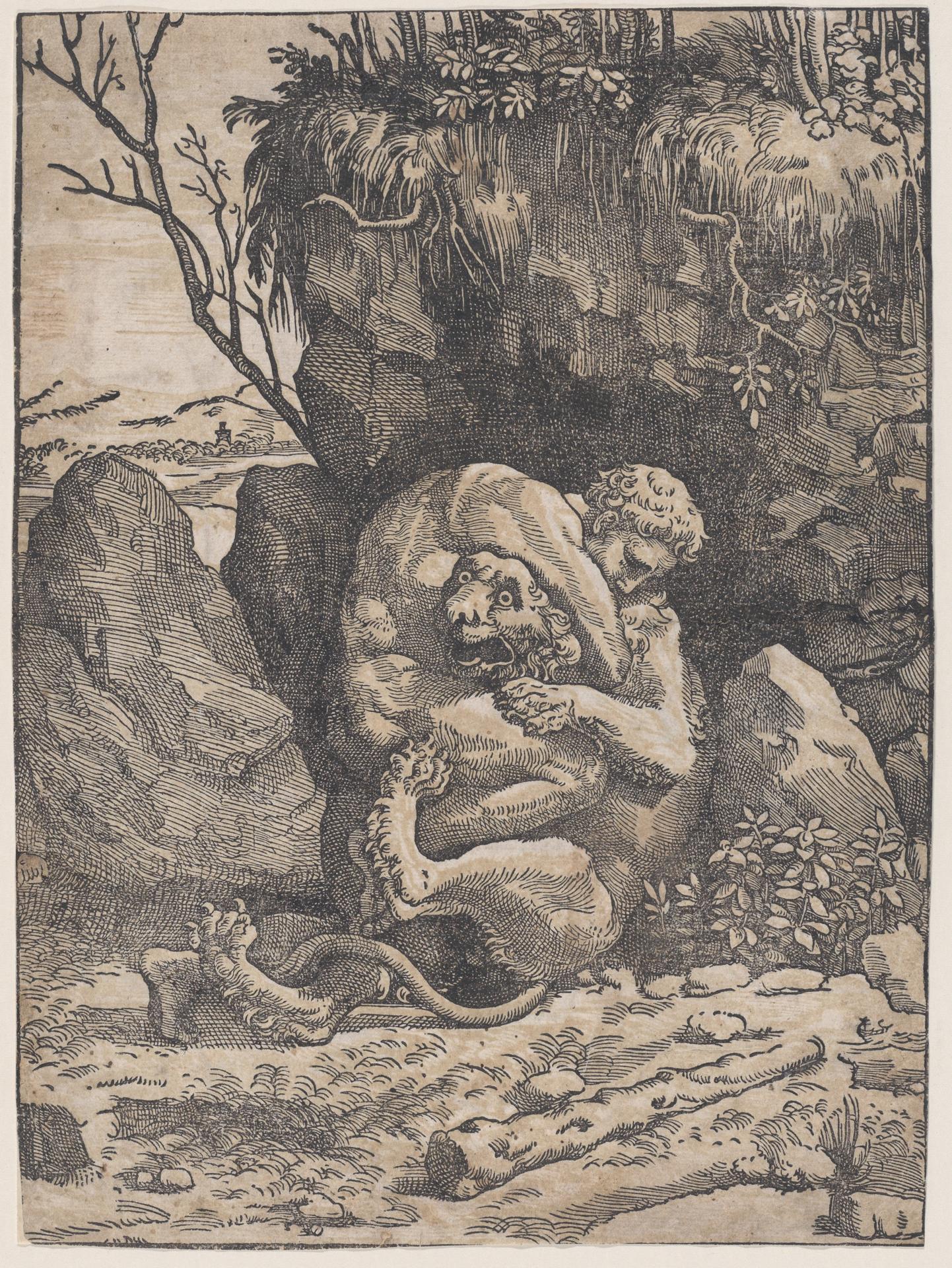
Hercules and the Nemean Lion (ca. 1517–18)
Original title: Hercules and the Nemean Lion
kurzbeschreibung
Around 1517–18, Ugo da Carpi produced a chiaroscuro woodcut depicting Hercules’ fight with the Nemean lion. Printed from two woodblocks in pale green, the sheet measures 29.8 × 21.8 cm.
Description
Hercules stands over the lion, which has been forced to the ground, and wrestles it into submission. Rocky formations and foliage place the event in a natural setting. The execution is detailed: skin, fur, and stone each assert their particular texture. Light and dark are deliberately distributed to heighten physical presence and tension. Sharp contours and hard contrasts define the style, characteristic of the Renaissance.
Context
Ugo da Carpi, an Italian Renaissance artist, became known for his chiaroscuro woodcuts. This printing method emerged in early sixteenth-century Italy and made it possible to create tonal transitions with multiple woodblocks. The sheet appeared in an era when printmaking played a major role in spreading art. The Hercules myth enjoyed great popularity in the Renaissance and stood for virtue and strength.
Impact
The strong contrast of light and dark gives the print a dramatic, animated presence that emphasizes the force of the struggle. The green coloring makes the view feel calm and almost atmospheric, placing the action within a natural environment.
Technique
Two woodblocks were used for the chiaroscuro woodcut: one for the outlines, another for the tonal values in pale green. In this way, fine gradations and a painterly effect could be achieved that go beyond pure line woodcut. Working with two blocks corresponded to the early development phase of chiaroscuro woodcut in Italy.
AI-generated description text
Source: Metropolitan Museum of Art · Public Domain (CC0 1.0)