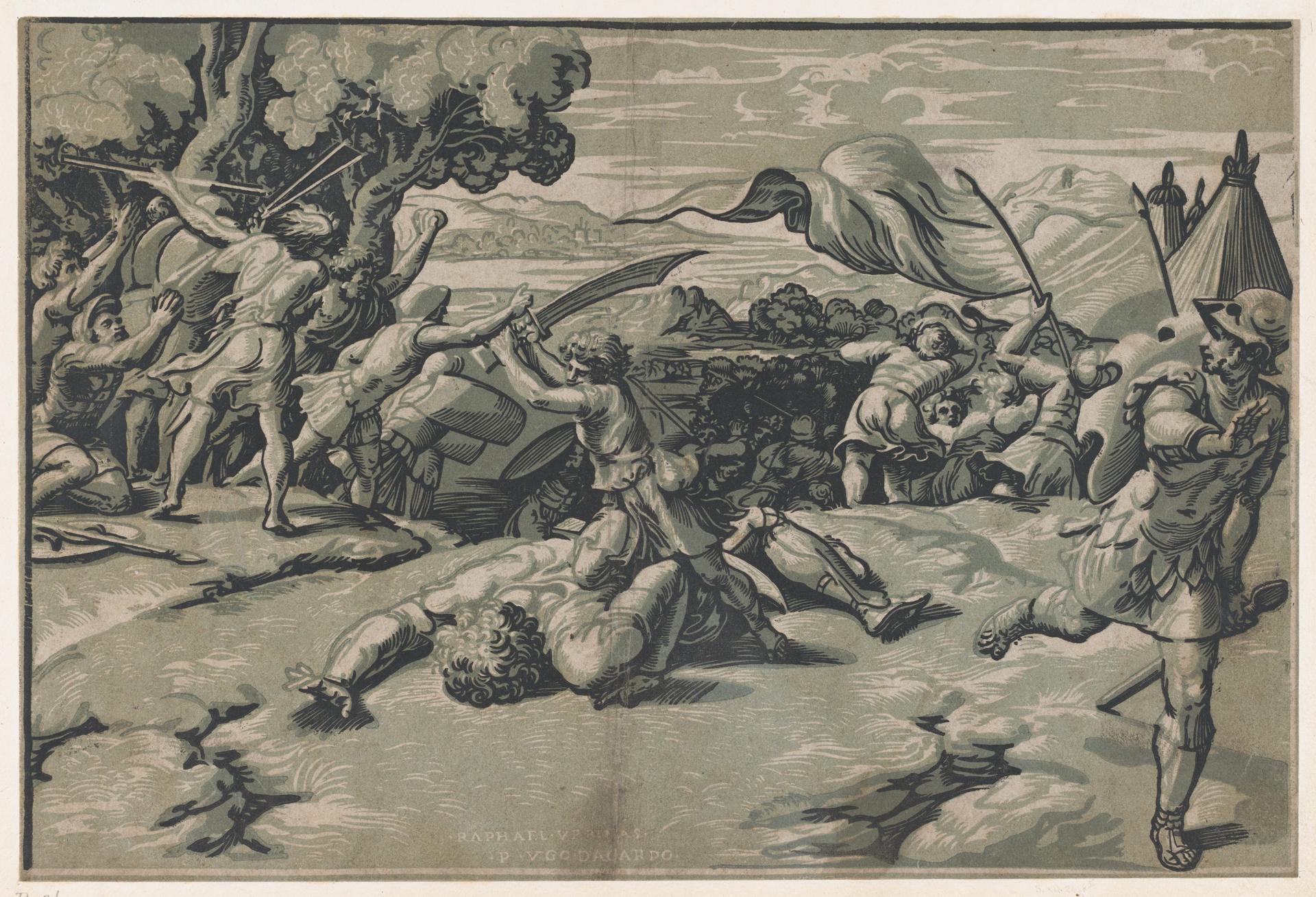
David and Goliath (ca. 1520–27, Met-Objekt 5983)
Original title: David and Goliath
kurzbeschreibung
Unlike many contemporary treatments of the biblical duel, this chiaroscuro woodcut by Ugo da Carpi does not dwell on the moment before the throw but on the instant after Goliath has fallen. Made around 1520–27, the sheet presents the confrontation between David and Goliath within a restless pictorial structure that draws in several figures behind them.
Description
Goliath lies motionless on the ground in the foreground, while David stands over him holding a spear, a shield on his back. Behind them appear several soldiers: some fighting, others with mouths open or in the act of falling. The setting is an open landscape with trees and mountains. The colouring remains monochrome in various shades of grey, and the light is evenly distributed.
Context
Ugo da Carpi, an Italian woodcutter, is regarded as a pioneer of the chiaroscuro technique. This work was made in the High Renaissance, when biblical subjects were often taken up in the visual arts. Carpi was active in Venice and Rome; the printing blocks for this sheet were also produced there.
Impact
The layout directs the eye to the two main figures, while the surrounding shapes bring unease into the event. The restriction to a monochrome palette and the clear linework create a tension that still preserves a certain calm—a trait characteristic of Renaissance printmaking.
Technique
The sheet was printed as a chiaroscuro woodcut from three blocks in green. By overprinting the plates, tonal values and shading could be graduated. The result is a finely differentiated monochrome print of high detail.
AI-generated description text
Source: Metropolitan Museum of Art · Public Domain (CC0 1.0)