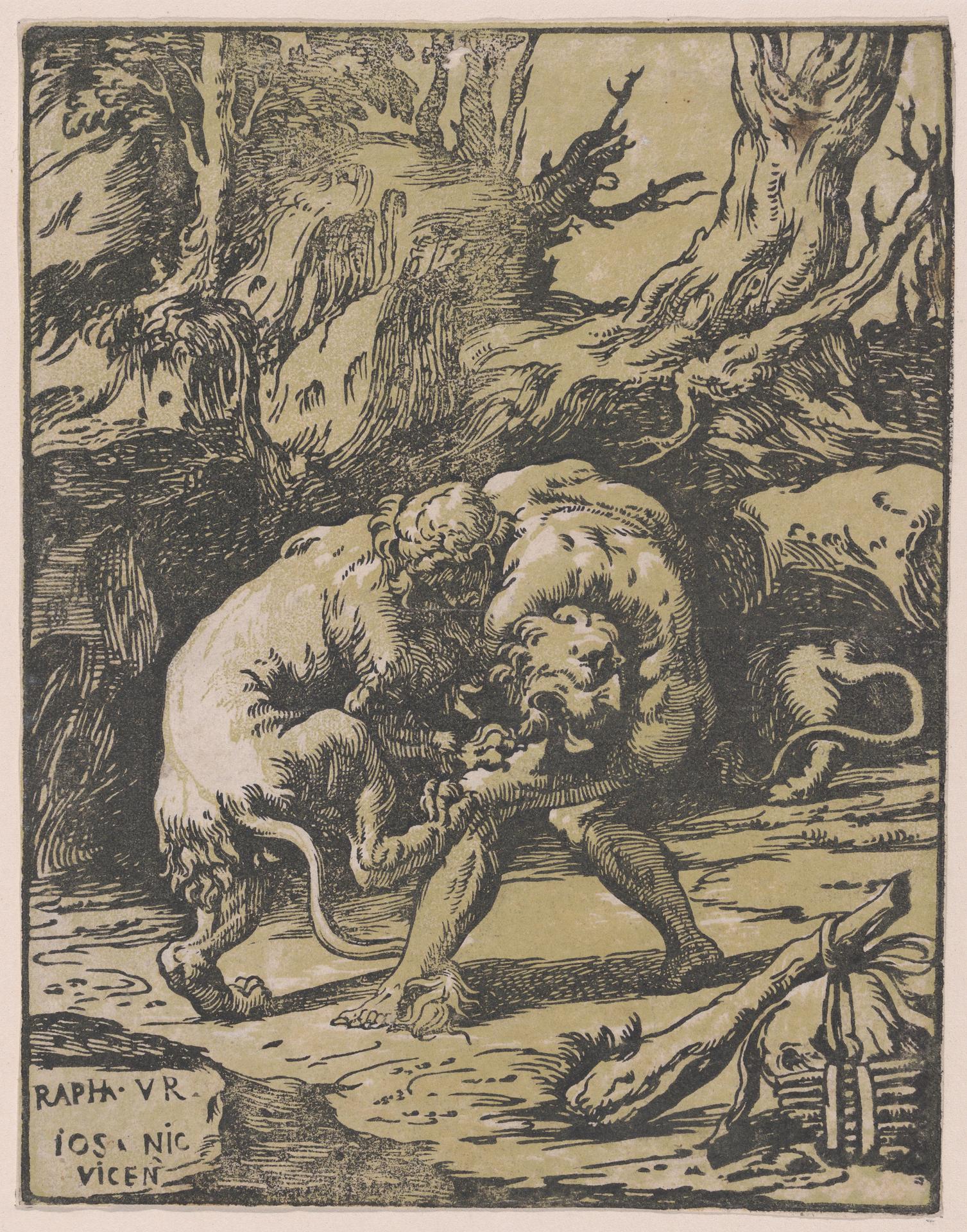
Hercules and the Nemean Lion (1540–50, Met-Objekt 5982)
Original title: Hercules and the Nemean Lion
kurzbeschreibung
Hercules wrestles the Nemean lion in this chiaroscuro woodcut by Niccolò Vicentino, made around 1540–50. Taken from Greek myth, the image was printed from two blocks in green (state ii), which gives it a striking sense of depth.
Description
In the foreground Hercules grips the massive, sinewy lion, whose thick mane and sharp teeth stand out clearly. One arm wraps around the beast, the other forces it back. Trees and rocks suggest a wild natural setting behind them. Strong light-dark contrasts define the sheet and are characteristic of the chiaroscuro technique. At the lower left are the initials 'Raphael VR' and 'Ios. Nic Vicen'.
Context
Niccolò Vicentino, a sixteenth-century Italian woodcutter, was known for his chiaroscuro woodcuts and often worked from designs by Raphael—the initials 'Raphael VR' in the image point to this. The work was made in the Renaissance, when mythological subjects were frequently taken up in art. Printing with two blocks to achieve the light-and-dark effect was a technique introduced in Italy by Ugo da Carpi around 1516.
Impact
The sharp contrasts between light and shadow create a dramatic, almost stage-like mood that heightens the struggle between Hercules and the lion. The detailed linework and greenish tone give the sheet a noble, quiet elegance that draws the viewer into the action.
Technique
This chiaroscuro woodcut was printed from two blocks: a tone block for the areas of color and a line block for the contours. The green version is typical of the second printing stage, which offers a variant in color. At 25 × 19 cm, the paper format is compact and suited to intimate viewing.
AI-generated description text
Source: Metropolitan Museum of Art · Public Domain (CC0 1.0)