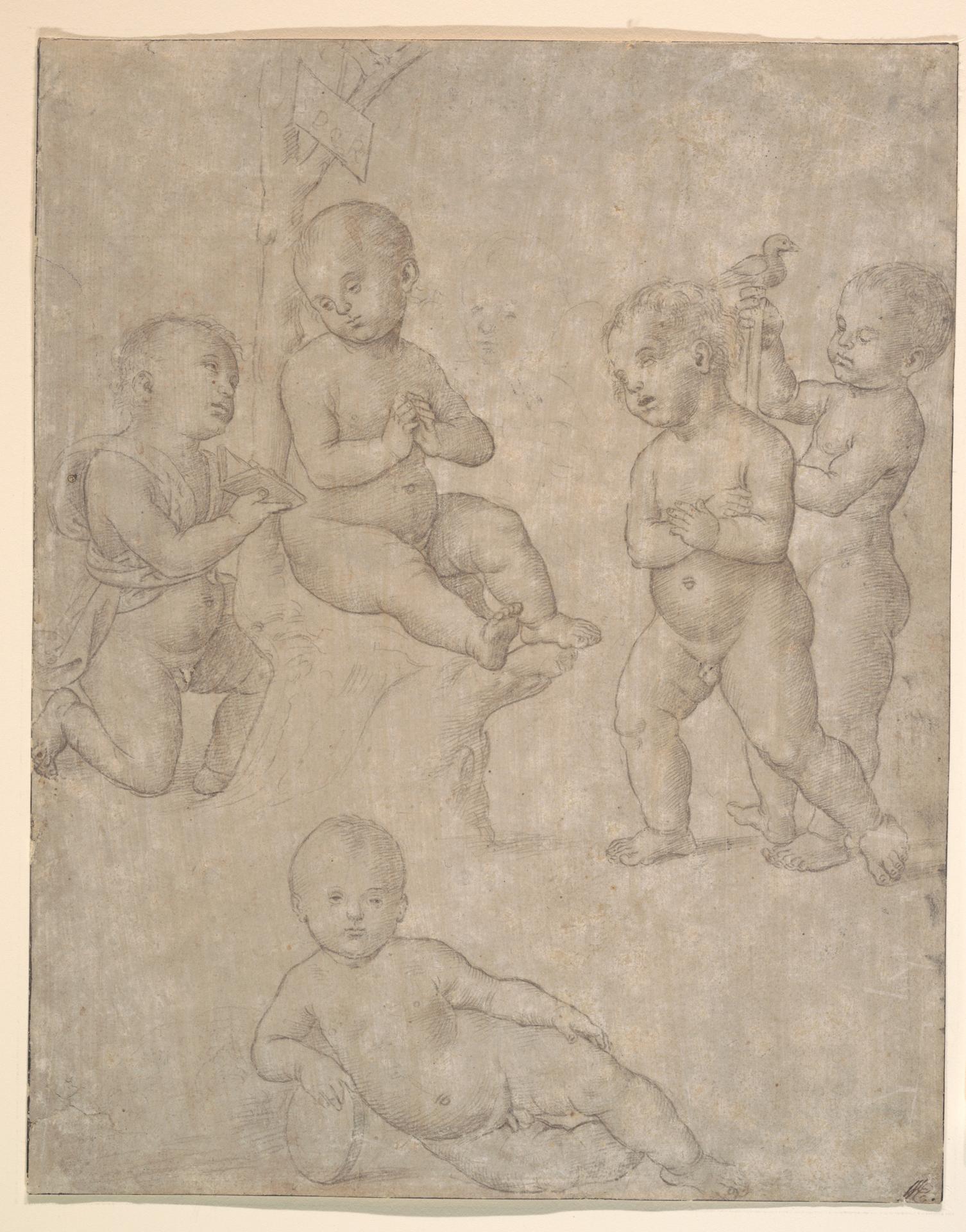
Five Nude Infants in Various Poses
Original title: Five Nude Infants in Various Poses
kurzbeschreibung
Around 1500, Raphael (Raffaello Sanzio) drew five naked children in various poses. The sheet measures 23.8 x 18.9 cm and is executed in metalpoint with traces of charcoal or black chalk on pale pinkish gray prepared paper. This study shows how early the artist engaged with the human figure and its movement.
Description
Two children sit, one climbs onto a kind of seat, another stands with a small bird on its head, one kneels holding something in its hand, and one lies on its back. The figures are distributed in an implied space created by their positions and light shading. Gray and beige dominate the color effect, due to the metalpoint technique and the remnants of charcoal. The light falls evenly, without strong shadows or bright highlights.
Context
Around 1500, Raphael was about 17 years old and working in the workshop of Pietro Perugino in Umbria. Studies from the live model, often with children or young assistants, were a standard part of artistic training at the time. Such sheets served as preparatory studies for larger paintings or as independent exercises to capture movement and proportions.
Impact
The thin metalpoint lines give the drawing something delicate, almost fragile, which emphasizes the carefree childishness of the motifs. The multitude of poses creates a lively, animated whole that remains calm and balanced thanks to the even lighting.
Technique
The drawing was executed in metalpoint on pale pinkish gray prepared paper, which allows fine, precise lines. Traces of charcoal or black chalk suggest a preliminary sketch that was reworked with the metal stylus. In the Italian Renaissance, this combination was common for capturing both the underdrawing and the final contours.
AI-generated description text
Source: Metropolitan Museum of Art · Public Domain (CC0 1.0)