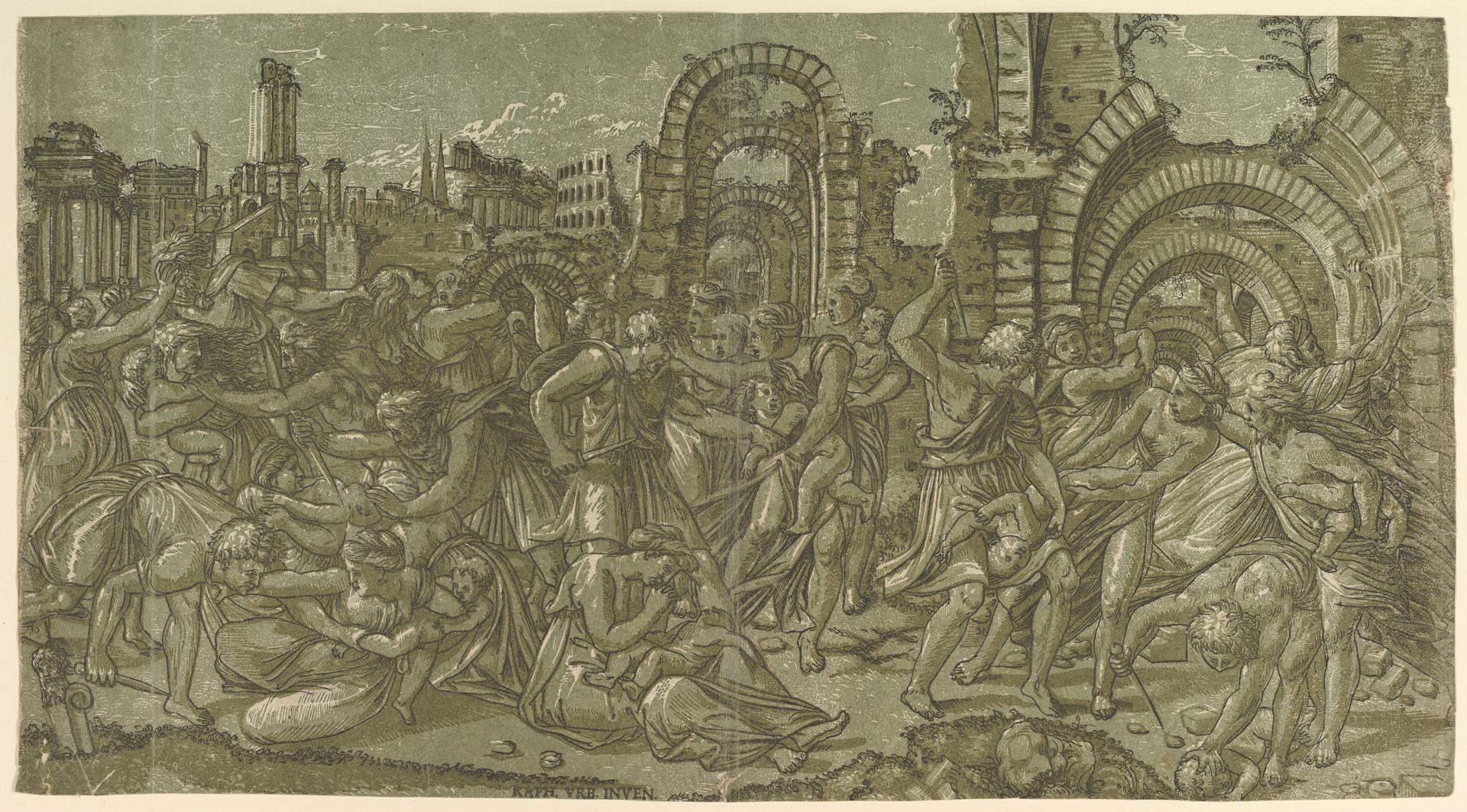
Massacre of the Innocents (ca. 1544, Met-Objekt 5967)
Original title: Massacre of the Innocents
kurzbeschreibung
Unlike many contemporary versions of the biblical Massacre of the Innocents, this chiaroscuro woodcut by Master ND (around 1544) uses an unusual green palette. The print presents the bloody scene at Bethlehem with a dense crowd of figures in violent motion. It was printed from three blocks in green, dark green, and black; the dimensions are 28 x 51.2 cm.
Description
A swarm of bodies defines the image: some lie fallen on the ground, others are caught in the act of dodging or seizing, suggesting a violent event. Ruins and buildings in the background hint at a devastated city. The clothing of the figures points to a historical period. Shades of green dominate, their gradations created by the chiaroscuro, heightening the drama.
Context
Little is known about Master ND; his work is assigned to the Renaissance, an era when chiaroscuro woodcut was widespread in Italy and Germany. The Massacre of the Innocents was a common subject in the 16th century, often used to visualize violence and suffering. Three separate blocks for green, dark green, and black attest to the technical skill of printmaking at the time. The sheet was probably created in an environment shaped by religious and humanist ideas.
Impact
The green palette, together with strong light-dark contrasts, creates a gloomy, menacing mood that emphasizes the brutality of the subject. The dynamic arrangement of figures draws the eye into the midst of the action and triggers an immediate emotional response. The ruins in the background make destruction and transience palpable.
Technique
This chiaroscuro woodcut employed three separate woodblocks to print green, dark green, and black. This allowed for tonal gradations and light effects reminiscent of a brush drawing. Printing on paper was done in multiple layers, with each block needing exact alignment to produce a coherent image.
AI-generated description text
Source: Metropolitan Museum of Art · Public Domain (CC0 1.0)