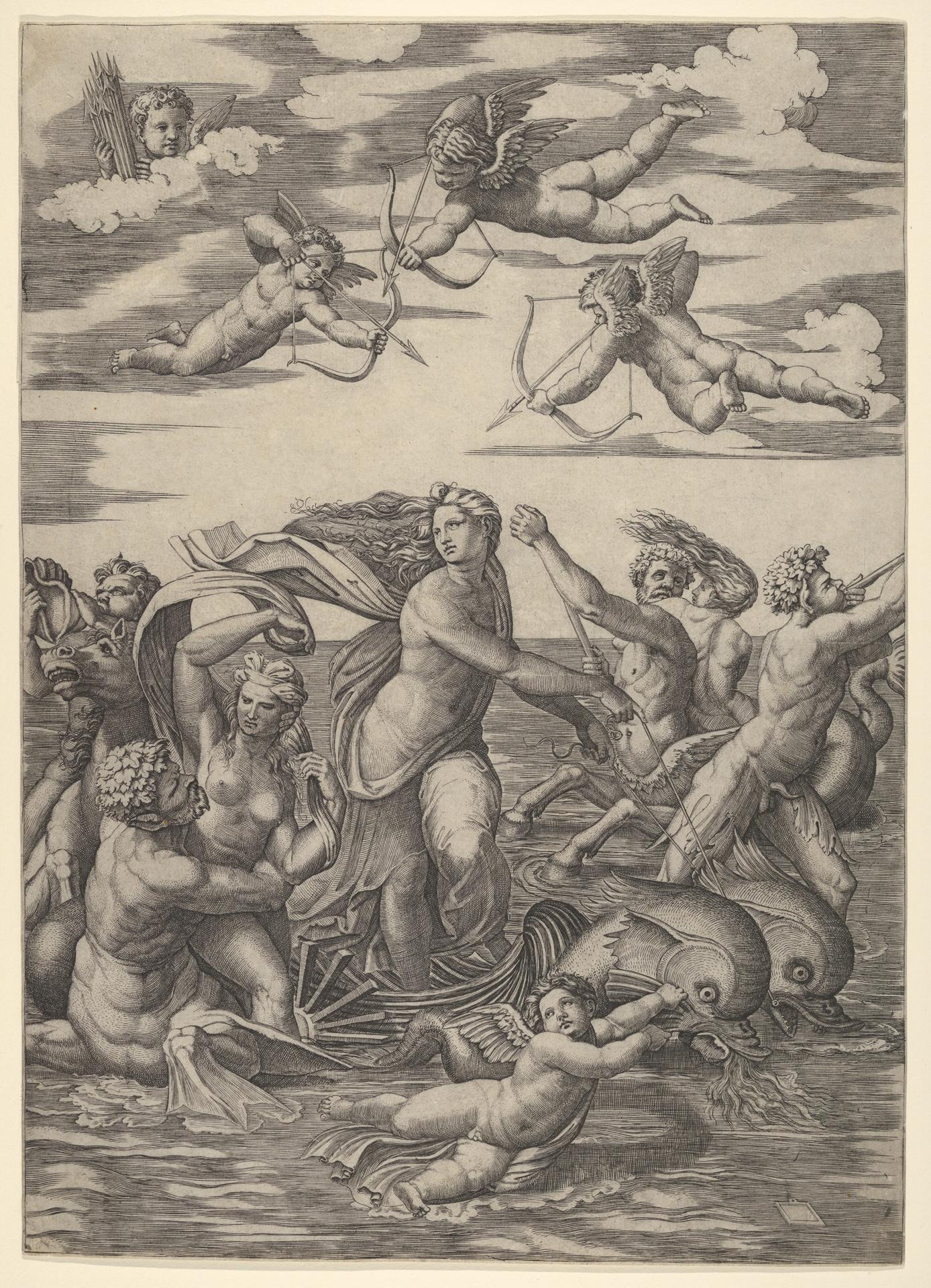
Galatea in a Water-Chariot Pulled by Two Dolphins, Surrounded by Tritons, Nereids, and Putti
Original title: Galatea standing in a water-chariot pulled by two dolphins, surrounded by tritons, nereids, and putti, three of which prepare to shoot arrows from above
kurzbeschreibung
Marcantonio Raimondi made this engraving in 1515–16. It presents the sea nymph Galatea riding in a shell-shaped chariot drawn by two dolphins, with Tritons, Nereids and putti gathered around her. The sheet measures 40 x 28.7 cm and is executed as an engraving.
Description
Galatea sits naked at the center, long hair falling over her shoulders, a cloth wrapped around her upper body. She rests on one dolphin while a second pulls the chariot. Tritons and Nereids swarm through the water on every side, some reaching for weapons, others turning toward one another. Above the group hover three naked winged putti with bows and arrows. A cloudlike stretch of sky closes off the top of the image.
Context
The print belongs to the High Renaissance and reflects both the rediscovery of antiquity and Raimondi's work with Raphael, whose designs he often translated into prints. The Galatea motif comes from classical mythology as handed down, for instance, in Ovid's Metamorphoses. Raimondi's prints played an important part in spreading Renaissance art across Europe.
Impact
The crowded ranks of figures and their restless bodies give the sheet great vitality. Mythological narrative and precise linework combine into a monumental, almost theatrical presence.
Technique
Burins cut the lines into a copper plate, which was then printed on paper. That process allows the finest detail and a wide range of tones, clearly visible in the graded hatching of the figures and the setting.
AI-generated description text
Source: Metropolitan Museum of Art · Public Domain (CC0 1.0)