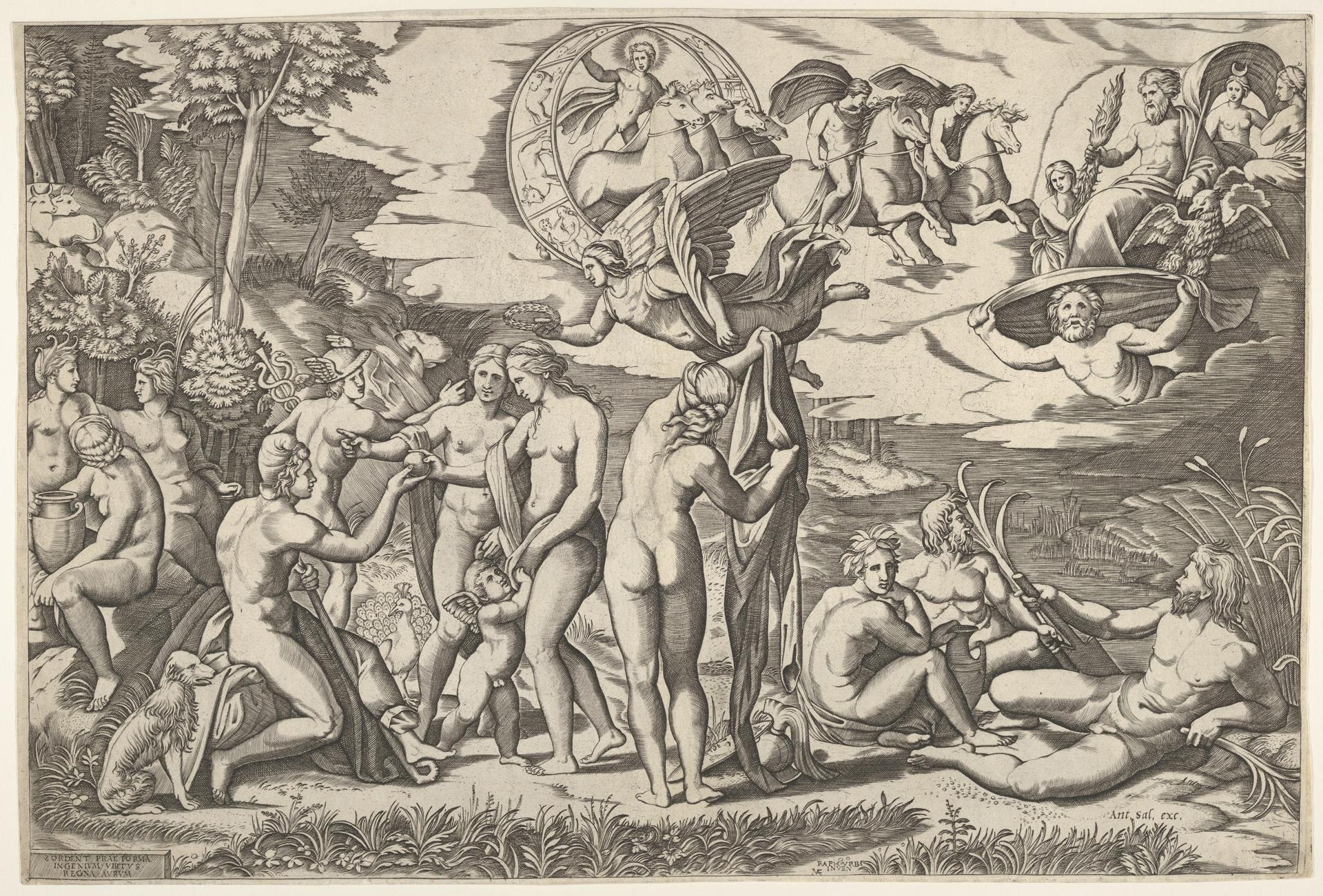
Judgment of Paris (ca. 1520–50)
Original title: Judgment of Paris
kurzbeschreibung
Marcantonio Raimondi made this engraving between roughly 1520 and 1550. It pictures the myth of the Judgment of Paris, in which the Trojan prince must decide which goddess is the fairest. Among Renaissance prints, the sheet counts as an important witness because it carries out a crowded scene with many details.
Description
Aphrodite, Athene and Hestia form the heart of the image; Paris gives his preference to Aphrodite. Paris himself is also present, while Zeus sits behind on a throne and wears a crown. A Pegasus flies through the middle of the picture, and trees and bushes frame the action as landscape. Further figures from the myth are spread through the distance, and in the foreground stand partly clothed persons.
Context
Raimondi, an Italian engraver of the Renaissance, became known above all for his reproductive prints after works by Raphael. The Judgment of Paris belongs to the widespread subjects of ancient mythology that received a new reading in the Renaissance. Its making falls in a phase when printmaking flourished in Italy; artists like him helped to spread classical themes further.
Impact
The symmetrical arrangement and the calm landscape give the sheet a balanced, harmonious character. Delicate lines and graded shading make it look noble and almost painterly, drawing the viewer into the mythological scene.
Technique
The sheet is executed as an engraving, which can be seen in the fine lines and the shading. Raimondi used this technique to achieve precise details and soft transitions, as was typical of his working method. The plate was presumably reworked several times, which the wide date range suggests.
AI-generated description text
Source: Metropolitan Museum of Art · Public Domain (CC0 1.0)