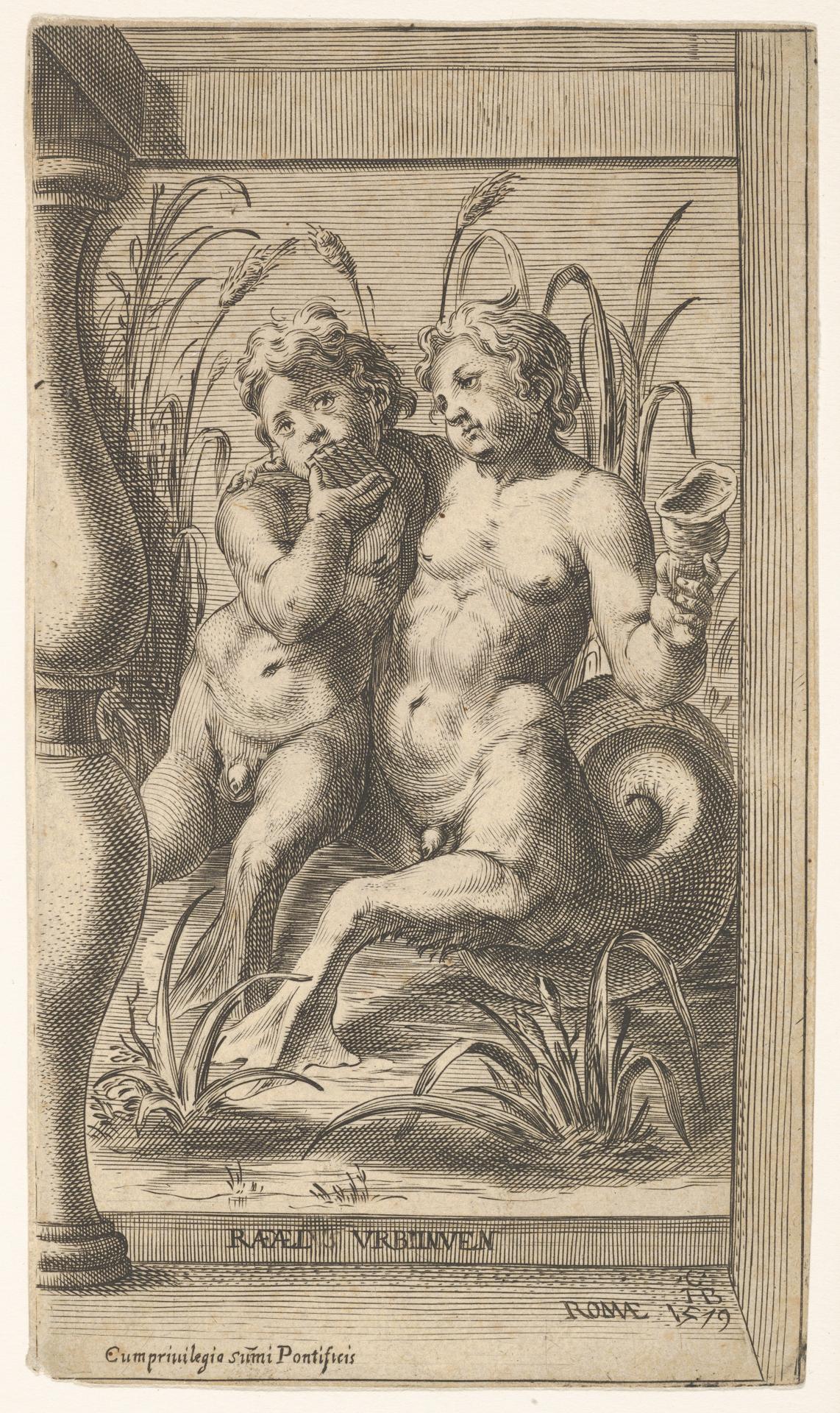
Two Tritons Embracing, One Playing a Panpipe, the Second Holding a Conch Shell Set Within a Recessed Space
Original title: Two tritons embracing, one playing a panpipe, the second holding a conch shell set within a recessed space
kurzbeschreibung
This engraving by Cherubino Alberti dates from 1579 and depicts two naked tritons locked in a close embrace: the one on the left blows a panpipe, while the right holds a spiral shell. Both figures stand in a shallow niche before a column, with plants and grasses around them.
Description
Muscular, naked men with fish tails face the viewer, their arms wrapped around one another. The left figure plays a panpipe; the right carries a large spiral shell. Part of a column rises behind them, giving the group an architectural frame. Delicately drawn plants and grasses enliven the setting. Along the lower edge appear the inscriptions 'RAELI URBINEN' and 'ROMA 1579'.
Context
Cherubino Alberti, born Zaccaria Mattia, made this print in Rome in 1579. It belongs to a series of mythological subjects that were popular in the Renaissance. Alberti was known for reproductive engravings after other artists' works, though he also composed his own. The date and signature are found at the bottom of the sheet.
Impact
The tight embrace of the two tritons gives the image a dynamic yet playful feel. Fine linework and the detailed rendering of plants and architecture lend the sheet an elegant, decorative quality. The layout is clear and balanced, with attention focused on the bodies of the figures.
Technique
For this engraving, lines were cut into a metal plate and the plate then printed on paper. Alberti used fine, parallel hatching to model shadow and volume. The precision of the lines speaks to the artist's considerable manual skill.
AI-generated description text
Source: Metropolitan Museum of Art · Public Domain (CC0 1.0)