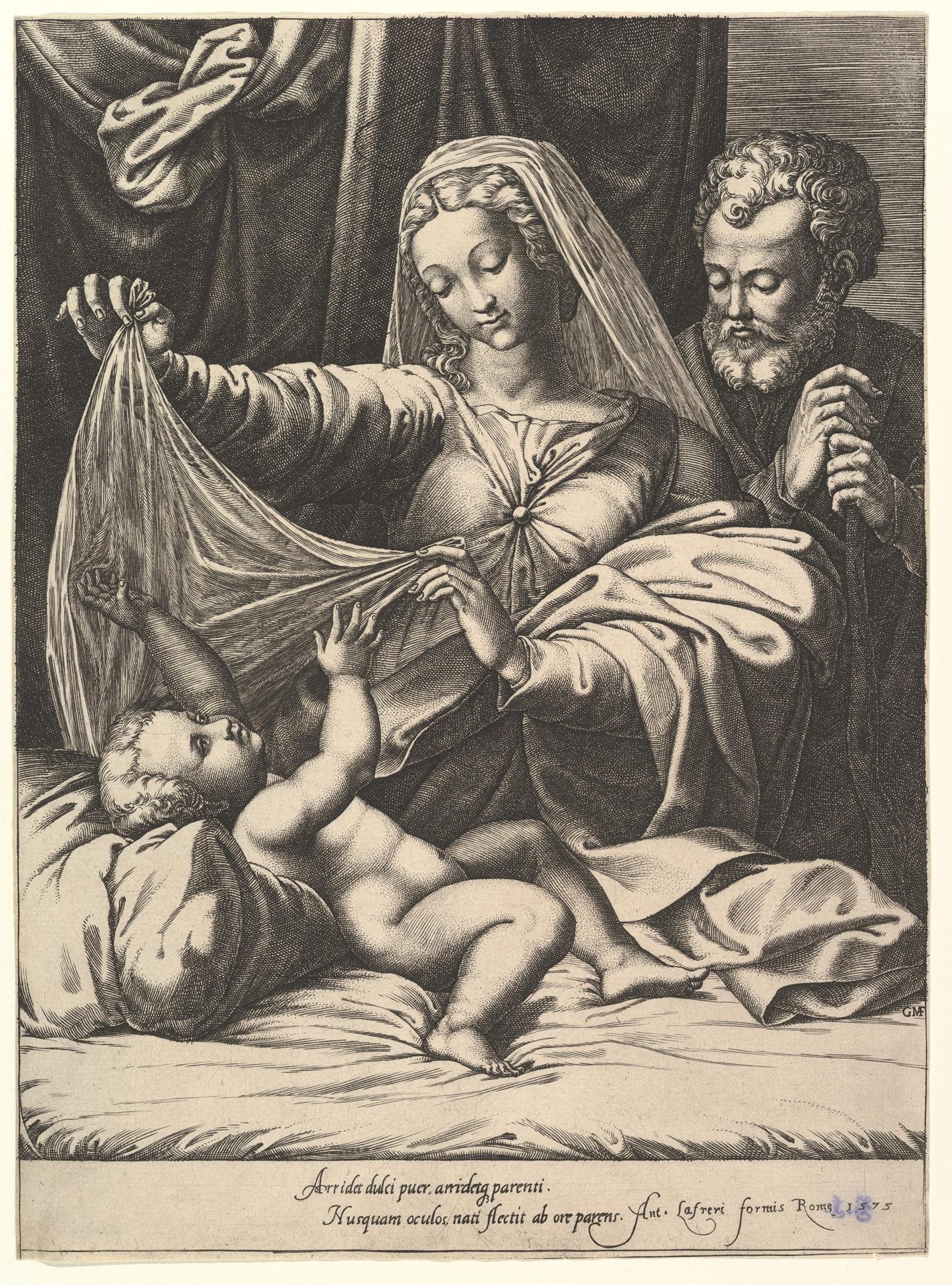
Madonna of Loreto
Original title: Madonna of Loreto, the Virgin lifts a veil above the Child, who lies on a bed and pillow, Joseph stands behind with both hands on his staff
kurzbeschreibung
Where many Madonna engravings of its era center on adoration, Giorgio Ghisi's 1575 print focuses instead on a quiet domestic moment: Mary spreads a cloth over the Christ Child resting on a bed, while Joseph stands nearby, leaning on his staff with both hands. This copperplate engraving, surviving in the second of three states, belongs to Renaissance printmaking.
Description
The layout feels balanced: Mary and the Child occupy the middle, Joseph is placed to the right. Mary holds a cloth over the Child, who lies on a pillow-bed. Curtains suggest the room behind the figures. The image remains monochrome, with cleanly engraved lines, evenly distributed light, and naturalistic figures.
Context
Giorgio Ghisi, a sixteenth-century Italian engraver, was known chiefly for his reproductive prints after Renaissance works. The Madonna of Loreto motif derives from the legend of the Holy House in Loreto and was a widespread devotional image. The sheet was made in 1575, when Ghisi was working in Mantua and Rome.
Impact
A calm, devotional mood emanates from the print, carried by the symmetrical arrangement and clear lines. The careful linework gives the surface an elegance and richness of detail that invites closer looking.
Technique
Engraving as a technique involves incising lines into a copper plate and then printing from it. The present example is the second of three states, which suggests later reworking of the plate. The trimmed sheet measures 29.3 × 21.6 cm.
AI-generated description text
Source: Metropolitan Museum of Art · Public Domain (CC0 1.0)