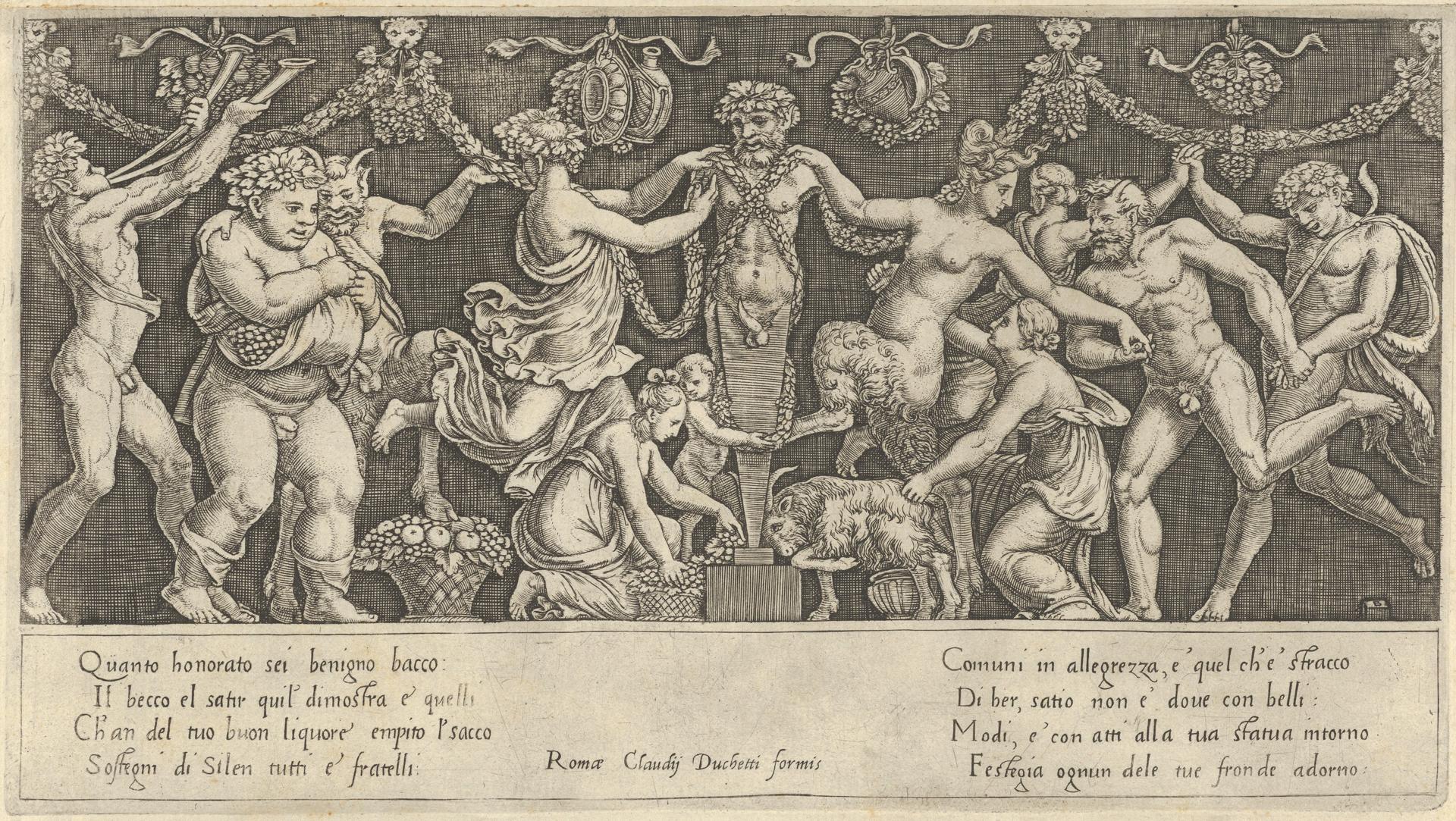
Sacrifice to Priapus, from "Speculum Romanae Magnificentiae"
Original title: Sacrifice to Priapus, from "Speculum Romanae Magnificentiae"
kurzbeschreibung
The Master of the Die, an engraver active in Rome, produced 'Opfer an Priapus' in the 16th century. This print presents a mythological sacrificial rite in honor of Priapus, involving satyrs, cherubs, and other figures.
Description
The layout is symmetrical: Priapus stands at the center, barefoot and adorned with a flower crown, surrounded by figures carrying flower wreaths, jugs, and fruits—signs of a festival or offering. Garlands and floral wreaths festively frame the scene in the background. Italian verses are inserted among the figures, elucidating the context. The print is monochrome with evenly distributed light, typical of the medium.
Context
Created in the 16th century, the engraving was incorporated into the collection 'Speculum Romanae Magnificentiae,' which documented Roman antiquities and monuments. The Master of the Die worked in Rome and made numerous reproductions of ancient and mythological scenes. The work reflects the Renaissance interest in classical mythology.
Impact
The symmetrical arrangement and festive elements evoke a solemn mood. Precise lines and detailed execution give the engraving a clear, almost ceremonial effect.
Technique
As an engraving, the work was made by incising lines into a copper plate and then printing. This technique allows fine details and even linework, as was common in the Renaissance. The sheet measures 25.5 x 30.6 cm, the plate 16 x 28.5 cm.
AI-generated description text
Source: Metropolitan Museum of Art · Public Domain (CC0 1.0)