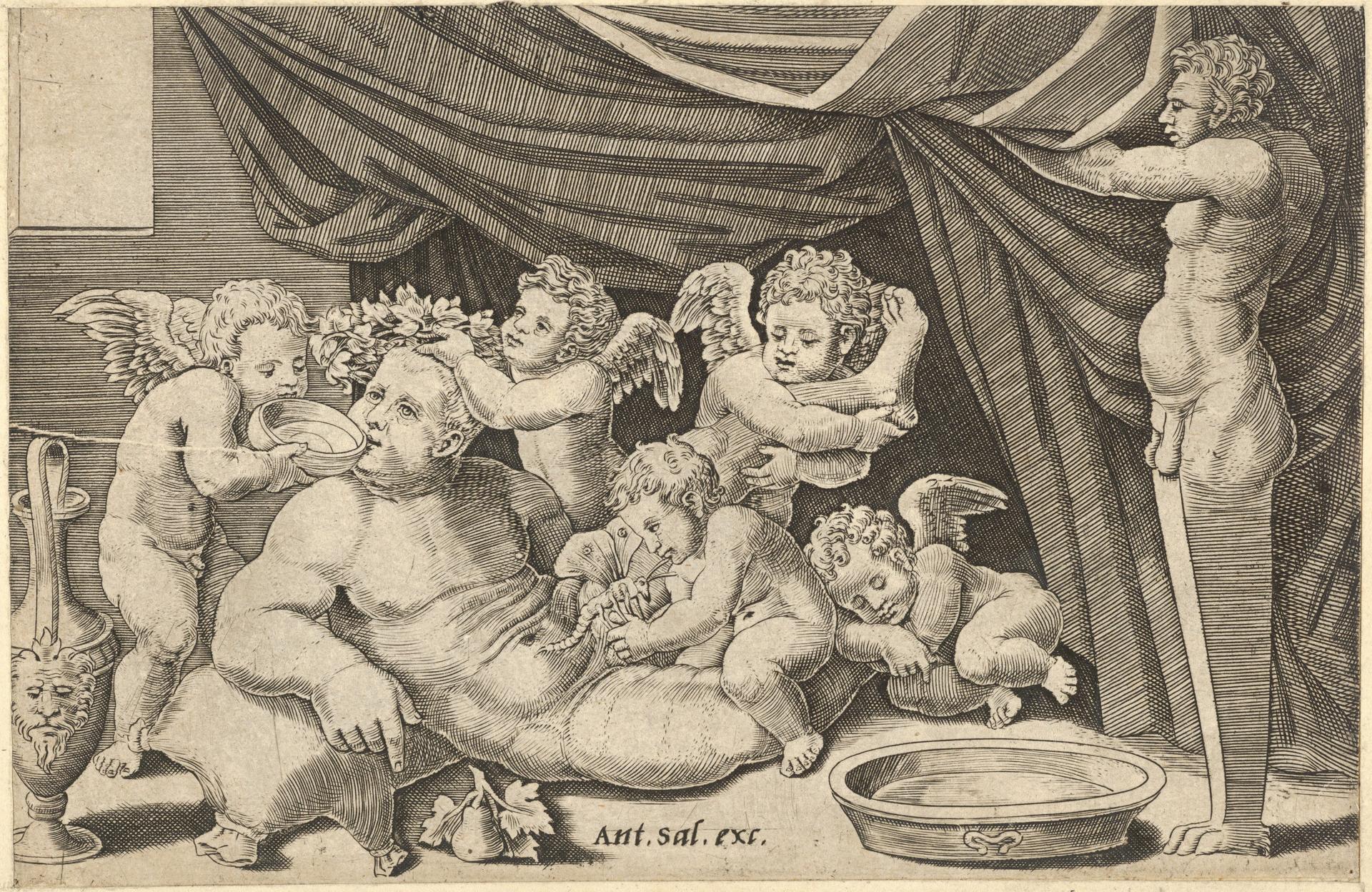
Bacchus Surrounded by Putti with Priapus holding back the curtain, from "Speculum Romanae Magnificentiae"
Original title: Bacchus Surrounded by Putti with Priapus holding back the curtain, from "Speculum Romanae Magnificentiae"
kurzbeschreibung
A putto holds a jug of wine to Bacchus's lips while others play with flowers and fruit. The Master of the Die engraved this scene in the 16th century. On the right, Priapus, god of fertility, pulls back a curtain and watches the goings-on.
Description
Bacchus stands at the center, surrounded by naked, winged putti. One holds a wine jug to the god's mouth; others bring flowers and fruit, and one drags a basket full of grapes. At the right edge appears the sturdy Priapus with a clearly phallic form; he draws the curtain aside and looks toward Bacchus. Curtains and a section of wall close off the back. At the lower right is the signature "Ant. sal. exc.," referring to the publisher Antonio Salviati.
Context
This sheet belongs to the "Speculum Romanae Magnificentiae," a collection of prints assembled from the 1540s onward that recorded ancient and modern monuments of Rome. The Master of the Die was an Italian engraver active in Rome in the first half of the 16th century. Antonio Salviati, a Roman print publisher, issued such sheets, as the signature attests. Mythological scenes of this kind were highly popular in the Renaissance and were often used to furnish collections.
Impact
The symmetrical distribution of the figures and the clean linework give the sheet a calm balance. Strong shading creates spatial depth and emphasizes the putti's movements as well as Priapus's muscular form. The cheerful, festive mood matches the usual Renaissance iconography of Bacchus.
Technique
For the engraving, the motif was incised into a copper plate and then printed on paper. Fine lines and cross-hatching produce the monochrome tones and shadows. At about 12 x 18.3 cm, it is a small-format collector's piece that was bound into albums such as the "Speculum" series.
AI-generated description text
Source: Metropolitan Museum of Art · Public Domain (CC0 1.0)