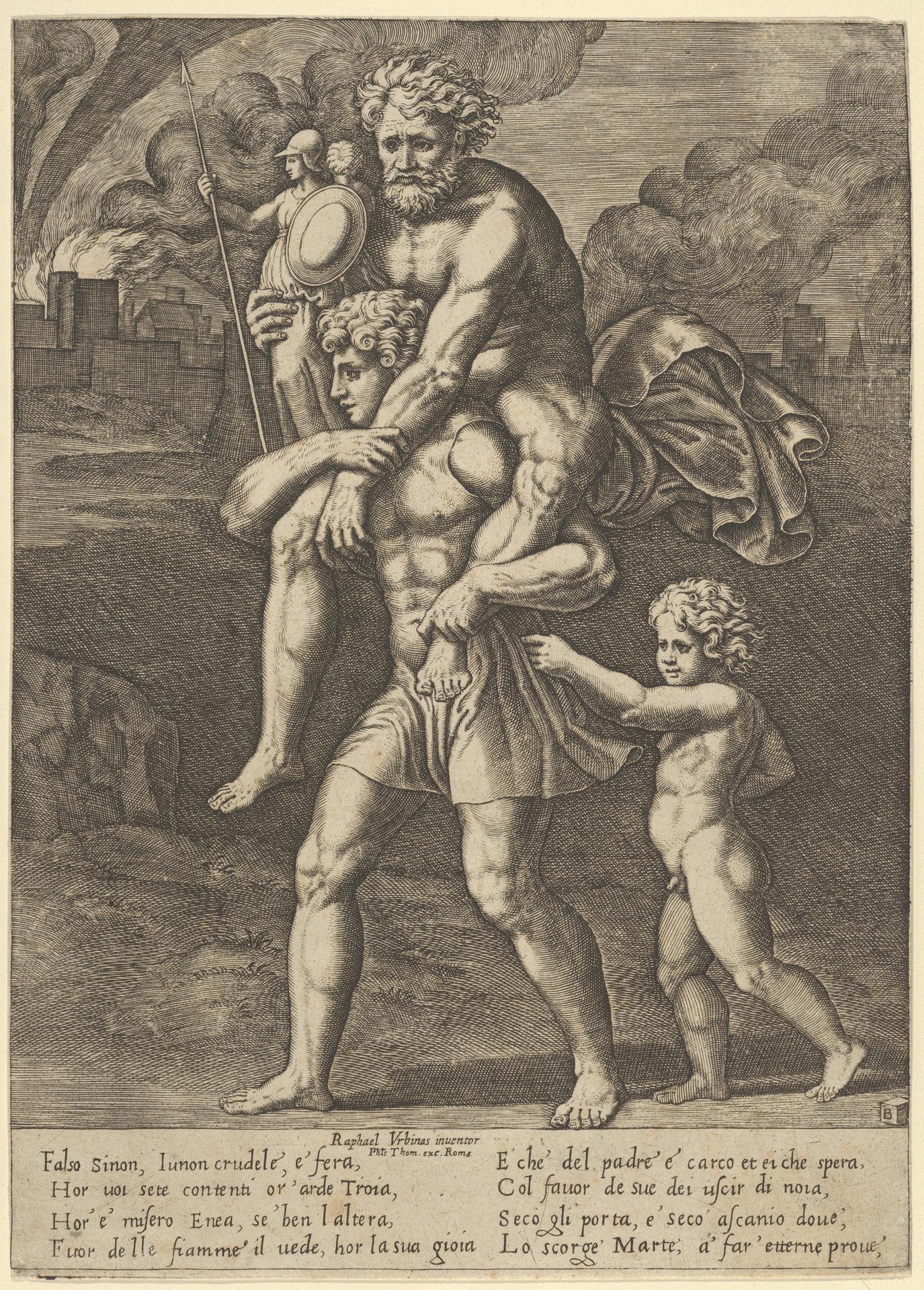
Aeneas carrying Anchises on his shoulders while Troy burns in the background (1530–60, Met-Objekt 5946)
Original title: Aeneas carrying Anchises on his shoulders while Troy burns in the background
kurzbeschreibung
This engraving by the Master of the Die, made between 1530 and 1560, shows Aeneas carrying his father Anchises on his shoulders out of burning Troy. The print derives from an invention by Raphael and bears a signature as well as Latin verses.
Description
Aeneas dominates the foreground: muscular, barefoot, in a short tunic, his spear in his right hand, while Anchises sits on his shoulders—also barefoot and lightly clad. A small boy, presumably Ascanius, clings to Anchises' tunic. Behind them, smoke rises over burning Troy; a figure with shield and lance, perhaps a warrior or god, stands to the side. Harsh contrasts and deep shadows model the bodies and plunge the scene into dramatic light.
Context
In the mid-sixteenth century, numerous prints after designs by famous masters such as Raphael were produced in Italy. The anonymous engraver known as the Master of the Die worked from Raphael's invention, as the signature 'Raphael Urbina inuentor' confirms. Aeneas's flight from Troy was a popular subject in the Renaissance: it was regarded as the founding myth of Rome and as a model of pietas. The Latin texts along the lower edge emphasize the learned ambition of the print.
Impact
Bright passages and dark shadows drive the eye from the bodies in the foreground to the burning background, creating a menacing, almost breathless mood. The bare feet and fully modeled muscles give the flight a physical immediacy that draws the viewer into the event.
Technique
As an etching, an intaglio process in which the drawing is etched into a metal plate, the print allows nuanced shading and fine lines. These model the figures plastically and give detail to the background as well. Signature and Latin inscription were engraved into the plate and printed along with it.
AI-generated description text
Source: Metropolitan Museum of Art · Public Domain (CC0 1.0)