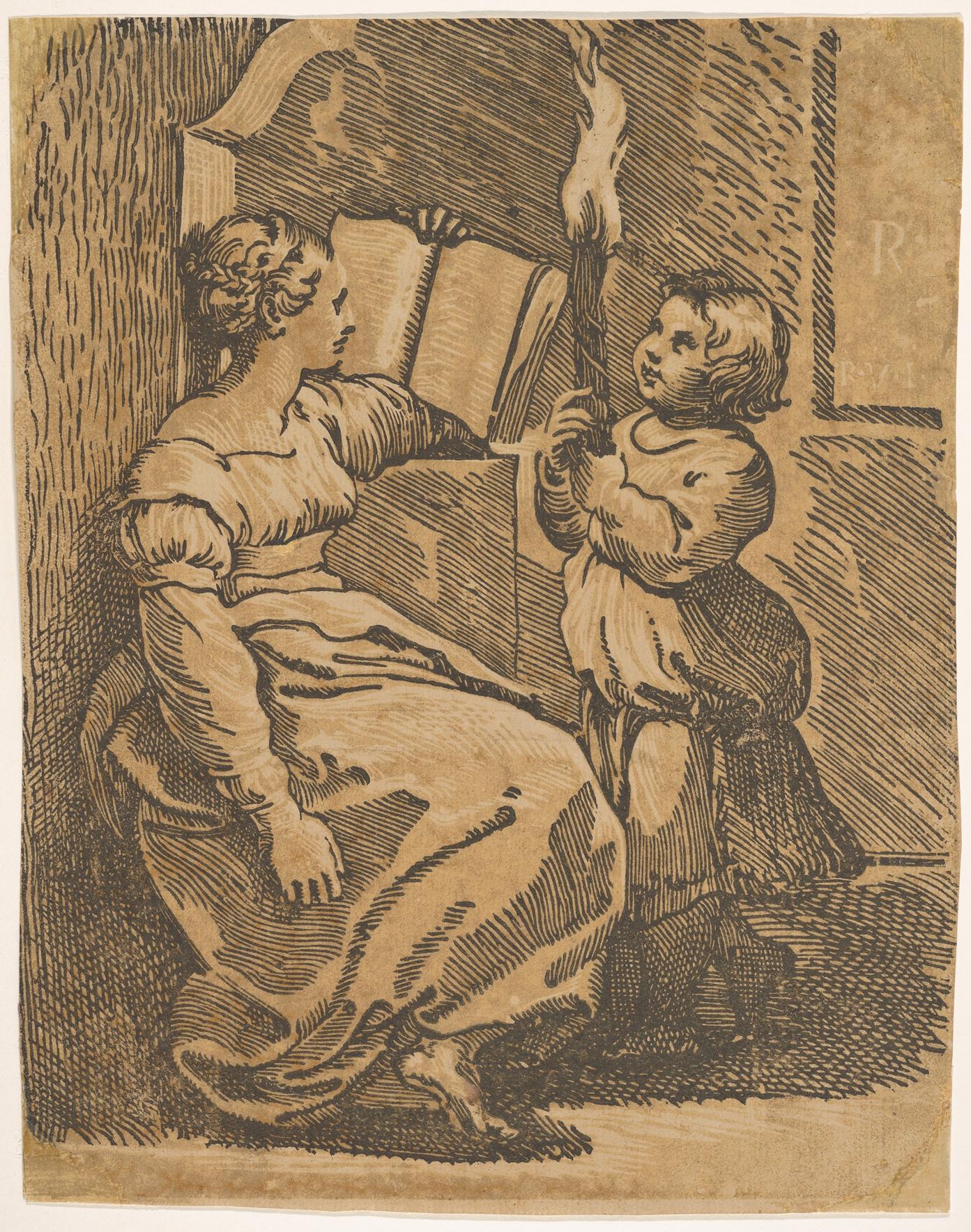
A Sybil reading facing right
Original title: A Sybil reading facing right
kurzbeschreibung
Around 1517–18 Ugo da Carpi made this chiaroscuro woodcut of a Sibyl reading, a child standing beside her holding a tablet with letters. Printed from two blocks in shades of brown, the sheet measures 27.9 x 22 cm.
Description
Two figures set the structure of the image: a seated Sibyl reads from an open book while a standing child presents a tablet of letters. Both wear heavy, folded drapery given volume by the woodcut technique. The setting stays plain, showing only a wall and part of a window. Light falls from the left, casting firm shadows on the right sides of the figures and the background. Colour is monochrome, a range of browns produced by the fine linework and shading of the blocks.
Context
Ugo da Carpi, an Italian printmaker, popularised the chiaroscuro woodcut in Italy, a technique that uses several blocks to build up tonal steps. This sheet dates from around 1517–18, when Carpi was working in Rome and in contact with artists such as Raphael. Sibyls, the prophetic figures of antiquity, were a favourite Renaissance subject and were often read in Christian terms. The small format points to private use or a collector's keeping.
Impact
A quiet, contemplative mood governs the print, carried by the intimate reading scene and the soft light. Restricting the palette to browns gives the work a refined, graphic elegance that draws the eye to the figures and their gestures.
Technique
Two woodblocks in brown were used for this chiaroscuro print. Overlapping the tone blocks produced light-and-dark effects resembling a drawing with wash. The delicate lines and nuanced shading testify to the printer's high craft.
AI-generated description text
Source: Metropolitan Museum of Art · Public Domain (CC0 1.0)