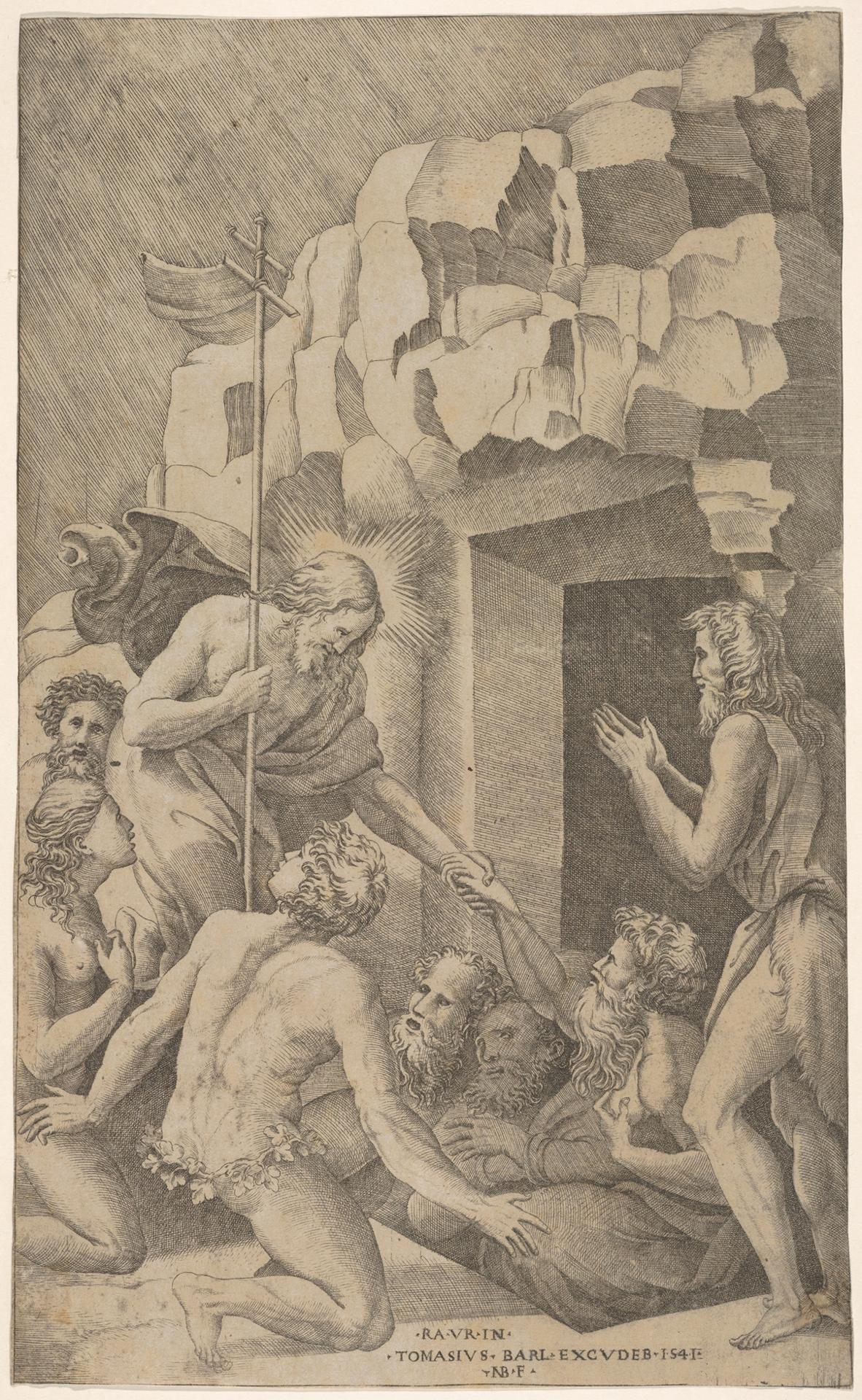
Christ in Limbo, after Raphael (1541, Met-Objekt 5939)
Original title: Christ in Limbo, after Raphael
kurzbeschreibung
In 1541 Nicolas Beatrizet engraved this sheet of Christ in Limbo after a design by Raphael. The subject follows the Christian belief in Christ's descent into the underworld to redeem the souls of the righteous. As a reproductive print of the Renaissance, the engraving conveys a major pictorial idea of the Roman High Renaissance.
Description
Christ, wearing only a loincloth, holds a cross-staff and extends it toward a group of men. They are inside a rocky cave; some are clothed, others naked, and a man on the right has his hands clasped in prayer. Rock walls and a dark entrance close off the back. Light falling from above models bodies and stone with delicate shadows. The print's gray tones produce a monochrome yet sculptural effect.
Context
Beatrizet made this sheet in 1541 in Rome, where he worked as an engraver for publishers such as Antonio Salamanca. It belongs to a series of engravings after designs by Raphael, who had died in 1520. A fresco or drawing from Raphael's circle probably served as the model, which the print made accessible to a wider audience. Reproductive engravings of this kind were an important means of spreading Roman art in the sixteenth century.
Impact
The symmetrical arrangement around Christ and the clear lighting give the image a calm, dignified presence. Fine lines and careful shading create an almost painterly depth. Christ's outstretched hand and the staggered figures draw the viewer into the cave.
Technique
For this engraving, the lines were cut into the metal plate with a burin. Fine cross-hatching and graduated gray tones attest to high technical precision. The sheet was printed on paper and then trimmed to 28.5 × 17.5 cm.
AI-generated description text
Source: Metropolitan Museum of Art · Public Domain (CC0 1.0)