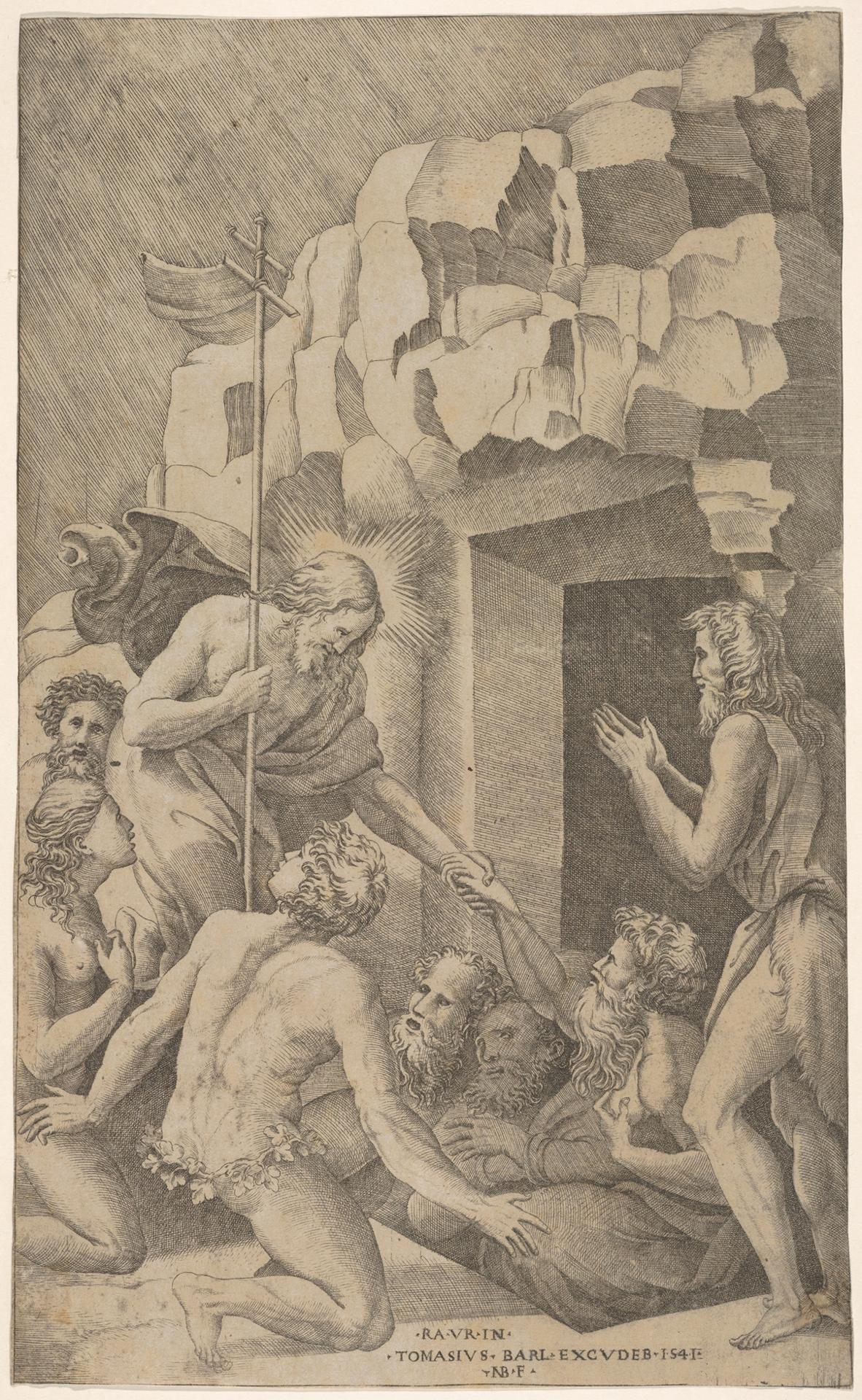
Christ in Limbo, after Raphael (1541, Met-Objekt 5938)
Original title: Christ in Limbo, after Raphael
kurzbeschreibung
Nicolas Beatrizet published an engraving titled Christus in der Vorhölle in 1541, presenting Christ freeing souls from limbo. The print derives from a model by Raphael and is distinguished by careful linework. Measuring 28.4 × 17 cm, it is a typical Renaissance devotional image.
Description
Diffuse light falls from the top edge, drawing the eye to Christ, who stands with a cross-staff among angels. He extends his hand to a figure emerging from a dark stone gate, pulling him to safety. Around this center, other figures gather—barefoot, in simple garments, some kneeling, some standing. Large rock formations rise behind them, suggesting heaven and earth. The symmetrical arrangement of the etching in shades of gray underscores the sacredness of the event.
Context
The French engraver Nicolas Beatrizet made this plate in Rome in 1541, where he worked for publishers including Antonio Salamanca. The model was a drawing or painting by Raphael, who had died in 1520; the print thus helped spread Raphael's pictorial ideas. The theme of the limbus patrum was widespread in sixteenth-century Catholic theology and art, especially in the context of the doctrine of redemption. Beatrizet became known for his reproductive engravings after works by famous High Renaissance masters.
Impact
The light from above and the symmetrical layout give the scene a solemn, dignified mood. The detailed linework and clear structure let the viewer experience the drama of redemption directly. The graduated gray tones create a calm, contemplative atmosphere that invites devotion.
Technique
This print uses engraving: the design is incised into a copper plate and then printed. Beatrizet worked with fine, precise lines to bring out shadows and details, as was characteristic of Renaissance engraving. The plate was inked and pulled onto paper, producing the typical gray tones.
AI-generated description text
Source: Metropolitan Museum of Art · Public Domain (CC0 1.0)