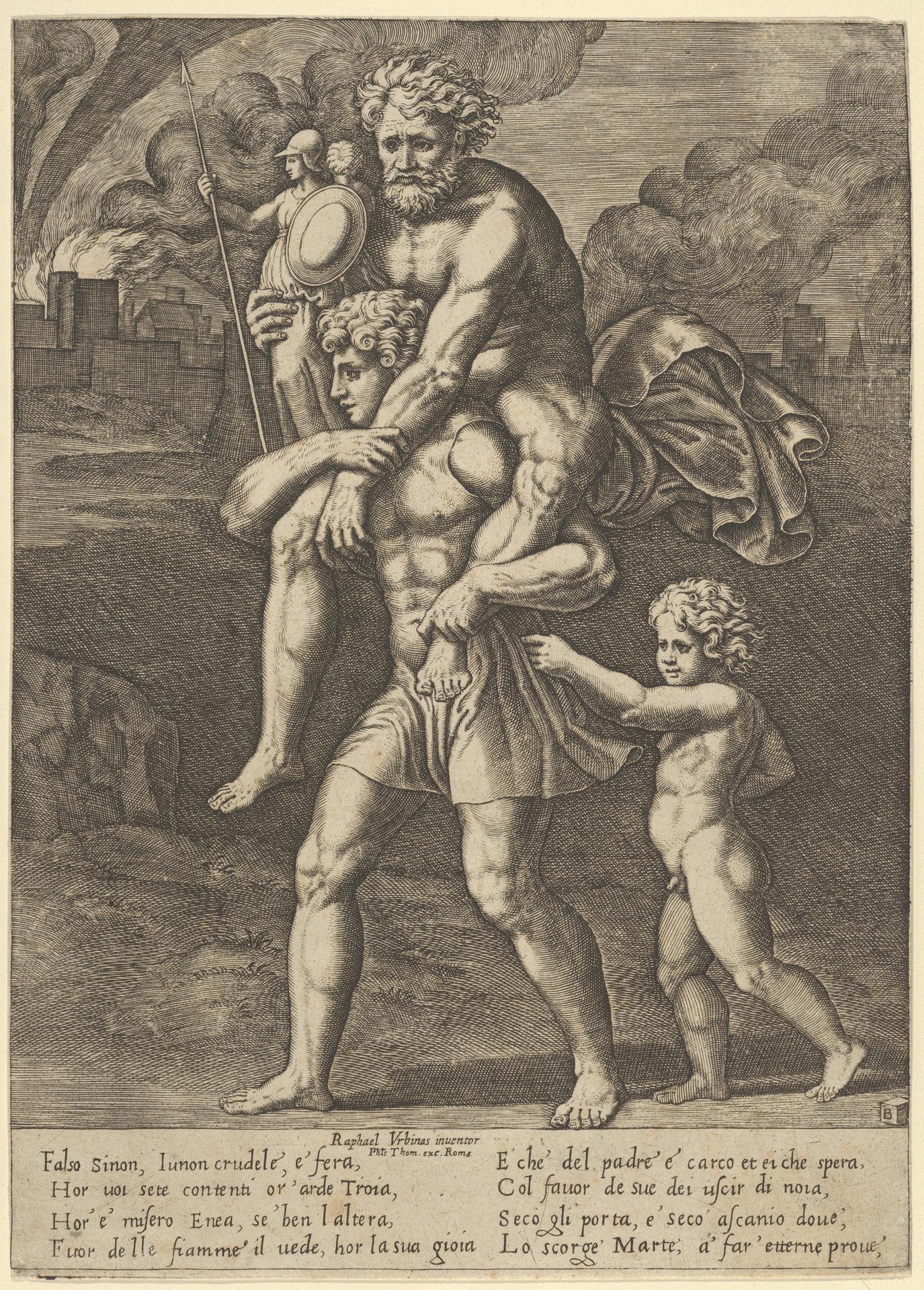
Aeneas carrying Anchises on his shoulders while Troy burns in the background (1530–60, Met-Objekt 5934)
Original title: Aeneas carrying Anchises on his shoulders while Troy burns in the background
kurzbeschreibung
The Master of the Die engraved this well-known episode from Roman mythology around 1530–60: Aeneas carries his father Anchises out of burning Troy. The print measures 25 x 18 cm. The figure group stands in the foreground, with the burning city behind them.
Description
Aeneas appears as a strong, muscular man with short curly hair and stubble; he wears a short, simple toga and is barefoot. On his shoulders sits his father Anchises, also muscular, with short curly hair and a beard, but naked. A small boy, presumably Ascanius, clings to Aeneas' leg and is likewise nude. In the background Troy burns, with smoke and destruction visible, along with a figure holding a shield and lance. Latin verses at the bottom explain the scene.
Context
The Master of the Die was an Italian Renaissance engraver who worked in Rome and is named after the die in his signature. The print was made between 1530 and 1560, when ancient mythological subjects were common in Italian art. The story of Aeneas comes from ancient literary sources, especially Virgil's Aeneid. Latin verses at the bottom of the image were customary for prints of this period and were meant to explain the content.
Impact
The muscular bodies and the dramatic setting in the background create a heroic yet threatening mood. The precise linework and clear layout draw the eye to the central figure group and emphasize the dramatic flight. The black-and-white execution heightens the contrast between light and shadow in burning Troy.
Technique
For this etching, the drawing was incised into a metal plate bitten with acid. The process allows fine and precise lines, visible in the musculature and the details in the background. The print is in black-and-white tones and shows the artist's high manual skill.
AI-generated description text
Source: Metropolitan Museum of Art · Public Domain (CC0 1.0)