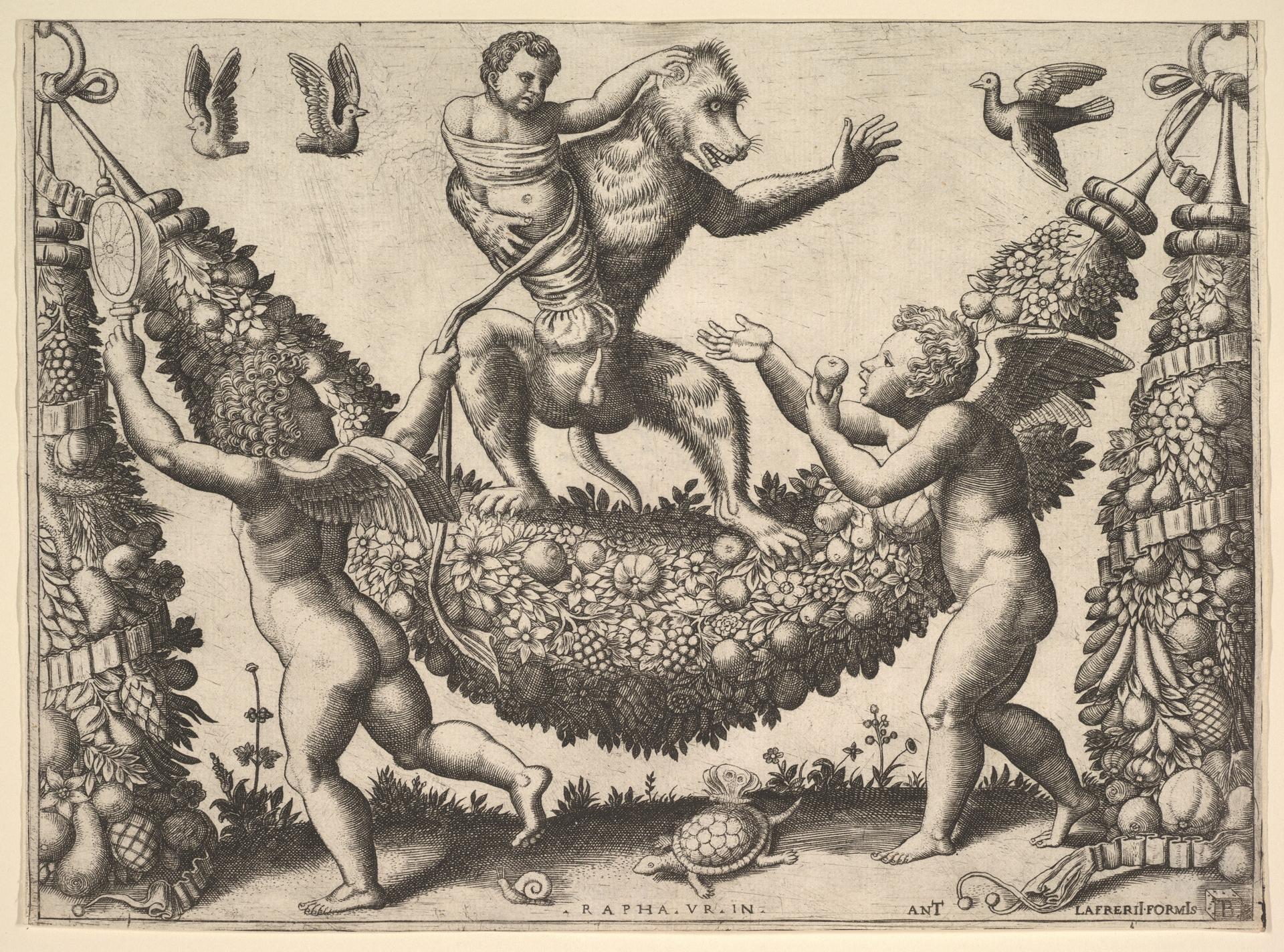
A monkey holding a bound putto standing on a garland in front of which are two winged putti, from a series of tapestries made for Leo X
Original title: A monkey holding a bound putto standing on a garland in front of which are two winged putti, from a series of tapestries made for Leo X
kurzbeschreibung
An engraving by the Master of the Die, made between 1530 and 1560, showing an ape clutching a putto whose body is bound with rope. The subject goes back to designs for a tapestry series commissioned for Pope Leo X. This impression is the second of two states.
Description
An ape grips a small putto by the neck, the child tied fast with rope. Beneath the animal lies a bundle of garlands threaded with fruit and flowers. To either side of this garland two winged putti are in motion, and two birds can be made out in flight near the top. The arrangement is symmetrical, with the garland as its still, weighted core.
Context
The print was made between 1530 and 1560 in connection with a tapestry cycle whose designs were drawn up for Pope Leo X. The Master of the Die worked in Rome and was known for reproductive engravings after Renaissance models. The inscription RAPHA.VR.IN. names Raphael as the inventor of the motif, while ANT. LAFRERII FORMIS identifies the publisher Antonio Lafreri.
Impact
The even layout and cleanly drawn lines give a calm, balanced impression. That the bound putto is set against figures moving freely lends the sheet a quiet tension.
Technique
Lines were incised into a metal plate and then printed from it, the process being engraving. That this is the second of two states points to later reworking of the plate. The print remains monochrome, with tone distributed evenly, as is usual for the technique.
AI-generated description text
Source: Metropolitan Museum of Art · Public Domain (CC0 1.0)