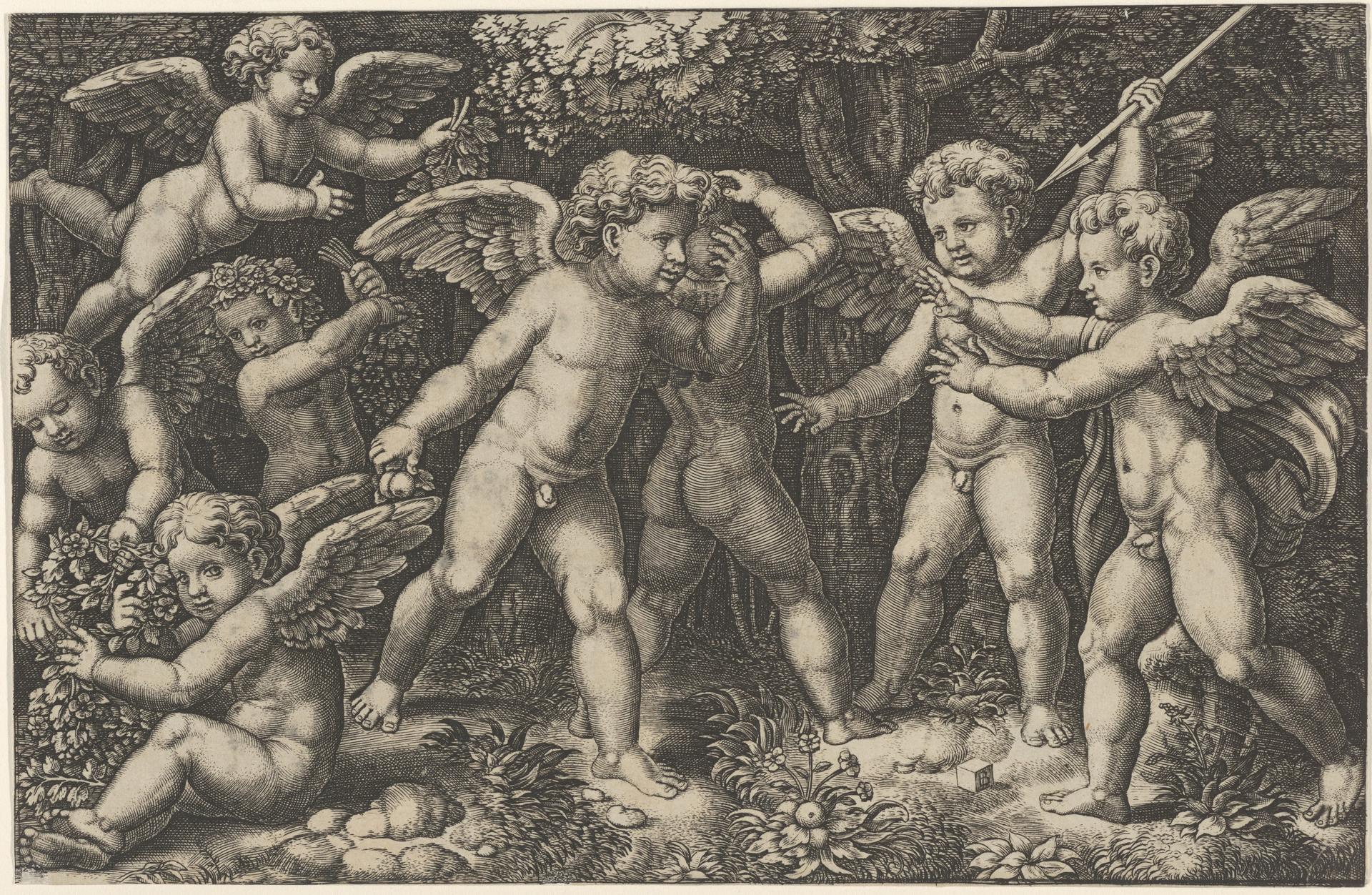
Eight Putti Playing
Original title: Eight putti playing
kurzbeschreibung
Two naked putti face each other in the foreground, while other figures play and gather fruit among the trees. This engraving, titled Acht spielende Putten (Eight Playing Putti), is by the engraver known as the Master of the Die and dates from between 1530 and 60. The sheet measures 18.5 x 28.5 cm and presents a group of putti in a wooded landscape.
Description
One putto in the foreground handles an arrow, another picks fruit, and others romp in the branches. The figures' bodies are rendered with precise musculature, revealing a knowledge of Renaissance anatomy. The layout feels orderly: the putti are grouped around the middle, with trees and shrubs forming the backdrop. There is no color; light falls evenly across the scene, and strong contrasts of light and dark are absent.
Context
Behind the notname Master of the Die is an Italian engraver who worked in Rome and Bologna in the first half of the 16th century; his monogram shows a die. The period of creation falls in the High Renaissance, when antiquity and human anatomy were studied in depth. The print may have served collectors as decorative graphic art or other artists as a model.
Impact
Despite the dense group of figures, the sheet radiates calm and balance, achieved through symmetrical arrangement and even distribution of light. The naked putti in nature evoke a cheerful, Arcadian mood characteristic of the Renaissance idealization of antiquity.
Technique
A burin was used to incise the lines into a copper plate, a process that allows fine, precise strokes and detailed reproduction of figures and background. Printing was done with black ink on paper, resulting in the monochrome appearance.
AI-generated description text
Source: Metropolitan Museum of Art · Public Domain (CC0 1.0)