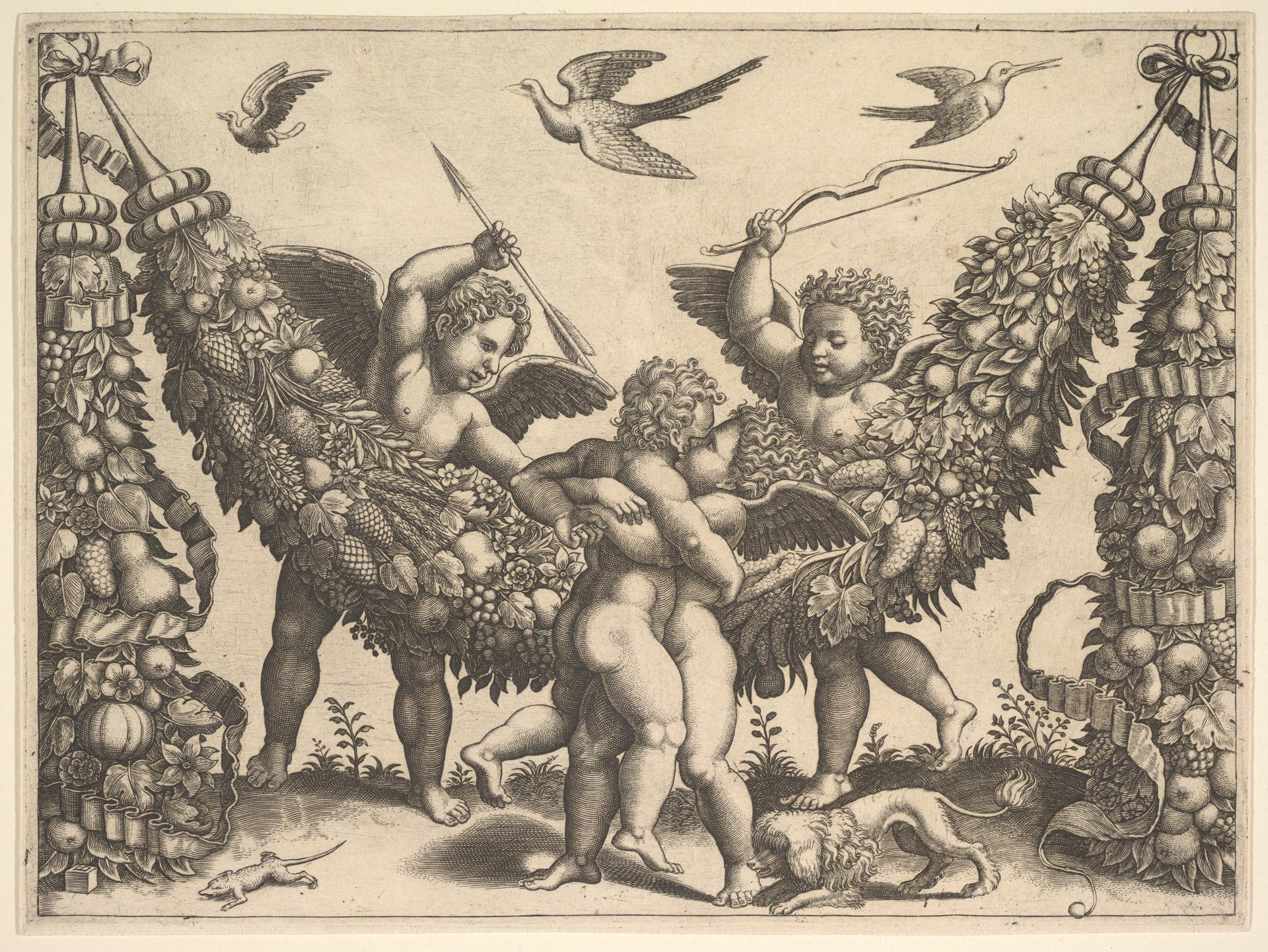
Four putti, two embracing in front of a large garland, two behind, the one at left holding an arrow, the one at right a bow, from a series of tapestries made for Leo X
Original title: Four putti, two embracing in front of a large garland, two behind, the one at left holding an arrow, the one at right a bow, from a series of tapestries made for Leo X
kurzbeschreibung
Four putti appear within an opulent ornamental frame in this engraving by the Master of the Die, made around 1530–40. Two of the boys embrace at the front, while the other two stand behind them, one holding an arrow and the other a bow. The sheet belongs to a series designed as wall hangings for Pope Leo X.
Description
The eye is drawn first to the two putti clasping each other at the front center, one with an arrow, the other with a bow. Two more boys appear behind them, likewise armed with arrow and bow. Fruit, flowers, and leaves fill the frame, bound together by ribbons. Birds flit across the upper zone, and near the lower edge a small animal and a dog can be made out. The bodies read as though modeled in half relief, their contours fine and exact, as a good engraving demands.
Context
The print derives from designs for tapestries made for Pope Leo X (r. 1513–1521). Cartoons by Raphael or from his workshop probably served as the model, which accounts for the high artistic quality. The Master of the Die, a sixteenth-century Italian engraver, was known for reproductive prints after Renaissance prototypes. The dating around 1530–40 falls after Leo X's death, suggesting the designs circulated more widely at a later point.
Impact
The symmetrical arrangement and rich ornament give the sheet a festive, almost triumphal presence. The putti's natural poses and clean linework make the figures seem lively and graceful. Set black on white, the sculptural weight of the bodies stands out clearly and shows the engraver's virtuosity.
Technique
Copperplate engraving means cutting lines into a copper plate. The fine, precise strokes allow for great detail and a sense of volume. This is a first state, pointing to an early impression. The sheet measures 21 x 28.5 cm, the plate 20.5 x 28 cm.
AI-generated description text
Source: Metropolitan Museum of Art · Public Domain (CC0 1.0)